Logging morning HRV
Take a heart rate variability reading from your oximeter each morning and see how it lines up with the night before.
Updated 2026-10-22
The HRV tab takes a short heart rate variability reading from your oximeter's live pulse wave and keeps a log of your mornings. It reports RMSSD, the measure most morning-HRV apps use.
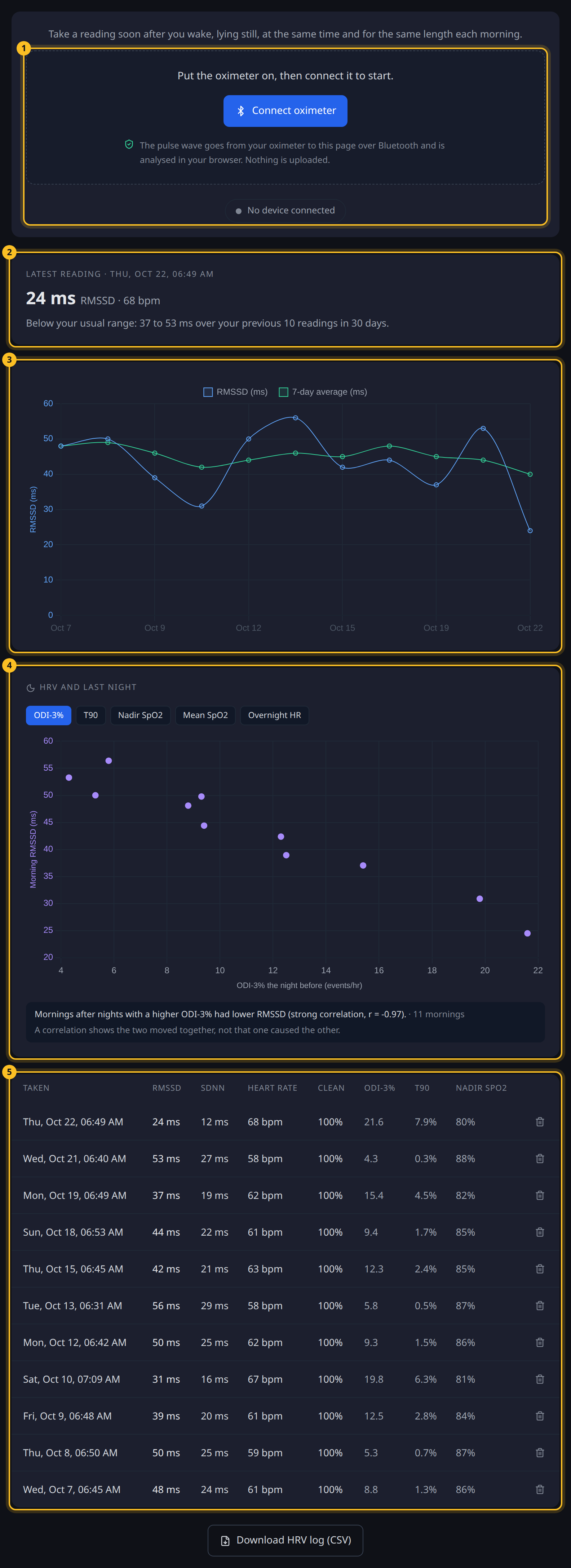
- Recorder - connect the oximeter and take a reading.
- Latest reading - your most recent RMSSD and how it sits against your usual range.
- Trend - RMSSD for each morning, with a 7-day average.
- HRV and last night - each morning's RMSSD against a metric from the night before.
- Log - every reading, with the night before's figures alongside.
Take a reading
- Soon after you wake, put the oximeter on and lie still.
- Open the HRV tab and press Connect oximeter (1).
- Pick your device in the browser's pairing dialog.
- Choose a reading length and press Start reading.
- Keep still until it finishes, then press Save to my log.
The first 15 seconds settle the signal and are left out of the numbers. Take your reading at the same time, in the same position and for the same length each morning, so one compares with the next.
This needs a device that streams a live pulse wave, such as the Checkme O2 Max, and Chrome or Edge on a computer or Android phone. Close the Wellue phone app first.
Read your log
- Latest reading (2) says whether today's RMSSD is below, within or above your usual range. The range appears after 7 mornings in 30 days.
- Trend (3) shows each morning with a 7-day average.
- HRV and last night (4) plots each morning against the night before. Pick ODI-3%, T90, Nadir SpO2, Mean SpO2 or Overnight HR above the chart. It needs 3 mornings that follow a recorded night.
- Log (5) lists every reading. Use the bin button to delete one, or Download HRV log (CSV) below it to export them all.
A finger oximeter times the pulse, not the heartbeat, so it measures pulse rate variability. Compare your readings with each other, not with a chest strap or watch. A correlation with the night before shows the two moved together, not that one caused the other.