Overnight analysis metrics
ODI, desaturation events, time-below thresholds and the bands beside them, explained.
Updated 2026-09-18
The analysis panel turns a night of raw samples into the measurements used to describe overnight oxygenation.
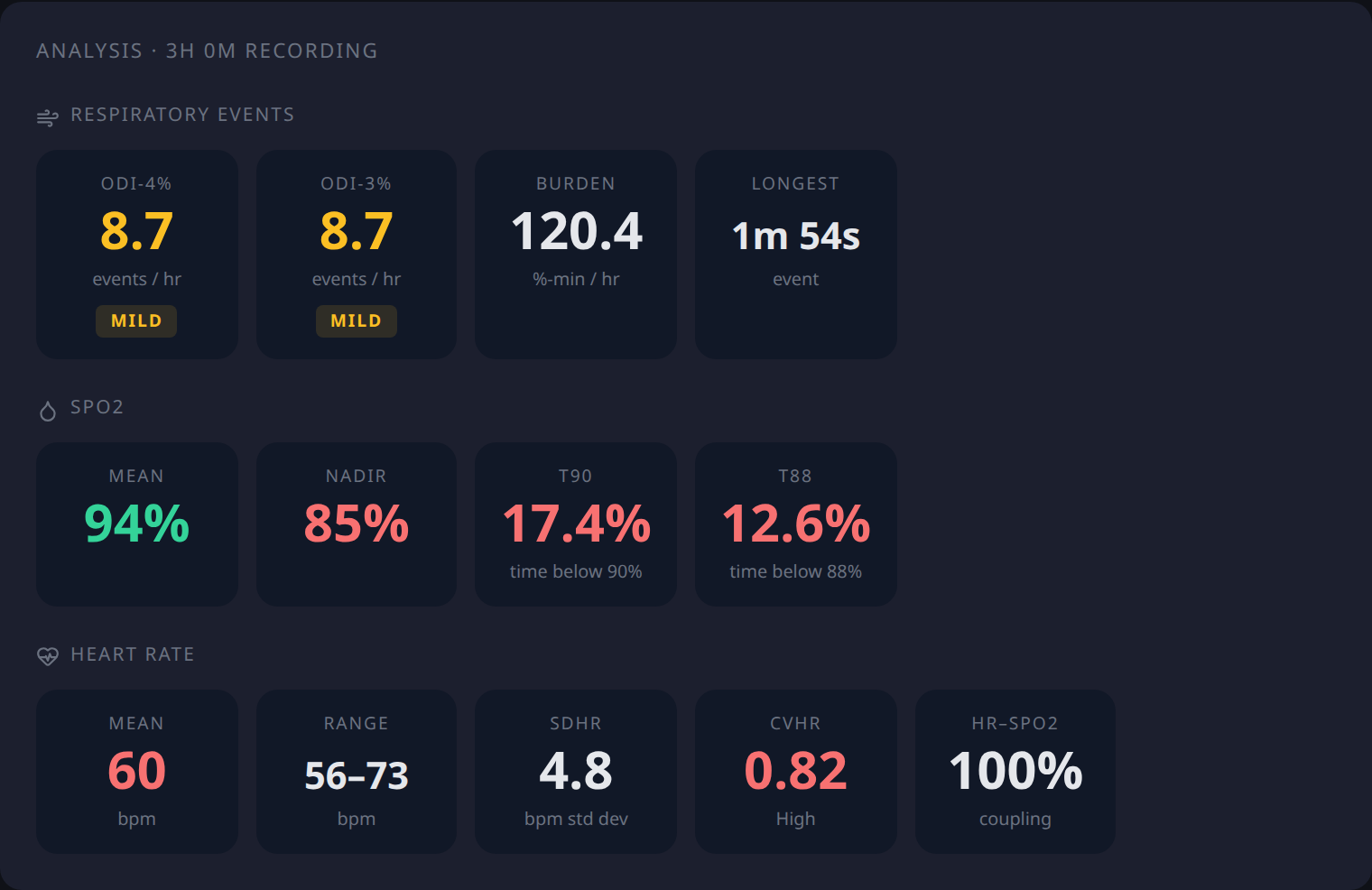
Respiratory events
- ODI-3% / ODI-4% - the oxygen desaturation index: how many times per hour your SpO₂ dropped by at least 3% (or 4%) from its local baseline, for at least 10 seconds.
- Band - a neutral label for where that index sits: low, elevated, high or very high desaturation index. It describes the measurement, not you or your health.
- Burden - the depth of every event multiplied by how long it lasted, per hour of recording.
- Longest - the single longest continuous desaturation on the 3% rule.
SpO₂
- Mean and Nadir - your average reading across the night, and the lowest one.
- T90 / T88 - the share of the recording spent below 90% and below 88%.
These figures are derived from your recording for your own tracking. The reference lines quoted beside them come from published sleep research, and home oximetry is not a sleep study.
Heart rate
Mean, range and variability (standard deviation) sit alongside CVHR in cycles per minute, its breakdown by dip size, the HR-to-SpO₂ coupling and the share of samples excluded. All of those are explained in heart rate and CVHR.
Sharing these numbers with someone
The same panel is available for a single recording in the free session viewer, which needs no account. It is a convenient way to show one night to a clinician or a family member without giving them access to your history.
Not a medical device. Does not diagnose, treat or prevent any condition. Discuss results and changes with a clinician.