Heart rate and CVHR
How the cyclic variation of heart rate figure is counted, and what the numbers beside it mean.
Updated 2026-10-07
CVHR - cyclic variation of heart rate - counts a specific repeating pattern in your overnight pulse: a fall below your local baseline, then a rise above it, then the same again. PulseOxTracker reports it as cycles per minute of usable recording.
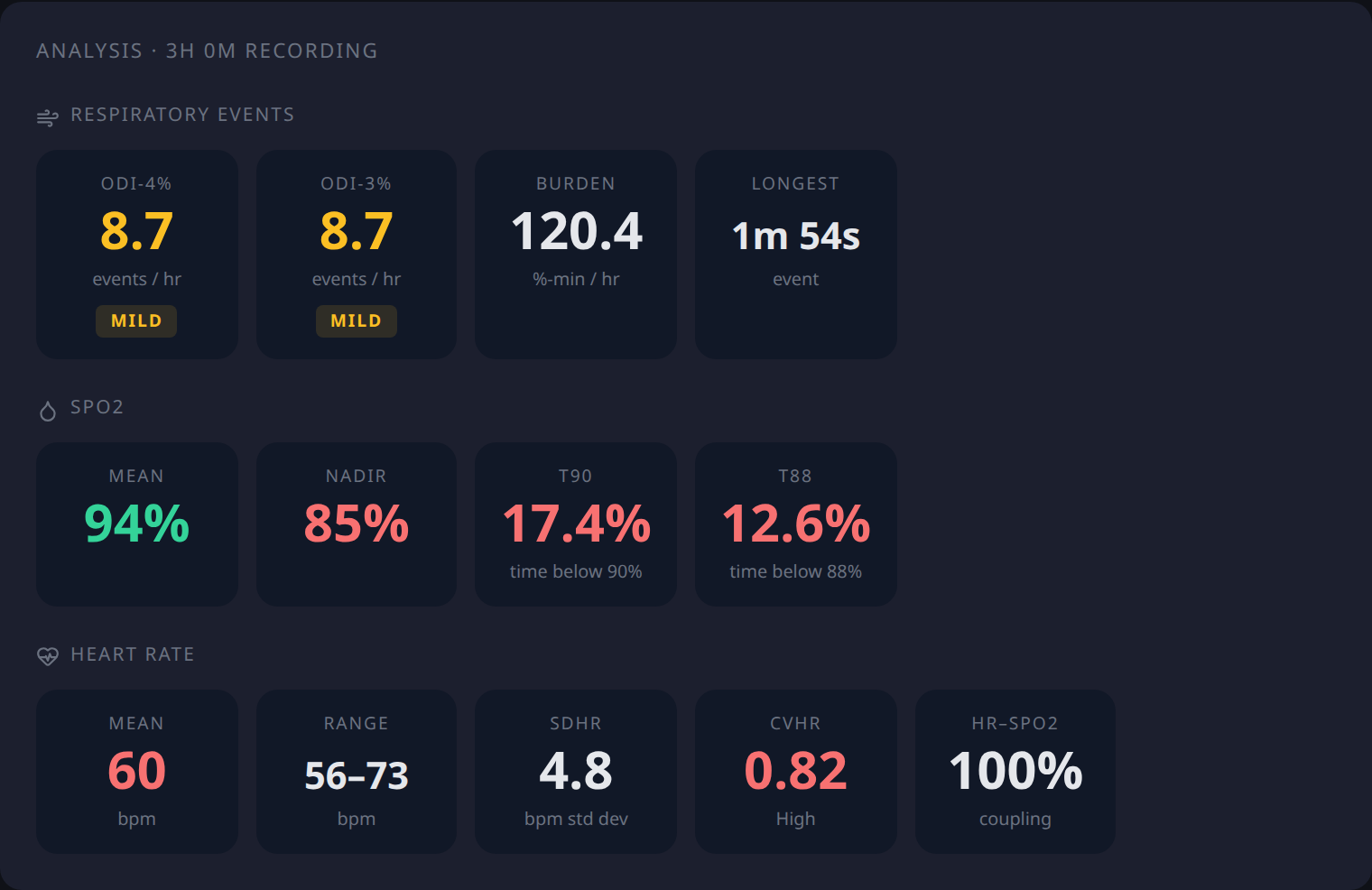
The heart-rate metrics
- Mean and range - your average pulse across the night, and its lowest to highest reading.
- SDHR - the standard deviation of your pulse rate over the night.
- CVHR - cyclic dips per minute, counted as described below.
- Dip size - the same count at three dip sizes, so you can see whether a figure rests on shallow dips.
- HR–SpO2 - the share of counted dips followed by an oxygen drop.
- Excluded - the share of samples left out of the heart-rate analysis.
What counts as a dip
A surge in pulse rate on its own is not counted. Movement, a limb jerk or the sensor shifting on your finger all produce one, and counting them would turn this figure into a movement counter.
A dip is counted only when all of the following hold.
- Amplitude. The peak stands at least 6 bpm, or 10% of your local baseline, above that baseline - whichever is larger. The percentage term keeps the figure comparable between someone whose pulse settles at 55 and someone whose settles at 75.
- Width. The surge is 10 to 60 seconds wide, measured halfway up. Anything narrower is a stray beat or an artifact; anything wider is a change of sleep stage rather than a cycle.
- Shape. Pulse rate falls below baseline in the 10 to 30 seconds before the peak. This fall-then-rise pair is the part that separates the pattern from an ordinary arousal.
- Repetition. The dip belongs to a run of at least three dips spaced 20 to 120 seconds apart. A single dip in an otherwise quiet hour is not a cycle and is not counted.
The baseline each dip is measured against is a rolling median of your pulse rate over about two and a half minutes, so a slow drift across the night does not create or erase dips.
Reading the three numbers beside it
Dip size shows the cycle count at dips of at least 4, 6 and 10 bpm. If the three numbers fall away steeply - 0.28, 0.18, 0.09 - the night is made up mostly of shallow dips, and the headline figure depends heavily on where the line is drawn. If they hold up, the pattern is larger than the threshold.
HR–SpO2 coupling is the share of counted dips followed within 45 seconds by an SpO₂ drop of 3% or more. The 3% floor matters: a 1% change sits inside the device's own measurement resolution and inside ordinary breathing, so counting those would report near 100% on any night at all.
Excluded is the share of samples dropped before any of this was counted: readings the device flagged as invalid, samples within 10 seconds of a movement reading, and rises too fast to be a real change in pulse rate. A large excluded share means there was less signal to work with, and the counts above should be read with that in mind.
Published reference lines
Hayano and colleagues (2011, Circulation: Arrhythmia and Electrophysiology) counted this pattern in ECGs from 862 laboratory sleep studies. They used a preset reference line of 15 cycles per hour, which is 0.25 cycles per minute. That figure comes from research using R-R intervals from an ECG, not from 2-second pulse rate off a wrist oximeter, and we have not validated it on this device. Home oximetry is not a sleep study. Use it as context for the scale of the number, not as a line your night is being scored against.
Compare your own numbers across nights with session comparison, which is the use this figure actually supports.
Not a medical device. Does not diagnose, treat or prevent any condition. Discuss results and changes with a clinician.