Is an Overnight Pulse Oximeter Worth It?
What an overnight pulse oximeter records, what it costs, what it can't tell you, and how to decide whether to buy one.
You've probably used a fingertip pulse oximeter at a doctor's office. You clip it on, wait a few seconds, and get one number.
An overnight pulse oximeter is different. It's a ring or wrist unit you wear to bed, and it records your blood oxygen (SpO2) and pulse every few seconds until you wake up. So instead of one number, you get the whole night.
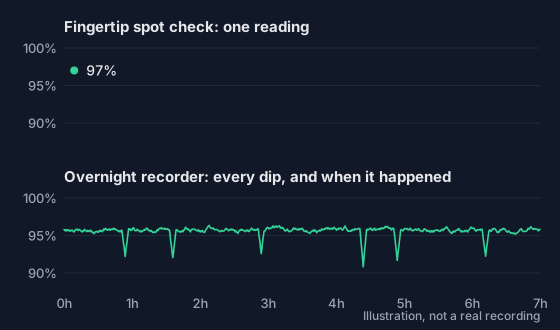
What will you actually see?
In the morning you'll get:
- How many times your oxygen dipped (ODI).
- How many minutes you spent below 90% (T90).
- Your lowest reading of the night.
- What your pulse did while you slept.
Not sure what a dip is? Start with what counts as an oxygen dip. For the wider picture, see what a pulse oximeter shows about your sleep.
How is it different from what you already own?
| Option | What you get | Good for |
|---|---|---|
| Fingertip clip | One reading while you're awake | A quick daytime check |
| Smartwatch | Occasional readings or a nightly average | A rough figure next to your sleep stats |
| Snoring app | A sound recording | Hearing how loud and how often |
| Overnight oximeter | SpO2 and pulse every few seconds, all night | Counting dips and comparing nights |
We go through each one in more detail here:
- Do cheap pulse oximeters work overnight?
- Smartwatch SpO2 vs a pulse oximeter
- Snoring apps vs oximeters
What does it cost?
At the time of writing, Wellue's own store listed its three overnight models between about $150 and $230, depending on the model and the discount running that day. Prices move, so check the listing.
That's a one-off cost. The device's own app is free.
What can't it do?
It's not a sleep study, and it can't tell you whether you have a sleep condition. Wellue sells the O2Ring for general wellness use, not medical use.
If you snore loudly, your partner has heard you stop breathing or gasp, or you're wiped out during the day, see a doctor first. Don't wait until you've bought a gadget.
Is it accurate enough?
Enough to compare your own nights, if you wear it well. Any pulse oximeter can read wrong when:
- Your hand is cold.
- You're moving.
- The sensor is loose.
- You're wearing nail polish.
The FDA lists skin temperature and nail polish among the things that affect a reading, along with skin pigmentation. See why a reading might be wrong and pulse oximeters and skin tone.
One odd number doesn't mean much. Look at the pattern over several nights.
What happens on night one?
- Charge it, put it on a finger where it sits snugly, and go to sleep.
- In the morning, open the app and let it sync.
- Expect the first night to look a bit off. You're sleeping with something new on your hand.
Here's what to expect on your first night. Then keep going, because one night isn't enough to compare.
So who should get one?
It's worth it if you want to:
- Test your own habits. Wear it for 5 ordinary nights. Then change one thing, like sleeping on your side, skipping that late drink, or eating dinner earlier. Keep that up for two weeks and compare.
- Check your oxygen when you travel. Heading somewhere high? Here's what to expect at altitude and on a flight.
- Log your oxygen alongside CPAP. Most home machines don't record it. See tracking your oxygen alongside CPAP.
- Bring something concrete to your doctor. "Here are my last three weeks" gets you further than "I think I sleep badly". Here's how to share it.
And who should skip it?
Probably don't bother if:
- You want a yes or no answer about a condition. It can't give you one.
- You'll look at one night and lose interest. Single nights are all over the place.
- You can't sleep with something on your finger.
- Your watch's nightly average is all you want.
Which one should you buy?
Get one made for overnight wear, not a spot-check clip. Check three things on the listing:
- It stores the night on the device.
- The battery covers your longest night.
- You can export your data as a CSV file, so you're not locked into one app.
The full list is in what to check before buying. For the shape, see ring vs fingertip vs wrist. For the three Wellue models, see O2Ring vs Checkme O2 Max vs SleepU.
One thing to know: the device's own app shows you one night at a time. If you want to see weeks side by side, that's what PulseOxTracker is for.
Not a medical device. Does not diagnose, treat or prevent any condition. Discuss results and changes with a clinician.
References
- US Food and Drug Administration. Pulse Oximeters, including a summary of the February 2021 safety communication. fda.gov. Checked October 2026.
- Wellue. O2Ring product listing, including price and intended use. getwellue.com. Checked October 2026.