Back vs Side Sleeping and Your Oxygen Levels
What sleep lab studies found about sleeping position, and how to compare back and side nights with an overnight oximeter that doesn't record position.
Someone has probably told you that you snore more on your back. A snoring app can record the noise. An overnight oximeter lets you check whether your oxygen numbers differ too.
What did the studies find?
- In a 1984 sleep lab study of 24 men, breathing events were about twice as frequent on the back as on the side.
- A 2013 review described this position-dependent pattern as common among the people studied.
Researchers put it down to gravity. On your back, your tongue and soft palate can fall toward your airway.
That doesn't mean your nights will follow the same pattern.
What's the catch with an oximeter?
A ring or wrist oximeter records oxygen and pulse. It doesn't record which way you're lying. So you have to control position yourself and write it down.
How do you stay on your side?
- Start the night on your side.
- Put a firm pillow behind your back.
- Or sew a tennis ball into the back of a snug T-shirt, so rolling over is uncomfortable.
- In the morning, note how you woke up: back, side or front.
You'll still roll over some nights, and that's fine as long as you note it.
How do you run the comparison?
- Record at least five nights sleeping however you usually do.
- Record about two weeks of side-sleeping nights.
- Keep bedtime, alcohol and dinner time steady, so position is the only thing you changed.
- Compare the two sets as averages, not night by night.
Not sure how many nights is enough? See how many nights to record.
Which numbers should you compare?
- ODI, the number of dips per hour.
- Your lowest reading of the night.
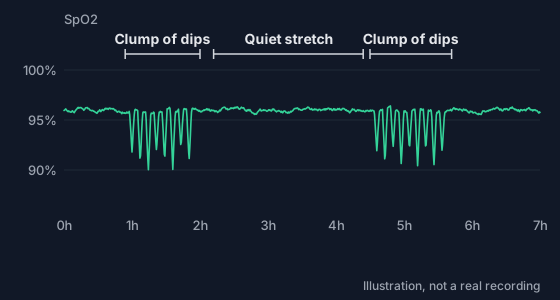
On your usual-position nights, look at where the dips sit on the chart. If they come in clumps with quiet stretches between them, those clumps may be the times you were on your back. You can't confirm that from the oximeter alone.
What if your numbers don't change?
Then position may not be what moves your numbers, and you can try a different experiment, like moving your last drink earlier.
Either way, an oximeter is not a sleep study. If you snore loudly, someone has heard you stop breathing or gasp, or you're exhausted during the day, see a doctor. If you already use CPAP or an oral appliance, keep using it as prescribed and ask your clinician before you change anything. Here's how to log your oxygen alongside CPAP.
How do you keep the two sets apart?
In PulseOxTracker you can tag each night as "side sleeping" or "usual position". Then put several nights side by side to see where the dips fall.
Not a medical device. Does not diagnose, treat or prevent any condition. Discuss results and changes with a clinician.
References
- Cartwright RD. Effect of sleep position on sleep apnea severity. Sleep. 1984;7:110-114. doi:10.1093/sleep/7.2.110
- Ravesloot MJL, van Maanen JP, Dun L, de Vries N. The undervalued potential of positional therapy in position-dependent snoring and obstructive sleep apnea: a review of the literature. Sleep and Breathing. 2013;17:39-49. doi:10.1007/s11325-012-0683-5