Sleep of High-Altitude Workers: A 2025 Study
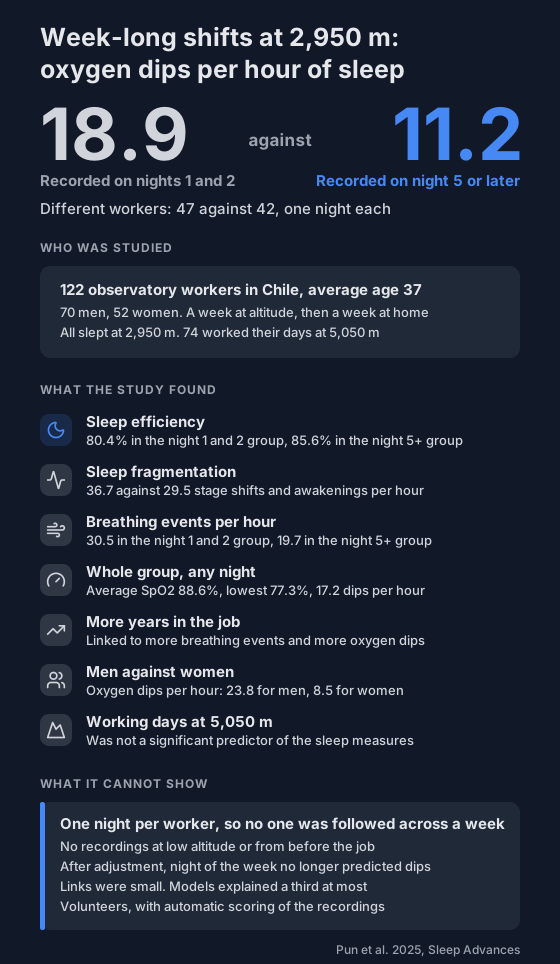
A 2025 study recorded one night of sleep from 122 workers on week-long shifts at 2,950 m. Workers recorded on nights 1 and 2 averaged 18.9 oxygen dips an hour, against 11.2 for different workers recorded on night 5 or later.
Your overnight oxygen reads lower at altitude, and the first nights are usually the roughest. But what about people who go up and down every other week, for years?
A 2025 cross-sectional study ran one night of sleep recording on each of 122 of them. Workers recorded on the first nights of a shift had worse numbers than other workers recorded later in the week. And the longer someone had done the job, the more breathing events and oxygen dips their recording showed.
Who was studied?
- 122 workers at the ALMA Observatory in the Atacama Desert, Chile: 70 men and 52 women, average age 37.
- They work one week at altitude, then spend one week at home.
- Everyone sleeps at the base camp at 2,950 m.
- 74 of them work their days at the telescope site at 5,050 m, with supplemental oxygen, and come back down to sleep.
- 78 live below 1,000 m and 39 live in towns at about 2,260 to 2,450 m. The paper doesn't say where the other 5 live.
- They'd done the job for 5 years on average, ranging from 3 months to 18 years.
Each worker had one night of full sleep recording at the base camp, on whichever night of the shift suited them. A wrist oximeter recorded SpO2 and pulse.
What did a typical night look like?
Across all 122 recordings:
- Average SpO2: 88.6%.
- Lowest SpO2 of the night: 77.3% on average.
- Oxygen dips of 4% or more per hour (ODI): 17.2.
- Breathing events per hour: 27.4. Only 8 workers had fewer than 5.
- Total sleep: 5 hours 52 minutes, with 63 minutes awake after first falling asleep.
Altitude is known for pauses where the brain briefly stops sending the signal to breathe. Here the blocked-airway kind was more common: 7.7 an hour against 2.4. The authors say the low count of the first kind is not unexpected at a sleeping altitude below 3,000 m.
Were the first nights worse?
In the workers recorded on them, yes. Nobody was recorded twice, so the study compared 47 workers recorded on night 1 or 2 with 42 different workers recorded on night 5 or later.
| Measure | Nights 1 and 2 | Night 5 or later |
|---|---|---|
| Oxygen dips per hour | 18.9 | 11.2 |
| Breathing events per hour | 30.5 | 19.7 |
| Sleep efficiency | 80.4% | 85.6% |
| Stage shifts and awakenings per hour | 36.7 | 29.5 |
| Deep sleep, share of the recording | 13.1% | 18.1% |
These are two different groups of people, not the same workers recorded twice. Each gap was statistically significant in a plain two-group test with no adjustment (p = .044 for oxygen dips).
In the authors' regression models, which also weighed things like age, sex and BMI:
- Night of the week still predicted fragmentation and deep sleep. Only the fragmentation result held after correcting for the number of tests.
- For sleep efficiency it was borderline. The paper's Table 4 prints p = .0498 and its text prints p = .498.
- It was not a significant predictor of oxygen dips (p = .132) or breathing events (p = .144).
What about years in the job?
This went the other way. More years on the altitude schedule was linked to:
- More breathing events per hour.
- More oxygen dips per hour.
- More time below 90% SpO2 (T90).
In the adjusted model, each extra year went with about 1.2 more breathing events an hour. Sex and BMI were the other significant predictors in that model. Years in the job did not make it into the final models for oxygen dips or time below 90%.
Did men and women differ?
- Oxygen dips per hour: 23.8 for men, 8.5 for women.
- Breathing events per hour: 36.6 for men, 15.1 for women.
- Average SpO2: 87.9% for men, 89.5% for women.
The women had also done the job for less time, 3.0 years against 6.4. The authors say that may explain part of the gap.
Working days at 5,050 m and living at altitude between shifts were not significant predictors of any of the sleep measures. The closest was oxygen dips, where working days at 5,050 m sat right on the line (p = .0500), pointing to fewer dips. The authors note those workers use supplemental oxygen up there, which may have affected their sleep results.
Did the workers notice?
43 workers also filled in questionnaires.
- 32 of the 43 scored as poor sleepers on a sleep quality questionnaire.
- A risk checklist for sleep apnea put only 3 of them in its high-risk group.
The authors say checklists like these can underestimate what a recording shows.
What doesn't it tell you?
- Change over a week. This is a cross-sectional study: each worker was recorded once. The authors say recording the same people at the start and end of a shift would answer this better.
- Cause. There were no recordings at low altitude, or from before the workers started the job. The authors say that makes it hard to pin the findings on the schedule.
- Size. The authors call the associations small. Their models explained a third of the variation at most.
- Who took part. About 290 workers were invited and 122 completed a recording. Those sleeping well or badly may have been more likely to sign up.
- Scoring. The recordings used two forehead brain-wave sensors and automatic scoring, checked by the researchers.
Six of the twelve authors work for the observatory's safety group. The funding came from Canadian research grants and a university research chair, and the authors declared no financial interests.
What can you do with this?
If you track your own nights at altitude:
- Note which night of the trip each recording is. In this study the early-night group and the later-night group read differently.
- One night is a thin sample. Here's how many nights to record.
- Compare recordings from the same altitude. See what changed when people slept lower down.
If you work a schedule like this and you're tired during the day, or someone has heard you stop breathing in your sleep, talk to a doctor. You can share your recordings with them.
Not a medical device. Does not diagnose, treat or prevent any condition. Discuss results and changes with a clinician.
References
- Pun M, Sanzana F, Faundez M, Mancilla M, Jara M, Gomez G, Moraga FA, Barrientos CA, Hansen B, Rawling JM, Lopez I, Poulin M. Sleep and nocturnal breathing of individuals working over 1-week periods at high altitude: a cross-sectional polysomnographic study. Sleep Advances. 2025;6(4):zpaf074. doi:10.1093/sleepadvances/zpaf074