Low-Altitude Bedrooms in Lhasa: 12-Week Trial
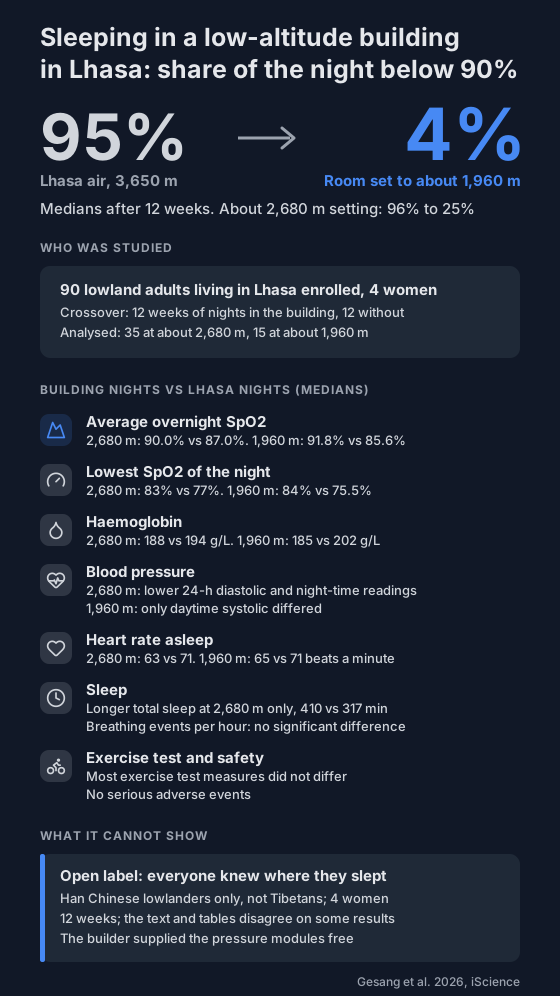
A 2026 crossover trial had adults living in Lhasa sleep in pressure-regulated rooms for 12 weeks. With the room set to about 1,960 m, the share of the night below 90% SpO2 was 4%, against 95% on Lhasa nights.
Your overnight oxygen reads lower at altitude, and for people who live there it stays that way every night. Moving down isn't practical for most of them. A 2026 trial in Lhasa tried bringing a lower altitude into the bedroom instead.
The "equivalent low altitude building" is a set of rooms held at a higher air pressure than outside, so the air inside matches a lower height.
Who was in the trial?
- 90 Han Chinese adults aged 18 to 59 who had moved to Lhasa from lower ground and got used to the altitude.
- Only 4 were women.
- Lhasa sits at about 3,650 m.
- Each person spent 12 weeks of nights in the building and 12 weeks sleeping as usual, in random order, with a 3-month break in between.
- The rooms were set either 8 kPa above outside (about 2,680 m) or 15 kPa above (about 1,960 m).
- The results tables cover 35 people at the 2,680 m setting and 15 at the 1,960 m setting.
Before and after each period they had a full sleep study (polysomnography), 24-hour blood pressure monitoring, blood tests and an exercise test.
What happened to overnight oxygen?
The clearest result of the trial. Medians after 12 weeks, building nights against Lhasa nights:
- Average SpO2: 90.0% against 87.0% at the 2,680 m setting, 91.8% against 85.6% at 1,960 m.
- Share of the night below 90%: 25% against 96%, and 4% against 95%.
- Share of the night below 85%: 0% against 19%, and 0% against 18%.
- Lowest SpO2 of the night: 83% against 77%, and 84% against 75.5%.
All of these differences were statistically significant. Time below 90% is the measure called T90.
An hour-by-hour chart showed where the gap opened. On Lhasa nights, SpO2 fell from about 88% at 11 pm to about 84% at 1 am, around the time people fell asleep, then crept back to about 86% by 7 am. In the building it went from about 90% to about 89% and stayed fairly flat.
What about blood and blood pressure?
At the end of the building period:
- Haemoglobin was 188 against 194 g/L at the 2,680 m setting, and 185 against 202 g/L at 1,960 m.
- Haematocrit was 56.2% against 58.9%, and 54.5% against 60.6%.
- Platelets were higher in the building at the 2,680 m setting, 280 against 249.
Blood pressure differed less consistently:
- At 2,680 m, 24-hour diastolic was 76 against 80 mmHg, night-time systolic 106 against 123, and night-time diastolic 65 against 79.
- 24-hour systolic at 2,680 m was not significantly different.
- At 1,960 m, only daytime systolic differed: 114 against 125 mmHg.
And sleep?
- Heart rate asleep was lower in the building: 63 against 71 beats a minute at 2,680 m, 65 against 71 at 1,960 m.
- Total sleep time was longer at 2,680 m, 410 against 317 minutes, with no significant difference at 1,960 m.
- Breathing events per hour were 15 against 20, and 8 against 16. Neither difference was statistically significant.
- Exercise test: most measures did not differ.
No serious adverse events were reported.
How is this different from the other pressurised room trial?
We covered an earlier 2026 trial of pressurised rooms. That one had 24 men at 3,500 m, stepped the room down to 2,000 m over 3 weeks and recorded one night a week with a forehead monitor. It looked mainly at sleep stages and arousals.
This one ran for 12 weeks, used fixed settings and a full sleep study, and added blood, blood pressure and exercise tests. Average SpO2 in the room was lower here: 91.8% at about 1,960 m, against 96.3% at 2,000 m in the earlier trial. The two used different people, monitors and timings, so the numbers aren't directly comparable.
What doesn't it tell you?
- How much was expectation. It was open label: everyone knew whether they were in the building.
- Much about women or Tibetans. There were 4 women, and everyone was a Han Chinese lowlander, not someone from a population adapted to altitude over generations.
- What happens past 12 weeks. Measurements were taken only before and after each period, so the paper can't show how the changes built up or whether they last.
- Some details for certain. The results text and the main table disagree in places, and this article follows the table.
- Breathing events at 2,680 m: the text calls the drop significant (p = 0.015), the table gives p = 0.065.
- Blood pressure at 1,960 m: the text says several measures differed, the table shows only daytime systolic did.
- Who was counted. 90 people enrolled, but the tables list 50, and the text doesn't explain the gap.
The company that built the rooms, China Railway Construction Heavy Industry (Xizang branch), supplied the pressure modules and installation free and its engineers ran the building during the trial. The authors say it gave no cash and had no role in design, analysis or writing. The study had no other funding.
What can you do with this?
In this trial, a lower simulated altitude at night went with higher overnight SpO2 and much less time below 90%.
If you live at or travel to altitude, average SpO2, lowest SpO2 and time below 90% are the numbers to watch across nights; the altitude oxygen tool gives a typical figure for a given height. Record several, since one night varies; how many nights to record covers that. You can open a recording in the session viewer.
Not a medical device. Does not diagnose, treat or prevent any condition. Discuss results and changes with a clinician.
References
- Gesang L, Suona Y, Danzeng Z, Gesang Q, Ci B, Ren D, Dingzeng Q, Liu B, Ma Q, Huang J, Zhaxi Q, Baima Z. Equivalent low altitude building improves physiological adaptation at high altitude. iScience. 2026;29(6):115881. doi:10.1016/j.isci.2026.115881