Overnight Oxygen and Altitude Sickness
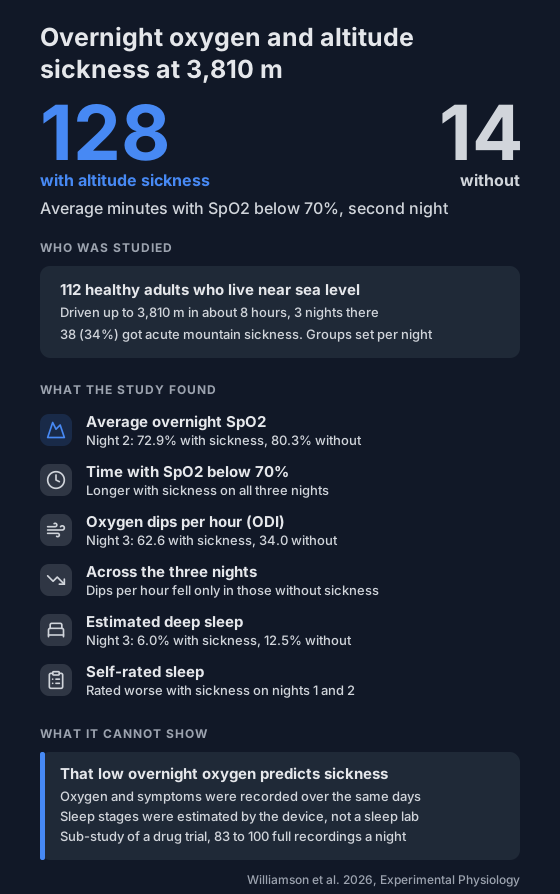
A 2026 study took 112 healthy adults to 3,810 m. Those with acute mountain sickness had lower overnight oxygen and more time below 70% SpO2 than the rest.
Everyone's blood oxygen reads lower at altitude. Some people also get acute mountain sickness: headache, nausea, tiredness and dizziness. A 2026 study compared nights with it and nights without.
Who was studied?
- 112 healthy adults aged 18 to 55 who live near sea level.
- They were driven from sea level to 3,810 m in about 8 hours and slept there for three nights.
- They wore a WatchPAT300, a home sleep test device with a finger oximeter.
- Every morning they scored their symptoms on the 2018 Lake Louise scale.
38 of them (34%) met the scale's cut-off for acute mountain sickness, most often after the first night. Each night's comparison is between the people who met the cut-off that day and those who didn't.
What did their nights look like?
- Average overnight SpO2. Night 1: 76.6% with sickness against 80.0% without. Night 2: 72.9% against 80.3%.
- Time below 70%. Longer with sickness on all three nights. On night 2 it averaged 128 minutes against 14.
- Oxygen dips per hour (ODI). About the same on night 1. On night 3 it was 62.6 with sickness and 34.0 without.
- Deep sleep, as estimated by the device. Night 3: 6.0% against 12.5%.
- Self-rated sleep. Worse with sickness on nights 1 and 2.
Over the three nights, dips per hour fell without sickness and stayed high with it.
Daytime spot checks differed significantly on day 2 only.
What else did the paper report?
- The 1993 version of the scale counts poor sleep as a symptom. With it, 64 people (58%) met the cut-off.
- In an exploratory model, first-night minutes below 70% and first-night sleep rating were each linked to sickness.
- The study sat inside a company-sponsored trial of a drug called AR36. Sickness rates did not differ significantly between the drug and placebo groups.
What can't it show?
- Prediction. Oxygen and symptoms were recorded over the same days. The authors call the model hypothesis-generating.
- Sleep stages. The device estimates them, and it has not been validated at high altitude.
- Complete data. Full recordings came from 100, 91 and 83 people on the three nights.
- The drug. The authors can't rule out that it affected the sleep measurements.
What can you do with this?
An overnight oximeter can log your oxygen and dips night by night on a trip. It can't tell you whether you have altitude sickness, which is judged by symptoms. If you feel ill at altitude, tell the people you're with and get medical help.
Not a medical device. Does not diagnose, treat or prevent any condition. Discuss results and changes with a clinician.
References
- Williamson DM, Gudelunas MK, Sall JW. The contributions of nocturnal hypoxaemia and sleep disturbances to acute mountain sickness. Experimental Physiology. 2026. Online ahead of print. doi:10.1113/EP093915