Periodic Breathing at Simulated Altitude
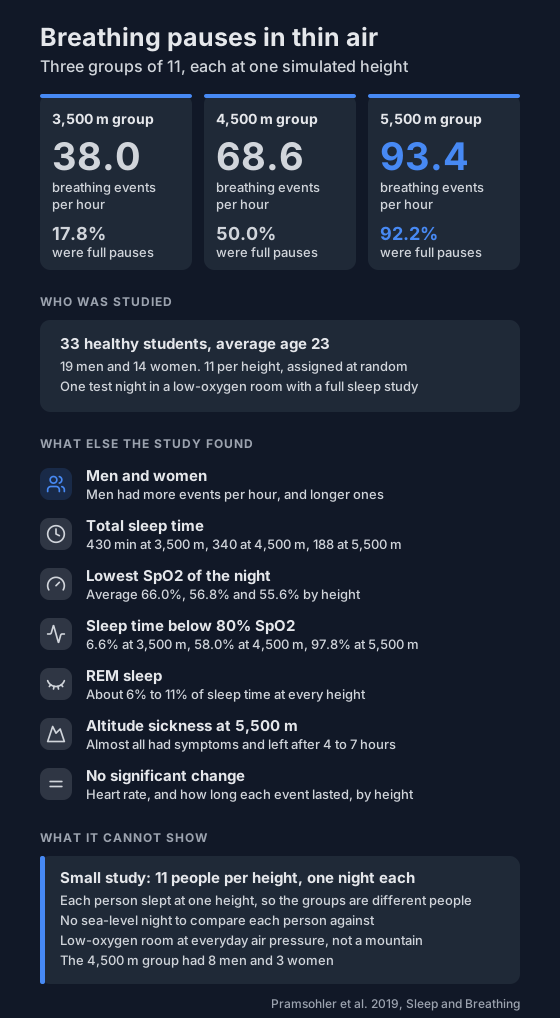
A 2019 study had 33 students sleep one night in a low-oxygen room set to 3,500 m, 4,500 m or 5,500 m. Breathing events averaged 38 an hour in the 3,500 m group and 93 in the 5,500 m group, and men had more of them than women.
At altitude, many people breathe in cycles during sleep: a few deep breaths, then a pause, then again. It's called periodic breathing, and it makes SpO2 swing up and down through the night. For the basics, see blood oxygen at altitude.
A 2019 study measured how much of it three groups of healthy young adults had, each at a different simulated height.
Who was studied?
- 33 healthy, non-smoking students from two universities in Germany and Austria.
- 19 men and 14 women, average age 23.
- None had a known sleep disorder.
- None had been at higher altitude in the 2 weeks before, though they had hiked below 2,000 m in the days before.
What did they do?
- Each student was randomly assigned to one of three groups of 11.
- Each group slept one test night in a room with the oxygen in the air lowered to match 3,500 m, 4,500 m or 5,500 m.
- The air pressure stayed at its everyday level. Only the oxygen share changed.
- The methods section says the 4,500 m and 5,500 m groups slept one night at simulated 3,500 m first, to lower the chance of altitude sickness. The limitations section says there were no acclimatisation nights at 3,500 m and 4,500 m. The paper does not explain the difference.
- Nobody slept at more than one test height, so the comparison is between three different groups of people.
- Everyone had a full sleep study from 11 pm to 6:30 am, which records breathing, brain activity, heart rate and SpO2.
What happened to breathing?
The paper's summary gives each group's average number of breathing events per hour, counting full pauses and shallow breaths together:
- 3,500 m group: 38.0 an hour.
- 4,500 m group: 68.6 an hour.
- 5,500 m group: 93.4 an hour.
These numbers appear only in the summary. The main text shows them as a chart without printed values, and its bars read close to these figures, not exactly on them. The difference between groups was significant (p = 0.017).
The type of event differed too. By the summary, full pauses made up 17.8% of events at 3,500 m, 50.0% at 4,500 m and 92.2% at 5,500 m.
Other things the study reports:
- All the events recorded were the central kind, where breathing effort stops or drops, not a blocked airway. The authors think the frequent periodic breathing may have hidden a few blocked-airway events.
- How long each event lasted did not differ significantly by height (p = 0.527).
- The authors describe the rise between 4,500 m and 5,500 m as exponential.
Did men and women differ?
Yes.
- Men had more breathing events per hour than women across all three heights (p = 0.014).
- Men's events also lasted longer (p = 0.003).
- SpO2 and total sleep time did not differ significantly between men and women.
The paper shows the men's and women's figures in a chart, without printing the numbers. The authors suggest hormones, lung volume and slower breathing in men as possible reasons, but the study did not test any of them.
What about oxygen and sleep?
Both were lower in the groups at greater simulated heights (p < 0.001 for each).
| 3,500 m | 4,500 m | 5,500 m | |
|---|---|---|---|
| Total sleep time | 430 min | 340 min | 188 min |
| Lowest SpO2 of the night | 66.0% | 56.8% | 55.6% |
| Sleep time below 90% SpO2 | 79.9% | 98.3% | 99.7% |
| Sleep time below 80% SpO2 | 6.6% | 58.0% | 97.8% |
- REM sleep was low at every height, between about 6% and 11% of sleep time. The paper's text and its table give slightly different REM figures, and the table's sleep-stage shares for 5,500 m add up to more than 100%.
- Heart rate was slightly higher at greater heights, but the difference was not significant (p = 0.100).
- At 5,500 m only one student had brief arousals. The others woke up fully instead.
- The study found no link between the number of breathing events and SpO2.
- At 3,500 m and 4,500 m, nobody had to leave the room.
- At 5,500 m, almost all the students scored above 6 on the Lake Louise altitude sickness scale and left the room after 4 to 7 hours.
For a study on a real mountain, see overnight oxygen and altitude sickness.
What can't it show?
- It's small. 11 people per height, one night each, and each person slept at one height only.
- No sea-level night. The authors call this a main limitation: there's no starting point for each person.
- The groups weren't balanced. The 4,500 m group had 8 men and 3 women, and the authors say this could have affected that group's average.
- It wasn't a mountain. The room lowered oxygen at everyday air pressure. The authors note that real altitude may bring lower overnight oxygen and more breathing events.
- Short nights at 5,500 m. The results say almost all of that group left after 4 to 7 hours with altitude sickness symptoms. The limitations section says "some" did. Either way, the authors say it may have cut the group's sleep time.
- Everyone was young and healthy. None had been to altitude in the 2 weeks before, and the study did not include older people.
- Menstrual cycle and contraceptive use weren't recorded, so the hormone explanation is untested.
What can you do with it?
- The authors say the jump in periodic breathing between 4,500 m and 5,500 m matters for mountaineers and others who go very high.
- In this study, healthy students averaged about 80% or more of their sleep time below 90% SpO2 at every simulated height.
- Planning a high trip? See how long pre-acclimatising takes.
- Feeling unwell at altitude is a reason to talk to a doctor or guide, whatever your oximeter reads.
Not a medical device. Does not diagnose, treat or prevent any condition. Discuss results and changes with a clinician.
References
- Pramsohler S, Schilz R, Patzak A, Rausch L, Netzer NC. Periodic breathing in healthy young adults in normobaric hypoxia equivalent to 3500 m, 4500 m, and 5500 m altitude. Sleep and Breathing. 2019;23(2):703-709. doi:10.1007/s11325-019-01829-z