Pre-Acclimatising for Altitude: How Long?
A 2026 review of seven controlled trials found more hours at simulated altitude meant less acute mountain sickness later, and projects about 200 hours for a risk near zero.
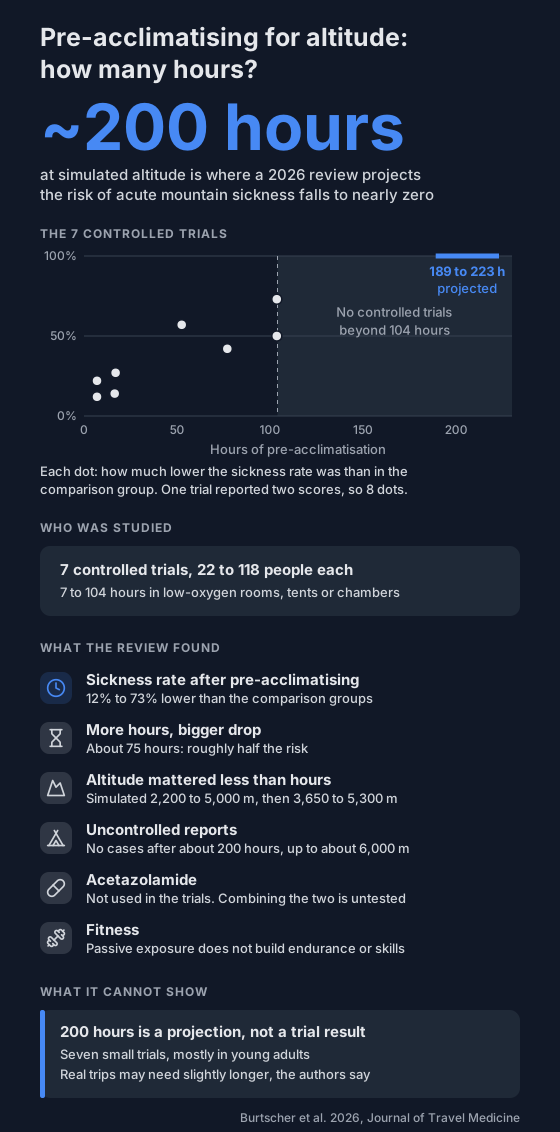
The usual way to lower the chance of acute mountain sickness is to climb slowly. Some trekkers now sleep in a low-oxygen tent at home first, called pre-acclimatisation. A 2026 review asked how many hours of it the published trials point to.
What did the review look at?
- Seven controlled trials, each with 22 to 118 people, mostly young adults.
- One group spent time in a low-oxygen room, tent or pressure chamber, and a comparison group didn't.
- Total time ranged from 7 to 104 hours over several days or nights, at a simulated 2,200 to 5,000 m.
- Afterwards everyone spent 8 hours to 5 days at 3,650 to 5,300 m, real or simulated.
- Nobody took acclimatisation medication such as acetazolamide.
What did it find?
- The sickness rate was 12% to 73% lower in the pre-acclimatised groups.
- The more hours, the bigger the drop.
- Hours explained 76% of the variation between trials.
- About 75 hours went with roughly half the risk.
- Extending the line, the risk reaches zero at 189 or 223 hours, depending on the symptom score used.
- The authors round that to about 200 hours.
- Earlier advice put the figure at 300 hours or more.
- The altitudes used made little difference within the range tested.
- The only side effect reported was early trouble sleeping in one trial.
Is there anything beyond 104 hours?
Only uncontrolled reports.
- Two observational reports, of 35 and 5 people, combined about 200 hours of real and simulated altitude, and neither reported a case.
- Expedition operators told the authors of over 300 people with at least 200 tent hours each, and no cases on a fast ascent to about 6,000 m.
What can't it show?
- 200 hours. It's a projection past the longest trial, not a tested result.
- Small trials. The authors used each result whether or not it was statistically significant.
- Older people. Most participants were young adults.
- Real trips. The authors say these may need slightly longer than the experiments did.
- Fitness. Time in low oxygen doesn't build endurance or mountain skills.
What can you do with this?
Talk to a doctor before using an altitude tent, especially if you have a heart, lung or sleep condition.
An overnight oximeter can log your oxygen and pulse on those nights and on the trip. It can't tell you whether you're acclimatised.
For more, read blood oxygen at altitude and overnight oxygen and altitude sickness.
Not a medical device. Does not diagnose, treat or prevent any condition. Discuss results and changes with a clinician.
References
- Burtscher J, Hüfner K, Gatterer H, Pichler-Hefti J, Hefti U, Tannheimer M, Kleinsasser A, Hackett P, Burtscher M. Time requirements of pre-acclimatization at simulated altitude to prevent acute mountain sickness. Journal of Travel Medicine. 2026;33(3):taag009. doi:10.1093/jtm/taag009