Breathlessness at Simulated Altitude: A Study
22 healthy young adults cycled for 30 minutes in a low-oxygen gym set to about 9,000 ft. How breathless they felt varied widely, had no significant link with resting HRV, and went with how much oxygen their thigh muscle lost. Men felt more breathless than women.
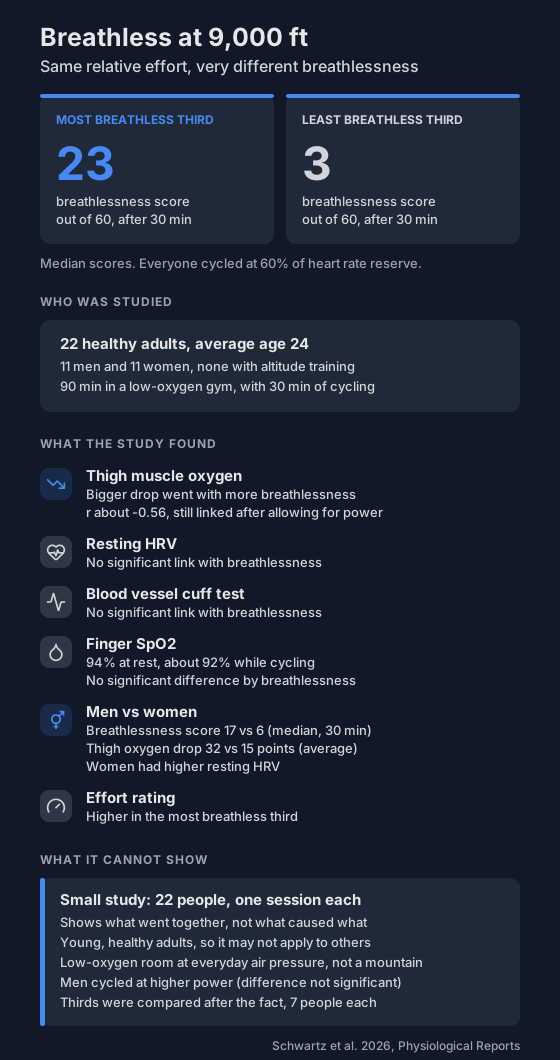
Altitude gyms and low-oxygen training rooms aren't just for endurance athletes anymore. The researchers behind a 2026 study had noticed that some people there get far more out of breath than others. Their study, at the University of Toronto, looked at who, and what went along with it.
Who was studied?
- 22 healthy adults, average age 24, 11 men and 11 women.
- None had trained at altitude before.
- Each spent about 90 minutes in a private altitude gym in Toronto.
- The air held about 15% oxygen instead of the usual 21%, roughly what you'd breathe at 9,000 ft.
During the session they:
- Lay still for 15 minutes while a chest strap recorded heart rate variability (HRV).
- Had a thigh cuff pumped up for 3 minutes to see how the muscle's blood vessels responded.
- Cycled for 30 minutes at 60% of their heart rate reserve, a steady training effort, with the bike adjusting its resistance to hold each person's target heart rate.
A sensor on the thigh tracked how much oxygen the muscle held. A fingertip pulse oximeter tracked SpO2. At 10, 20 and 30 minutes they rated their breathlessness on a standard scale, scored out of 60 here.
How different were people?
Very. At the same relative effort, some got more breathless as they went, some less, and some stayed level. The group average barely moved.
The researchers compared the most breathless third with the least breathless third, 7 people each:
- Median score after 30 minutes: 23 out of 60 against 3.
- Every part of the score was higher, including air hunger, chest tightness and breathing effort.
- The most breathless also rated the whole workout as harder.
- The two groups had no significant differences in age, height, weight, BMI or how active they were day to day.
Did resting HRV predict it?
Not in this study. None of the HRV measures had a statistically significant link with how breathless people felt. The blood vessel cuff test didn't either.
That went against what the researchers expected. They suggest 9,000 ft may not be a strong enough low-oxygen challenge to bring out differences in these measures, or that they just aren't what drives breathlessness.
For more on what HRV can and can't tell you, see exercise, HRV and sleep apnea.
What did go with it?
How much oxygen the thigh muscle lost while cycling.
- The bigger the drop, the more breathless people felt, at 10, 20 and 30 minutes (r about -0.56 each time).
- The link held after allowing for how hard each person was pedalling.
Finger SpO2 didn't separate the groups. It sat at about 94% at rest and about 92% while cycling, with no significant difference between the most and least breathless.
The authors' explanation is that when working muscle runs short of oxygen, it builds up by-products that push up breathing and the feeling of breathlessness. This study didn't test that directly.
Were men and women different?
Yes.
- Men had higher breathlessness scores: a median of 17 against 6 after 30 minutes.
- Air hunger, mental effort of breathing and breathing hard were significantly higher in men.
- Discomfort, physical effort and chest tightness had no statistically significant difference.
- Men's thigh muscle lost more oxygen: an average drop in muscle oxygen saturation of 32 points against 15.
- Women had higher resting HRV, for example RMSSD 110.8 against 59.8 ms, but HRV wasn't linked to breathlessness.
The most breathless third was 86% men, the least breathless 29%, but that gap wasn't statistically significant.
Men also pedalled at somewhat higher power, though not significantly so. The authors say that may account for some of the difference.
What can't it show?
- Cause. It's a cross-sectional study: it shows what went together, not what caused what.
- Size. 22 people, one session each. The thirds were picked after the fact and had only 7 people each.
- Who it applies to. Young, healthy adults with no altitude training, at one oxygen level.
- Real mountains. A low-oxygen room keeps everyday air pressure. Real altitude doesn't.
The authors also note breathing rate can affect HRV readings, and it wasn't controlled.
What can you do with this?
If you use an altitude gym, expect people around you to feel very different in the same heart rate zone. The authors suggest that how breathless you feel, or how hard the work feels, could be used alongside heart rate to set the effort.
Heading to real altitude? See blood oxygen at altitude for what your SpO2 does there, and pre-acclimatising for altitude for what the trials found about time spent in low-oxygen rooms beforehand.
If you get breathless more easily than you'd expect, at altitude or at home, tell your doctor.
Not a medical device. Does not diagnose, treat or prevent any condition. Discuss results and changes with a clinician.
References
- Schwartz JL, Khan A, Bentley RF. Interindividual differences in dyspnea during acute hypoxic exercise in healthy adults: A single exposure to simulated altitude at ~9000 ft. Physiological Reports. 2026;14(17):e71085. doi:10.14814/phy2.71085