Brain Oxygen vs Finger SpO2 at Altitude
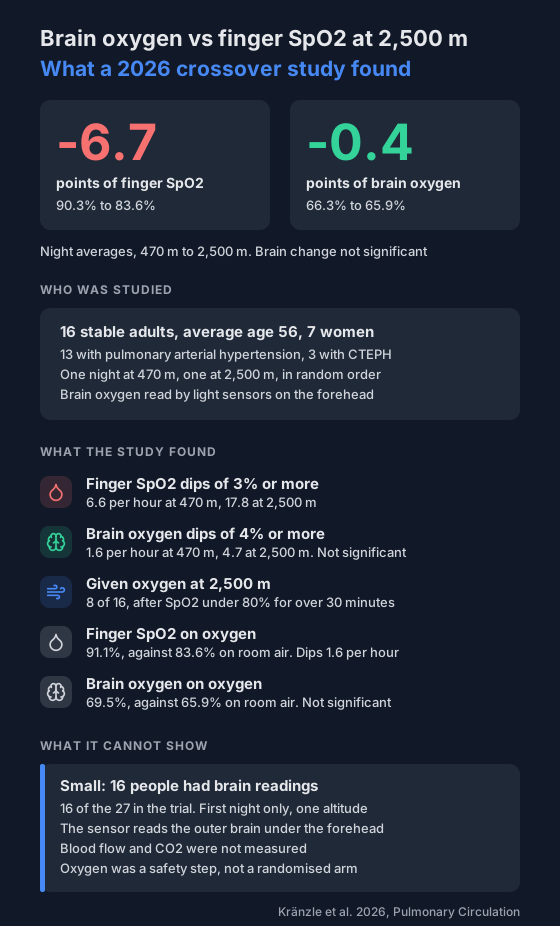
A 2026 study recorded brain and finger oxygen overnight at 2,500 m in 16 people with pulmonary vascular disease. Finger SpO2 fell by 6.7 points, while brain oxygen stayed about the same.
Your oximeter measures oxygen in the blood at your fingertip. It's easy to assume your brain gets the same drop when that number falls.
A 2026 study from Zurich measured both, overnight at 2,500 m, in people with pulmonary hypertension. Finger SpO2 fell by about 7 points. Oxygen in the brain tissue under the forehead stayed about the same.
This is a second paper from the same trial as pulmonary hypertension: a night at 2,500 m. That post covers the whole trial, oxygen use and next-day exercise. This one covers only the brain oxygen measurements from the nights. It includes 16 of the trial's 27 people, so its figures differ: 8 of these 16 were given oxygen, against 10 of all 27 in the other post.
Who was studied?
- 16 adults with pulmonary vascular disease, average age 56, 7 of them women.
- 13 had pulmonary arterial hypertension and 3 had chronic thromboembolic pulmonary hypertension (CTEPH).
- All were stable, with no change to their pulmonary hypertension medication for at least 4 weeks.
- 27 people took part in the trial, but only these 16 had brain recordings that could be used, for technical and logistical reasons.
Each person slept one night at 470 m in Zurich and one night at 2,500 m on Mount Säntis. The order was random, with more than 2 weeks in between. The recordings ran from 10 pm to 6 am.
How do you measure oxygen in the brain?
With near-infrared spectroscopy (NIRS). Sensors high on the forehead shine light into the skin and read how much comes back. That gives the share of haemoglobin carrying oxygen in the outer layer of brain tissue under the sensor.
It isn't the same number as SpO2. SpO2 reads blood in the arteries, which is mostly full of oxygen. The brain reading is a mix of arteries, veins and small vessels, so it sits lower, around 66% here. What matters is how each one changed, not how they compare.
What happened at 2,500 m?
On room air, overnight averages:
| Measure | 470 m | 2,500 m | Change |
|---|---|---|---|
| Finger SpO2 | 90.3% | 83.6% | 6.7 points lower |
| Brain oxygen | 66.3% | 65.9% | 0.4 points lower, not statistically significant |
| Finger dips per hour | 6.6 | 17.8 | 11.2 more |
| Brain dips per hour | 1.6 | 4.7 | 3.1 more, not statistically significant |
- A finger dip was SpO2 falling by 3% or more for at least 10 seconds, the rule behind the oxygen desaturation index.
- A brain dip was brain oxygen falling by 4% or more for at least 10 seconds. The paper's methods also require a finger dip at the same time; its table note and abstract leave that out.
- The length and depth of brain dips, and the number of larger brain dips (13% or more), rose a little too, but none of those changes was statistically significant.
- Blood pressure and heart rate barely changed, apart from diastolic pressure, which was 4 mmHg higher at 2,500 m.
The authors' explanation is that blood vessels in the brain widened and brought in more blood, making up for the lower oxygen in it. The study didn't measure blood flow, so that part is their reading of the data rather than a result.
Is that true for everyone?
Not necessarily. The authors cite an earlier study of people with COPD who spent a night at 2,590 m. Their SpO2 fell by 8.8 points, a bit more than here, and their brain oxygen fell too, by 3.6 points.
So a steady brain reading in this group doesn't mean it holds for other lung conditions.
What did extra oxygen change?
8 of the 16 (50%) were given oxygen at 2,500 m. That was a safety rule set in advance: SpO2 under 80% for more than 30 minutes.
Compared with time on room air at 2,500 m:
- Finger SpO2 went up by 7.5 points, to 91.1%, a little above the 470 m night.
- Finger dips went down from 17.8 to 1.6 per hour.
- Brain oxygen was 69.5% against 65.9%, 3.6 points higher, but not statistically significant.
- Brain dips were about 1 per hour against 4.7, also not statistically significant.
The authors describe oxygen here as an added safety margin rather than a fix for a shortfall in the brain.
What can't it show?
- Small. 16 people, from one clinic. The authors say this may have been too few to pick up subtle changes.
- A wide range on the brain result. The 95% range ran from 4.0 points lower to 3.2 points higher, so a drop the size of the COPD study's can't be ruled out.
- One night, one altitude. The first night at 2,500 m only. Longer stays and higher altitudes may differ.
- Stable patients. 14 of the 16 were in the two least limited functional classes.
- Part of the brain. NIRS reads the outer brain under the forehead, not deeper areas or overall blood flow.
- No CO2 or blood flow. So the explanation for the steady brain reading is untested.
- Oxygen wasn't randomised. It went to whoever met the safety rule. In the paper's table, the figures for those 8 on oxygen sit beside room-air figures for all 16.
- Wording varies within the paper. The discussion says oxygen may have helped brain oxygen; the conclusion says brain oxygen was unchanged. The numbers show a rise that wasn't statistically significant.
- Funding. The Swiss National Science Foundation funded the research. The senior author reports a grant from Johnson & Johnson during the study, plus other industry fees she describes as outside this work.
What can you do with it?
- Know what your oximeter measures: blood at your fingertip, not your brain. In this study the two didn't move together.
- Don't read this as "low SpO2 at altitude doesn't matter". Half of this group met the trial's oxygen safety rule in one night, and the authors call for careful monitoring and individual risk assessment.
- If you record overnight at altitude, compare it with a night at home. Sleep and breathing on the first nights at altitude covers what usually changes, and blood oxygen at altitude covers readings in general.
- Whether to travel to altitude with pulmonary hypertension, and whether to take oxygen, is a decision for you and your specialist team.
Not a medical device. Does not diagnose, treat or prevent any condition. Discuss results and changes with a clinician.
References
- Kränzle C, Bissig V, Schneider SR, Müller J, von Gruenigen K, Bauer M, Mayer L, Lüönd L, Ulrich T, Forrer A, Carta A, Schwarz EI, Bloch KE, Lichtblau M, et al. Nocturnal Cerebral Oxygenation in Low-Altitude Residents With Pulmonary Vascular Disease Staying Overnight at High Altitude. Data From a Randomized, Controlled, Crossover Trial. Pulmonary Circulation. 2026;16(3):e70363. doi:10.1002/pul2.70363