High Altitude to Sea Level: Overnight Oxygen
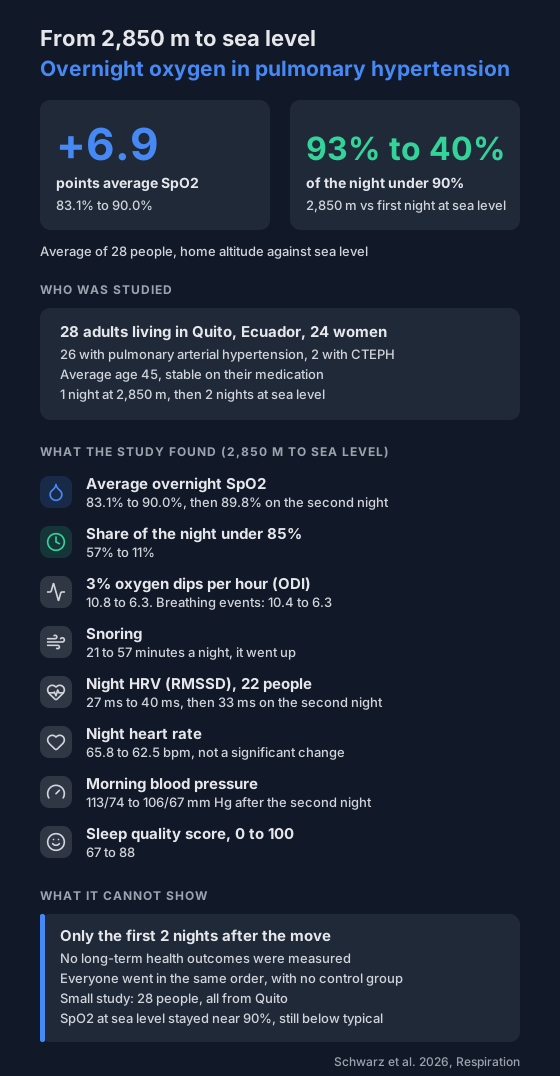
A 2026 study recorded 28 people with pulmonary hypertension who live at 2,850 m in Ecuador, at home altitude and then at sea level. Average overnight SpO2 went from 83.1% to 90.0%, and time under 90% from 93% of the night to 40%.
Overnight SpO2 is lower at altitude, and lower still if your lungs or heart already limit how much oxygen gets into your blood. Over 80 million people live above 2,500 m, so for some people with lung or heart disease that's every night.
A 2026 study from Zurich and Quito asked what happens to those nights when people with pulmonary hypertension go down to sea level.
Who was studied?
- 28 adults who live in Quito, Ecuador, at about 2,850 m.
- 24 were women, and the average age was 45.
- 26 had pulmonary arterial hypertension (PAH), and 2 had chronic thromboembolic pulmonary hypertension (CTEPH), the kind linked to old blood clots in the lungs.
- All had been stable on PAH medication for at least 3 months.
- Half normally used extra oxygen. It was stopped for at least two nights before the recordings, so every night was on room air.
Each person had one night recorded near home at 2,850 m. They were then taken to Pedernales on the coast and recorded for two nights in a row at sea level. The recordings were cardio-respiratory polygraphy: airflow, breathing effort, a fingertip oximeter, an ECG and body position.
What happened to overnight oxygen?
- Average overnight SpO2 went from 83.1% at 2,850 m to 90.0% on the first night at sea level, and 89.8% on the second.
- That's a rise of 6.9 points.
- Time under 90% went from 93% of the night to 40%.
- Time under 85% went from 57% of the night to 11%.
- Awake SpO2 went up too, from about 86% to about 92%.
The second night at sea level showed no statistically significant difference from the first.
New to time under 90%? See what T90 is.
Even at sea level, the group's average stayed around 90%. The authors point out that healthy people living at Quito's altitude average 88 to 92% overnight. They say 90% at sea level is still below what healthy people reach there.
Who had the biggest rise?
- A lower overnight SpO2 at altitude was linked to a bigger rise.
- Older age was linked to a slightly bigger rise.
- Higher lung artery pressure, as first measured, was linked to a smaller rise.
- Body mass index and lung vessel resistance weren't linked to the size of the rise.
The half who normally used oxygen at night started lower: 81.8% against 84.5% at altitude. Their rise was 6.3 points, against 7.4 in the other half.
What about dips and breathing?
- 3% oxygen dips per hour (ODI) went from 10.8 to 6.3.
- Breathing events per hour went from 10.4 to 6.3. Almost all of them were partial events, not full pauses.
- The study's oxygen burden measure, which adds up the depth and length of dips tied to breathing events, went down but not by a statistically significant amount.
- Snoring went up, from 21 to 57 minutes a night. 17 people snored at altitude and 24 on the first night at sea level.
- Breathing rate and heart rate during the night didn't change significantly.
Did HRV and blood pressure change?
HRV was measured from the ECG in 22 people, after leaving out 3 with atrial fibrillation and 3 with poor recordings.
- Night RMSSD went from 27 ms at altitude to 40 ms on the first night at sea level, then 33 ms on the second.
- The LF/HF ratio at night fell from 3.7 to 1.7.
- The authors read this as a shift towards the "rest and digest" side of the nervous system.
- The changes were larger on the first day than the second.
Morning blood pressure went from 113/74 to 106/67 mm Hg after the second night. Evening blood pressure and morning heart rate went down too.
People rated their sleep 67 out of 100 at altitude and 88 after the first night at sea level.
For another study of HRV and overnight oxygen, see daytime HRV and night breathing.
What can't it show?
- Two nights only. The authors say they can't tell whether any of this lasts, or whether it changes symptoms, exercise capacity or how the disease progresses.
- No comparison group. Everyone went from altitude to sea level in the same order. There was no group of healthy highlanders making the same trip.
- Small. 28 people, all living in Quito, mostly with a typical form of PAH. The study planned to enrol 26 and needed 21 for its main result.
- Less medication than guidelines suggest. Only 29% were on more than one PAH medicine, which the authors put down to limited access to drugs in Ecuador.
- Some numbers in the paper don't line up. The abstract says 8 patients where the tables show 28, and the patient flow text and its figure give different counts. The breathing events figure caption gives p < 0.001 for both sea level nights, but the table gives 0.056 and 0.049. We've used the table figures.
- Funding. The Swiss National Science Foundation paid for it. Two authors were on the journal's editorial board.
The authors also note that oxygen at altitude is another option for low overnight oxygen, and that comparing the two is a question for future studies.
What can you do with it?
- If you live high up or move between altitudes, compare nights at the same altitude. A night at home and a night on holiday at a different height aren't like for like.
- A healthy-person version of this experiment is in overnight oxygen at lower altitude.
- For a night going the other way, up to 2,500 m, see pulmonary vascular disease at 2,500 m.
- For what altitude does to readings in general, see blood oxygen at altitude.
- Whether to use oxygen, travel or move with pulmonary hypertension is a decision for you and your specialist team. Your recordings can help that conversation: here's how to share them.
Not a medical device. Does not diagnose, treat or prevent any condition. Discuss results and changes with a clinician.
References
- Schwarz EI, Herzig JJ, Bauer M, Cajamarca E, Furian M, Lichtblau M, Mueller J, Saragoni D, Saxer S, Schmucki M, Schneider SR, Hoyos R, Ulrich S. Nocturnal Hypoxaemia in PAH Patients Living at High Altitude Relocated to Low Altitude. Respiration. 2026:1-12. Online ahead of print. doi:10.1159/000552738 (PubMed)