Pulmonary Hypertension: A Night at 2,500 m
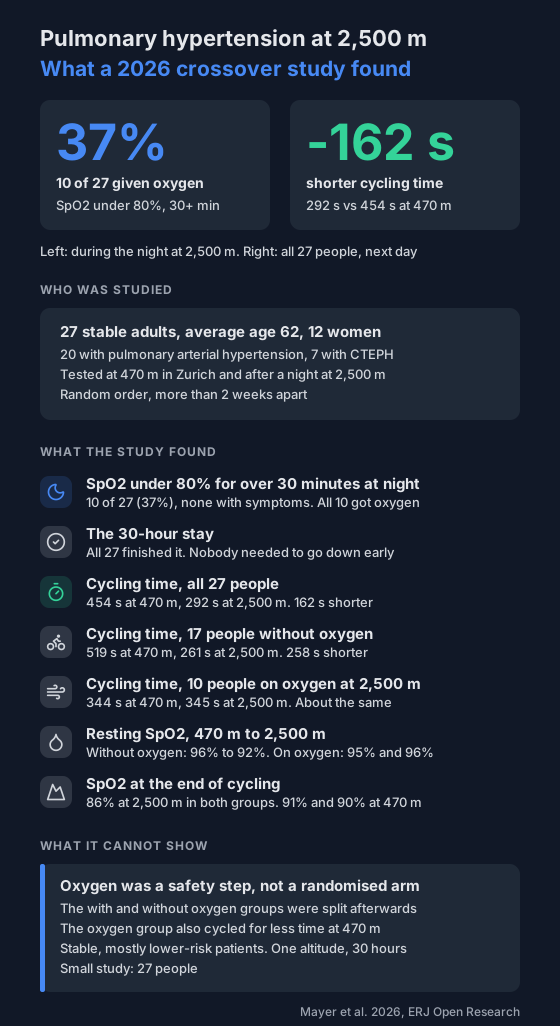
A 2026 crossover study took 27 people with pulmonary vascular disease to 2,500 m for a night. 10 were given oxygen after their SpO2 stayed under 80%, and cycling time the next day was 162 seconds shorter than at 470 m.
People with pulmonary hypertension are often told to be careful with mountain trips. The authors of this study say current guidelines advise against going above 1,500 m if you have symptoms, and there isn't much data on what an overnight stay does.
A 2026 study from Zurich took 27 patients up a mountain for a night and measured it.
Who was studied?
- 27 adults with pulmonary vascular disease, average age 62, 12 of them women.
- 20 had pulmonary arterial hypertension.
- 7 had chronic thromboembolic pulmonary hypertension (CTEPH), the kind linked to old blood clots in the lungs.
- All were stable, with no change to their medication for more than 4 weeks.
- 25 of the 26 with a recorded functional class were in class I or II, the two least limited of the classes.
Each person was tested twice: at 470 m in Zurich, and at 2,500 m on Mount Säntis. The order was random, with more than 2 weeks between the two. The stay at 2,500 m lasted about 30 hours and included one night.
How many were given oxygen overnight?
The study had a safety rule set in advance. Anyone whose SpO2 stayed under 80% for more than 30 minutes got oxygen at 3 litres a minute through a nasal cannula for the rest of the stay.
- 10 of the 27 (37%) met that rule during the night.
- None of them had symptoms from it.
- All 27 finished the stay, and nobody had to go down early.
Low oxygen at night with no symptoms is the pattern you only see on a recording. For what altitude does to readings in general, see blood oxygen at altitude.
What happened to exercise the next day?
The test was cycling at 75% of each person's peak work rate until they had to stop.
| Group | 470 m | 2,500 m | Difference |
|---|---|---|---|
| All 27 | 454 s | 292 s | 162 s shorter |
| 17 without oxygen | 519 s | 261 s | 258 s shorter |
| 10 on oxygen at 2,500 m | 344 s | 345 s | 1 s longer, not statistically significant |
- Across everyone, cycling time was 36% shorter at 2,500 m.
- The 10 people on oxygen cycled for about as long as they had at 470 m.
- Individual results varied: 6 of those 10 cycled longer at 2,500 m than at 470 m, and 2 cycled more than 105 seconds less.
- On a one-minute sit-to-stand test, the paper reports no difference in repetitions between the two altitudes, with or without oxygen.
And oxygen levels?
At rest:
- Without oxygen, SpO2 went from 96% at 470 m to 92% at 2,500 m.
- On oxygen, it was 95% at 470 m and 96% at 2,500 m.
At the end of cycling:
- Without oxygen, SpO2 was 91% at 470 m and 86% at 2,500 m.
- On oxygen, it was 90% at 470 m and 86% at 2,500 m.
So the oxygen group still dropped to 86% during exercise. Their drop from rest to the end of cycling was larger at 2,500 m than at 470 m: 10.7 points against 5.4 (the paper's Table 6). The authors put that down to the low flow rate and breathing through the mouth while cycling.
What can't it show?
- Oxygen wasn't randomised. It was a safety step, and the authors split the results by it afterwards. The study wasn't designed to test what oxygen does.
- The two groups were different to begin with. The people who ended up on oxygen cycled for less time at 470 m too (344 s against 519 s).
- Stable patients only. Most were in a lower-risk class, and the authors say the results don't carry over to unstable or high-risk patients.
- Small. 27 people from one clinic, one altitude, one night.
- Low readings only. The authors say it isn't known whether people with smaller overnight dips would get the same result from oxygen.
- Funding. The Swiss National Science Foundation paid for the trial. Three authors report grants or fees from drug or device companies, which they describe as outside this work.
What can you do with it?
- Know that in this group, more than a third had long stretches under 80% at night without feeling anything.
- If you record overnight at altitude, compare it with a night at home rather than reading it on its own. Sleep and breathing on the first nights at altitude covers what changes.
- Whether to travel to altitude with pulmonary hypertension, and whether to use oxygen there, is a decision for you and your specialist team.
- Flying raises the same question: see blood oxygen on flights.
Not a medical device. Does not diagnose, treat or prevent any condition. Discuss results and changes with a clinician.
References
- Mayer L, Schneider SR, Röösli A, Müller J, Bauer M, Carta A, Furian M, Bloch KE, Schwarz EI, Lichtblau M, Ulrich S. The effect of high altitude on exercise capacity and cardiorespiratory function in patients with pulmonary vascular disease after an overnight stay at 2500 m: a randomised crossover study. ERJ Open Research. 2026;12(3):01139-2025. doi:10.1183/23120541.01139-2025