What Happens to Blood Oxygen on a Flight?
Why your SpO2 reads lower in an airliner cabin, how much lower studies have measured, and how to record a flight yourself.
Wear a pulse oximeter on a plane and you'll probably see a lower number than you get at home. That's expected. The cabin isn't kept at sea level pressure.
How high is the cabin?
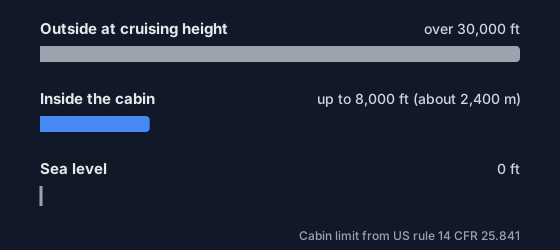
Airliners cruise at well over 30,000 feet, but the cabin is pressurized. US aviation rules require the cabin to stay at or below the equivalent of 8,000 feet in ordinary operation. That's about 2,400 m, similar to a high ski resort.
Some newer aircraft are built to hold a lower cabin altitude than that. The airline or the maker's spec sheet will say.
What does that do to your SpO2?
Lower air pressure means less oxygen gets into your blood with each breath. One study measured airline passengers on the ground and again at cruising altitude.
- On the ground, their average was 97%.
- At cruise, it was 93%.
- Just over half of them were at 94% or below.
So a drop of a few points is common in people who feel fine. Your number will depend on the aircraft, the flight and you. We explained the pressure effect in blood oxygen at altitude, and you can try your own figures in the altitude oxygen tool.
What if you sleep on the plane?
Most people read a little lower asleep than awake. On a long flight that stacks on top of the cabin effect, so your lowest readings will probably come while you doze. Expect your T90 to be higher than on a night at home. That makes a flight a poor match for your usual nights, so don't mix them into your averages.
Who should talk to a doctor before flying?
If you have a lung or heart condition, or you use oxygen at home, ask your doctor before you book. They can tell you whether you need anything arranged for the flight. Don't use a ring to decide that yourself.
And if you feel breathless, dizzy or unwell on board, tell the cabin crew. Don't wait for a number.
How do you record a flight?
- Take a reading at the gate first, so you have a ground figure from the same day.
- Check your airline's rules on Bluetooth devices.
- Keep your hand warm and still. Cabins are cold, and cold fingers read low.
- Note the time of takeoff and landing, so you can find them on the chart later.
In PulseOxTracker you can tag the recording as a flight, so it's easy to tell apart from your nights at home.
Not a medical device. Does not diagnose, treat or prevent any condition. Discuss results and changes with a clinician.
References
- US Code of Federal Regulations. 14 CFR 25.841, Pressurized cabins. ecfr.gov
- Humphreys S, Deyermond R, Bali I, Stevenson M, Fee JPH. The effect of high altitude commercial air travel on oxygen saturation. Anaesthesia. 2005;60:458-460. doi:10.1111/j.1365-2044.2005.04124.x