How Common Is Altitude Sickness?
A 2026 meta-analysis pooled 58 studies and 2,705 people. About 48% had acute mountain sickness, and the rate was higher at greater altitude and after a faster ascent.
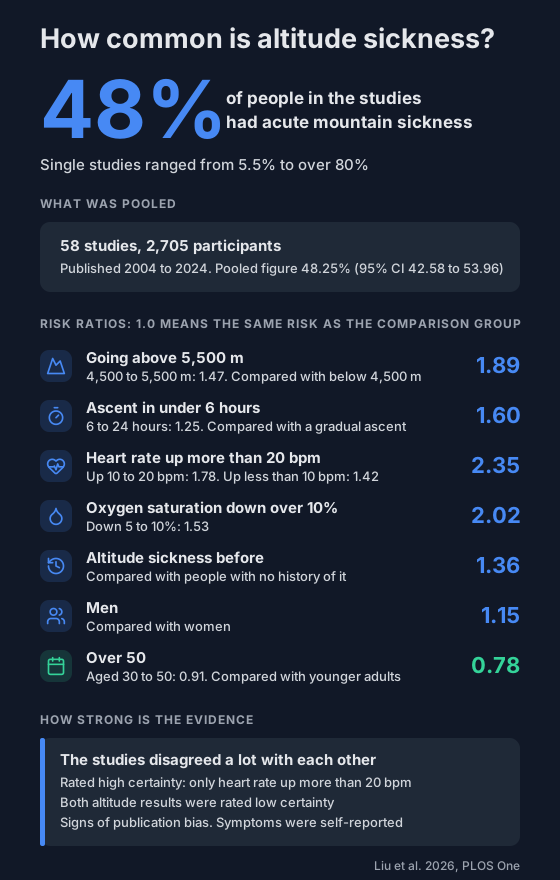
Reported rates of acute mountain sickness run from about 1 in 20 people to more than 4 in 5. A 2026 meta-analysis in PLOS One pooled 58 studies to get one figure, and looked at who gets it more often.
How common is it?
- The pooled figure was 48.25%.
- The 58 studies covered 2,705 people and were published from 2004 to 2024.
- Most used a Lake Louise symptom score. Symptoms include headache, nausea, vomiting, dizziness, fatigue and poor sleep.
The studies were small, 10 to 170 people each. It isn't the rate for every mountain trip.
Who got it more often?
The review reports risk ratios, where 1.0 means the same risk as the comparison group.
- Altitude. Above 5,500 m: 1.89, and at 4,500 to 5,500 m: 1.47, both against below 4,500 m.
- Speed of ascent. Under 6 hours: 1.60, and 6 to 24 hours: 1.25, both against a gradual ascent.
- Past altitude sickness. 1.36 against no history of it.
- Men. 1.15 against women.
Who got it less often?
Older people. Over-50s had a risk ratio of 0.78 against younger adults, and people aged 30 to 50 had 0.91. The authors say the reason needs more research.
What about heart rate and oxygen?
- Heart rate up more than 20 bpm: 2.35.
- Oxygen saturation down more than 10%: 2.02.
The paper doesn't say what the change was measured from, or when. It also says the link runs both ways: the changes can follow the illness as well as come before it. So this doesn't show that a reading tells you in advance who'll get sick. Two smaller studies looked at that: overnight oxygen and altitude sickness and predicting it from oximetry.
How strong is the evidence?
- The studies disagreed a lot (I² = 82.3%).
- There were signs of publication bias.
- Only the heart rate result above 20 bpm was rated high certainty. Both altitude results were rated low.
- Symptoms were self-reported, and there's no objective test for acute mountain sickness.
- Every included study was published in English.
What can you do with this?
The authors point to existing guidance to go up in stages: above 2,500 m, gain no more than 300 m a day. They also suggest watching heart rate and oxygen saturation, but the review didn't test that.
Everyone's oxygen reads lower at altitude, so a lower number alone doesn't mean you're ill. If you feel unwell up high, don't go higher, and get medical help if it gets worse.
Not a medical device. Does not diagnose, treat or prevent any condition. Discuss results and changes with a clinician.
References
- Liu X, Tan L, Ren Z, Bai X, Yong S, Gao H, Ba S, Gongga L. Prevalence and risk factors for AMS: A systematic review and meta-analysis. PLOS One. 2026;21(4):e0345796. doi:10.1371/journal.pone.0345796