Sleeping on a Flight: Oxygen Below 90%
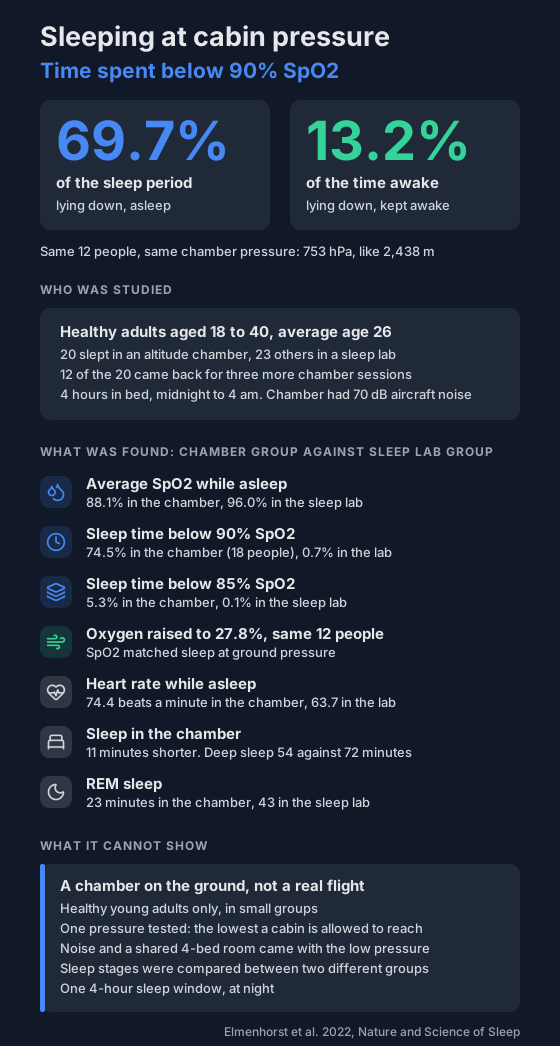
In a chamber set to airliner cabin pressure, 12 healthy adults spent about 70% of the sleep period below 90% SpO2, against 13% of the time when kept awake. With added oxygen, SpO2 matched ground level.
Your SpO2 reads a few points lower in an airliner cabin than on the ground. We covered why in blood oxygen on flights.
A 2022 study from the German Aerospace Center looked at what happens when you fall asleep there. Awake, healthy people mostly stayed above 90%. Asleep in a chamber set to cabin pressure, they spent most of the time below it.
Who was studied?
- 48 healthy adults aged 18 to 40 were enrolled, and 43 were analysed.
- 20 slept in an altitude chamber set up as a four-bed crew rest room.
- 23 others slept in a quiet sleep lab at 53 m above sea level.
- Everyone had a first night in the lab to rule out sleep apnea.
The chamber was held at 753 hPa. That equals 2,438 m, or 8,000 feet, the highest cabin altitude the rules allow. A recording of aircraft noise played at 70 dB.
Each person got 4 hours in bed, from midnight to 4 am. That short night was one part of a larger sleep-loss experiment. The researchers picked that length to match a crew rest break on a long flight.
12 of the 20 chamber sleepers came back for three more sessions in the chamber:
- Sleep at ground pressure.
- Sleep at cabin pressure with the oxygen raised from 21% to 27.8%.
- 4 hours lying down at cabin pressure, kept awake.
They weren't told which pressure or oxygen level they were getting.
How low did SpO2 go during sleep?
In the first part of the study, with 18 chamber sleepers and 23 in the lab:
- Average SpO2 while asleep was 88.1% in the chamber and 96.0% in the lab.
- The chamber group spent 74.5% of their total sleep time below 90%. The lab group spent 0.7%.
- The chamber group spent 5.3% of their total sleep time below 85%. The lab group spent 0.1%.
- While they were still falling asleep, the chamber group averaged 90.4%.
The readings were steady, not a string of sharp dips. SpO2 crossed below 90% about 53 times in 4 hours on average, and its standard deviation was 1.8 points.
Time below 90% is the figure your oximeter report calls T90.
Was it sleep, or just the cabin?
The 12 people who came back help answer that, because the pressure was the same and they were kept awake instead of sleeping. Their sleep figures here come from their first chamber night. The paper reports them as a share of the sleep period, not of total sleep time, so they don't line up exactly with the 74.5% above.
- Asleep at cabin pressure: 69.7% of the sleep period below 90%, and 6.2% below 85%.
- Awake at cabin pressure: 13.2% of the time below 90%, and 0.6% below 85%.
Lying awake at cabin pressure still read lower than sleeping at ground pressure. But the average stayed above 90%.
The authors conclude that sleep itself makes the cabin's effect on blood oxygen much larger.
What did adding oxygen do?
With the oxygen at 27.8%, the chamber held the same amount of oxygen as air on the ground, at the same low pressure.
- SpO2 during sleep matched sleep at ground pressure, with no statistically significant difference.
- Heart rate during sleep was 67.6 beats a minute, the same as at ground pressure. At cabin pressure without added oxygen it was 76.2.
The authors suggest oxygen-enriched cabin air as something airlines could use for crew rest. No sleep stage data came from these sessions because of a recording fault, so the study can't say whether the added oxygen changed sleep.
Did they sleep worse?
Sleep recordings were usable for 19 people in the chamber group and 22 in the lab group. Compared with the lab group, the chamber group had:
- 11 minutes less sleep: 204 against 215 minutes.
- Less deep sleep: 54 against 72 minutes.
- Less REM sleep: 23 against 43 minutes.
- More light (N2) sleep: 120 against 89 minutes.
- More awakenings: 8.0 against 5.3.
- Lower sleep efficiency: 73.2% against 85.7%.
- Fewer brief arousals: 14.8 against 20.0.
- A higher heart rate while asleep: 74.4 against 63.7 beats a minute.
They rated their sleep as less calm. Their sleepiness the next morning was high in both groups, with no statistically significant difference between them.
What can't it show?
- It was a chamber on the ground, not a real flight.
- Everyone was young and healthy. The authors expect larger effects in older people and in people with sleep apnea or lung disease, but they didn't test that.
- Only one pressure was tested, and it's the lowest a cabin is allowed to reach.
- The low pressure came with aircraft noise and a shared room. The lab was quiet with private rooms. So the study can't separate how much of the worse sleep came from low oxygen.
- The sleep comparison was between two different groups of people.
- It tested one 4-hour sleep window at night, inside a larger sleep-loss experiment. It says nothing about a full night or a daytime nap on a plane.
- The groups were small. Four chamber recordings were dropped because the chamber overheated, and two more lost their oxygen data.
What can you do with this?
- In this chamber study the low readings came during sleep. If you record a flight, compare the stretch where you slept with the stretch where you were awake.
- The study tested the lowest cabin pressure the rules allow, in a chamber. Your numbers on a real flight may not match it.
- Keep flight recordings out of your usual averages.
- A night flight is one night at altitude with no time to adapt. For what the first nights look like, see sleep breathing in the first nights at altitude.
- If you have a heart or lung condition, sleep apnea, or use oxygen at home, ask your doctor before a long flight.
- If you feel unwell on board, tell the cabin crew. Don't wait for a number.
Not a medical device. Does not diagnose, treat or prevent any condition. Discuss results and changes with a clinician.
References
- Elmenhorst EM, Rooney D, Benderoth S, Wittkowski M, Wenzel J, Aeschbach D. Sleep-Induced Hypoxia under Flight Conditions: Implications and Countermeasures for Long-Haul Flight Crews and Passengers. Nature and Science of Sleep. 2022;14:193-205. doi:10.2147/NSS.S339196