Oxygen Dips in the First Nights at Altitude
A 2021 study tracked 15 healthy adults at sea level and over three nights at 3,800 m. Oxygen dips per hour went from 3.1 to 34.3 on night one, then eased to 7.2 by night three.
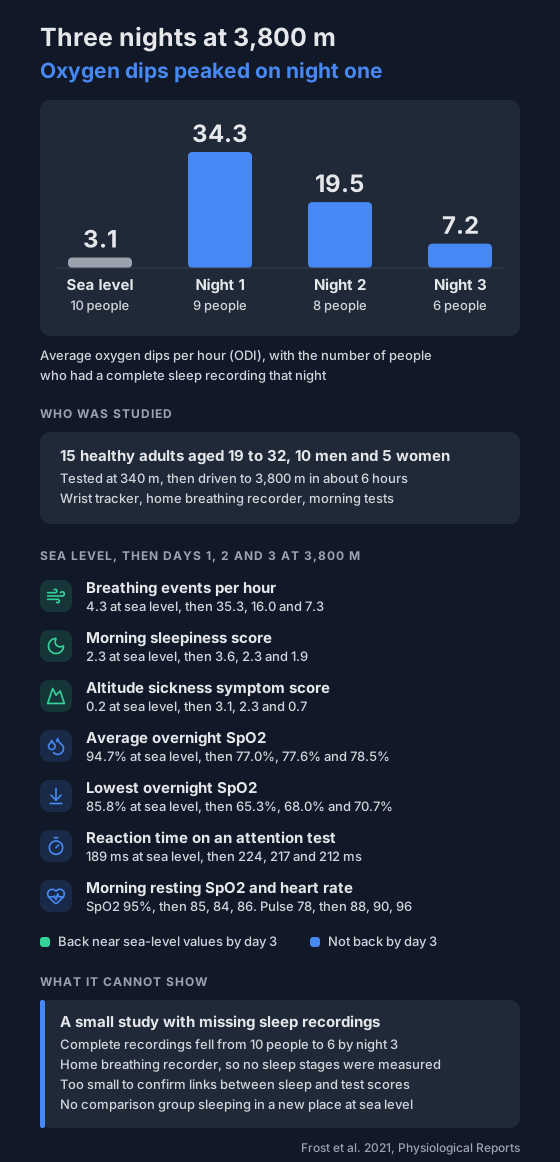
People often sleep badly on their first night at altitude. A 2021 study measured how much of that eases over the next two nights, and whether thinking speed recovers with it.
For the basics, see blood oxygen at altitude.
Who was studied?
- 15 healthy adults aged 19 to 32, 10 men and 5 women.
- They were tested near sea level (340 m), then driven up to a research station at 3,800 m in about 6 hours.
- They stayed three nights.
- Each night they wore a wrist activity tracker and a home breathing recorder with a pulse oximeter.
- Each morning they had resting SpO2, pulse and blood pressure taken, answered sleep and altitude sickness questions, and did a 30-minute set of eight thinking tests on a tablet.
Not everyone has a complete sleep recording: 10 people at sea level, 9 on night one, 8 on night two and 6 on night three.
What happened to oxygen dips?
They jumped on night one and eased after that. The oxygen desaturation index (ODI) is the number of oxygen dips per hour.
- Sea level: 3.1 an hour.
- Night one: 34.3.
- Night two: 19.5.
- Night three: 7.2.
Each average covers only the people with a complete recording that night, so the groups are not identical.
Breathing events per hour followed the same path: 4.3, then 35.3, 16.0 and 7.3. The night-one rise came mostly from shallow breathing and central pauses, where breathing stops with no effort to breathe.
Only the night-one rise was statistically significant. Nights two and three were not significantly different from sea level.
Did overnight oxygen come back up too?
No. The dips eased, but the overall level stayed low.
- Average overnight SpO2: 94.7% at sea level, then 77.0%, 77.6% and 78.5%.
- Lowest overnight SpO2: 85.8% at sea level, then 65.3%, 68.0% and 70.7%.
- Morning resting SpO2: 95% at sea level, then 85%, 84% and 86%.
- Morning resting pulse: 78 at sea level, then 88, 90 and 96 beats a minute.
So fewer dips per hour did not mean a higher average.
How did people feel?
Worst after the first night.
- Morning sleepiness score: 2.3 at sea level, 3.6 after night one, then 2.3 and 1.9.
- The sleep disturbance score followed the same pattern: 15.3 at sea level, then 27.3, 20.9 and 15.2.
- Altitude sickness symptom score: 0.2 at sea level, then 3.1, 2.3 and 0.7.
- Time awake during the night was 35 minutes at sea level, then 58, 76 and 44 minutes. Those changes were not statistically significant after correcting for the number of tests.
What about thinking speed?
Reaction time on an attention test was slower at altitude and was still slower on day three.
- The results table gives 189 ms at sea level, then 224, 217 and 212 ms. The abstract prints 199 ms for sea level.
- The day-three difference was statistically significant after correction. Days one and two were not.
- Lapses and false starts on that test did not change significantly.
On a risk-taking game, people clicked faster each day: 474 ms at sea level, then 376, 297 and 267 ms. The authors say that could mean more risk-taking, or just practice. People who did their sea-level test after the trip were faster on it than those who did it before (340 ms against 608 ms).
The other six tests showed no significant change.
Was poor sleep behind the slower reactions?
The study points that way but couldn't confirm it.
On the morning after night one:
- People who reported worse sleep had slower reaction times and more lapses.
- Morning SpO2 was not linked to the score on any test.
- People with more oxygen dips did better on a visual learning test, which the authors did not expect.
The team ran 208 of these comparisons. The authors say the study was too small to confirm the links after correcting for that many, and that they need more research.
What can't it show?
- It's a small study of healthy young adults at one altitude.
- Only 6 people had a complete recording on night three.
- The breathing recorder is a home device, so sleep stages weren't measured.
- There was no comparison group, so sleeping in an unfamiliar place may account for some of the poor sleep.
- Practice may have affected some test scores.
- The authors cite other studies in which breathing during sleep did not settle at altitudes above 4,500 m.
- The paper discloses that ResMed, which makes the breathing recorder, gave a philanthropic donation to UC San Diego, and that one author held a research fellowship carrying its name.
What can you do with this?
If you record your overnight oxygen on a trip, expect night one to look different from nights two and three.
- Record a few nights at home first, so you have your own baseline.
- Compare each night at altitude with that baseline, and look at dips per hour and average SpO2 separately.
- If you feel unwell at altitude, follow local medical advice. Don't wait for a number.
More on this: overnight oxygen and altitude sickness.
Not a medical device. Does not diagnose, treat or prevent any condition. Discuss results and changes with a clinician.
References
- Frost S, Orr JE, Oeung B, Puvvula N, Pham K, Brena R, DeYoung P, Jain S, Sun S, Malhotra A, Heinrich EC. Improvements in sleep-disordered breathing during acclimatization to 3800 m and the impact on cognitive function. Physiological Reports. 2021;9(9):e14827. doi:10.14814/phy2.14827