Insomnia and Altitude Sickness: A Small Study
15 students rated their sleep a week before a climb. The 10 who got acute mountain sickness had a higher sleep-complaint score at home: 7.7 out of 24, against 5.2.
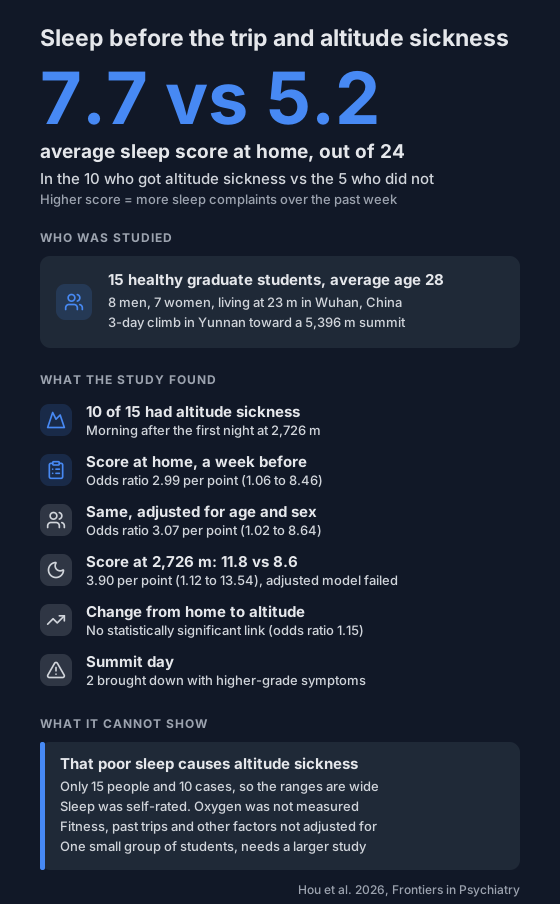
Sleep often gets worse at altitude, and people with acute mountain sickness tend to sleep badly. That makes it hard to tell which comes first. A 2026 study from China asked a different question: does how you slept at home, before the trip, go with who gets sick?
In 15 people, it did. But that's a very small group, and only 10 of them got sick, so read this as an early hint.
Who was studied?
- 15 healthy, non-smoking graduate students from a university in Wuhan, China, which sits at 23 m.
- 8 men and 7 women, average age 28.
- None had been to high altitude in the previous 3 months, and none took medication.
- They did 5 weeks of running and strength training before the trip.
The climb took 3 days in Yunnan, China:
- Day 1: driven up to a village at 2,726 m and slept there.
- Day 2: hiked to a base camp at 4,100 m and slept in tents.
- Day 3: set off at 3am for the 5,396 m summit, then came back down.
What was measured?
- Sleep complaints. The Athens Insomnia Scale, an 8-item self-rated checklist scored 0 to 24. It covers falling asleep, waking in the night, waking early, total sleep, sleep quality, and daytime mood, functioning and sleepiness. A higher score means more complaints. People rated the past week.
- When. Once at home a week before leaving, then each morning on the trip.
- Altitude sickness. The 2018 Lake Louise score, each morning. A score of 3 or more with a headache counted as acute mountain sickness.
The main analysis used the morning after the first night at 2,726 m.
No oxygen, pulse or sleep recording was taken. Everything was self-rated.
What did it find?
10 of the 15 had acute mountain sickness that morning. 9 were in the lowest band of the score and 1 was in the highest.
Average sleep scores, out of 24:
- At home: 7.7 in those who got sick, 5.2 in those who didn't.
- At 2,726 m: 11.8 against 8.6.
- On summit day: 13.4 against 12.0.
What that means in odds:
- Home score. Each extra point went with about 3 times the odds of getting sick (odds ratio 2.99, range 1.06 to 8.46).
- Home score, adjusted for age and sex. Much the same: 3.07, range 1.02 to 8.64.
- Score at altitude. Each extra point went with 3.90 times the odds (range 1.12 to 13.54). It couldn't be adjusted for age and sex, because the model broke down: in so few people, the altitude score split the two groups too cleanly to estimate.
- Change from home to altitude. How much worse sleep got on the trip had no statistically significant link with getting sick (odds ratio 1.15).
So both scores went with altitude sickness. The home score is the one that held up after adjusting for age and sex. That doesn't mean it mattered more than sleep at altitude: the altitude score's odds ratio was higher, and the study couldn't test it the same way.
What happened on summit day?
- 10 people met the cut-off for altitude sickness on day 3, and the average score roughly doubled.
- 2 people had high scores during the summit push and were taken down to base camp by guides.
- After 6 to 12 hours of rest lower down, both scores dropped to the lowest band.
The authors say day 3 mixes altitude with a 3am start and hard exercise, so they didn't use it for the main analysis.
What can't it show?
- A firm answer. 15 people and 10 cases is very few. The ranges around each odds ratio are wide, so the true effect could be much smaller or larger.
- Cause. It's an observational study. Poor sleep at home may go along with something else, like stress or fitness, that the study didn't measure.
- Other factors. Only age and sex were adjusted for. Fitness, past altitude trips, weight, ascent speed and infections weren't.
- Other people. Everyone was a young, fit graduate student on one fast climb.
- Precise timing. The checklist covers the past week, so the score on day 2 also includes nights before the trip.
- Sleep on the trip. Everyone had the same fixed bedtime and wake time, which the authors say may have shaped the altitude scores.
- Oxygen. Nobody's SpO2 was recorded, so the study says nothing about overnight oxygen.
The authors say a larger, more varied study is needed before the result can be relied on. They declared no commercial ties.
What can you do with this?
The authors suggest that checking sleep before a high-altitude trip could be worth adding to pre-trip health checks. That's their view, and a study this small can't settle it.
If you're heading up, two other studies looked at overnight oxygen directly:
- Overnight oxygen and altitude sickness compared overnight oxygen in 112 people with and without it at 3,810 m.
- Predicting altitude sickness with oximetry asked whether one night of oximetry at 2,600 m could flag it early, in 20 trekkers.
An overnight oximeter can log your SpO2 and pulse at home and on the trip, so you can see how your oxygen changes with altitude. It won't tell you whether you'll get altitude sickness. If you have symptoms, follow your guide's or doctor's advice.
Not a medical device. Does not diagnose, treat or prevent any condition. Discuss results and changes with a clinician.
References
- Hou S, Jiang J, Huang Y, Liang Y, Zhou X, Li L. The independent predictive effect of insomnia symptoms before high-altitude exposure on acute mountain sickness: an observational study of healthy volunteers at 2726 m. Frontiers in Psychiatry. 2026;17:1765494. doi:10.3389/fpsyt.2026.1765494