Oxygen Sessions and Sleep at High Altitude
A 2026 survey of 1,316 military personnel at high-altitude posts in China found more frequent and longer oxygen sessions went with fewer sleep difficulties. The links were small, and the study cannot show cause.
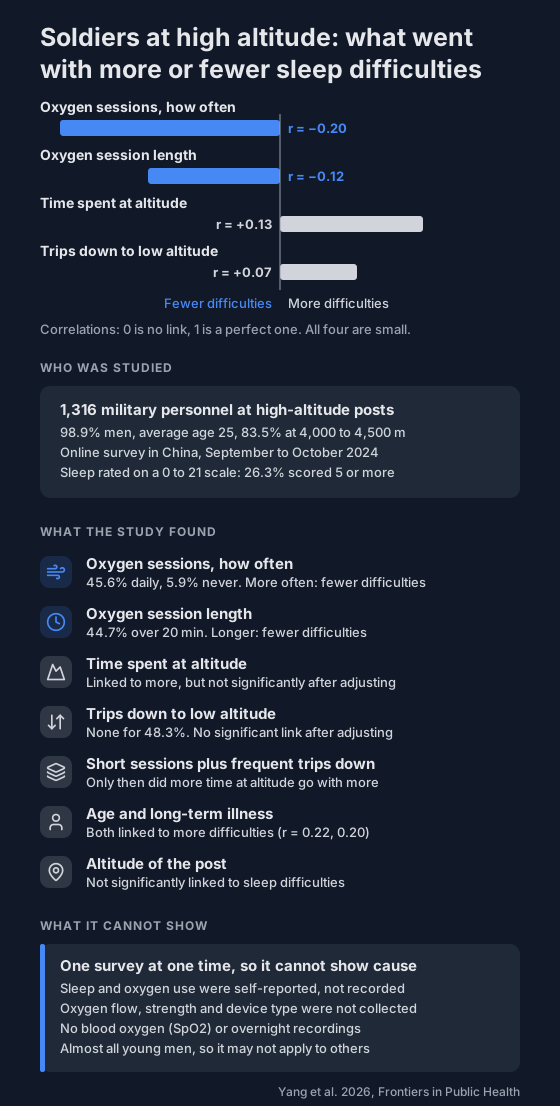
Sleep at high altitude is often poor, and lower oxygen is one of the main reasons. Many high-altitude posts have oxygen on hand, from cylinders, bags, concentrators or a piped supply. A 2026 survey asked 1,316 military personnel how often they used it, how long each session lasted, and how they slept.
Who was in the study?
- 1,316 military personnel stationed at high altitude in China.
- 98.9% were men, aged 18 to 45, with an average age of 25.
- 83.5% were posted at 4,000 to 4,500 m.
- 35.1% were at high altitude for the first time, and 40.3% had spent 1 to 6 months there in total.
- They filled in an online survey between September and October 2024.
Sleep was rated with a standard sleep questionnaire covering the past month, scored from 0 to 21. Higher means worse sleep. 26.3% scored 5 or more, the cut-off the authors used for sleep difficulties.
What went with fewer sleep difficulties?
Using oxygen more often, and for longer each time.
- 45.6% used oxygen daily, and 5.9% never did.
- 44.7% used it for more than 20 minutes a session, and 11.1% for under 5 minutes.
- How often they used it had a correlation of -0.20 with sleep difficulties.
- Session length had a correlation of -0.12.
- Both links held after adjusting for age, long-term illness, first time at altitude, time at altitude and trips down.
A correlation runs from 0, no link, to 1 or -1, a perfect one. These are small.
What went with more?
- More time spent at altitude in total: correlation 0.13.
- More trips down to low altitude, for more than 3 days at a time: correlation 0.07.
- Older age: 0.22.
- A long-term illness such as asthma, high blood pressure or sleep apnea: 0.20.
After adjusting for age and the other factors, time at altitude and trips down were no longer significantly linked to sleep on their own. How high the post was wasn't significantly linked to sleep.
For more on going up and down, see whether SpO2 is higher on a second altitude trip.
Did the factors combine?
In one pattern, yes. When the authors modelled short oxygen sessions together with frequent trips down, more time at altitude went with more sleep difficulties. In every other combination, the link wasn't significant. The pattern showed up for session length, not for how often people used oxygen.
The authors suggest repeated trips may interrupt adjustment to altitude, and short sessions may not keep oxygen up for long enough. The study didn't test either idea.
What can't it show?
The authors list these limits:
- Cause. It's a single survey, so it shows what went together, not what caused what.
- Self-report. Sleep, oxygen use and trips were all from the questionnaire. Nobody's sleep or blood oxygen was recorded.
- Oxygen dose. Flow rate, oxygen strength and the type of device weren't collected.
- Who. Almost all were young men. The results may not apply to women, older adults or civilians.
- Trips. The reasons for each trip down and how long people stayed weren't captured.
The paper also doesn't say when the oxygen sessions happened, so it isn't clear how many were at night.
What can you do with this?
If you live or work at altitude, a questionnaire tells you how you felt about your sleep. An overnight oximeter records what your SpO2 and pulse actually did.
- Read blood oxygen at altitude for what readings to expect up high.
- See how workers on week-long shifts at 2,950 m slept on their first nights against later ones.
- See what happened when workers slept in a pressurised room.
Whether and how you use extra oxygen is a decision for you and your doctor.
Not a medical device. Does not diagnose, treat or prevent any condition. Discuss results and changes with a clinician.
References
- Yang Q, Liu Y, Xu C, Li F, Yan X, Zong X, Peng L. Sleep quality among military personnel exposed to high altitude: a cross-sectional study of oxygen supplementation and altitude transition. Frontiers in Public Health. 2026;14:1854316. doi:10.3389/fpubh.2026.1854316