Sleep at High Altitude: A Firefighter Study
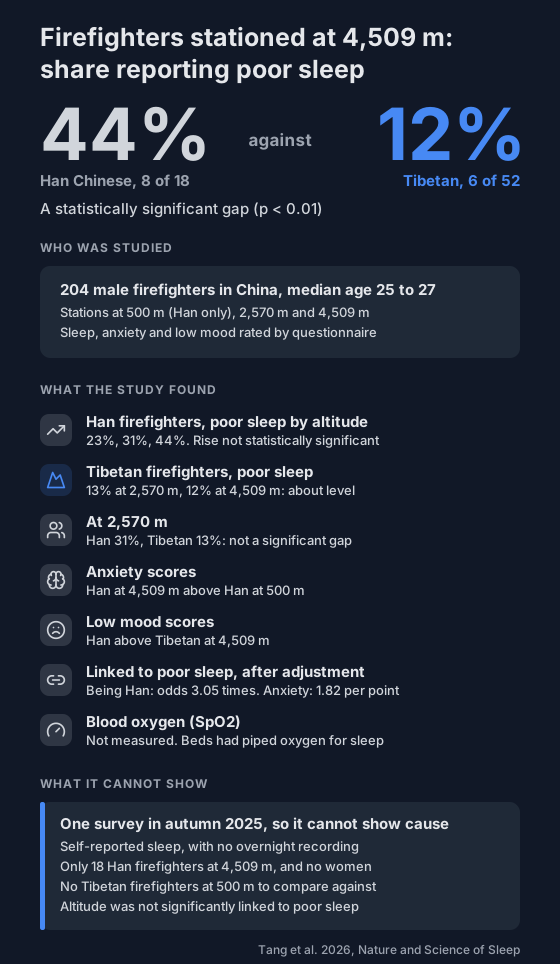
A 2026 study surveyed 204 firefighters in China at 500 m, 2,570 m and 4,509 m. At 4,509 m, 44% of Han Chinese firefighters reported poor sleep, against 12% of Tibetan firefighters.
Sleep often gets worse when you go high, and your overnight oxygen reads lower up there. Tibetans, whose families have lived high for generations, are known to cope with altitude better than people from the lowlands.
A 2026 study asked whether that shows up in how firefighters say they sleep. At the highest station, Han Chinese firefighters were far more likely than Tibetan firefighters to report poor sleep.
Who was studied?
- 204 male firefighters at three fire and rescue stations in southwest China, surveyed in September and October 2025.
- 500 m (Chengdu): 60 Han Chinese firefighters. There were no Tibetan firefighters at this station.
- 2,570 m (Kangding): 36 Han Chinese and 38 Tibetan firefighters.
- 4,509 m (Nagqu): 18 Han Chinese and 52 Tibetan firefighters.
- Median ages were 25 to 27, and the groups had similar BMI and smoking rates.
- At the two high stations, everyone had been there at least a month and had no heart or lung disease.
They live, train and sleep at the station on the same daily routine. At the high-altitude stations, every dormitory bed has a piped oxygen supply they can breathe from during rest and overnight.
Each firefighter filled in three standard questionnaires: one on sleep quality, one on anxiety and one on low mood. A sleep score above 5 out of 21 counted as poor sleep. The authors report no conflicts of interest.
Did Han firefighters sleep worse higher up?
The share reporting poor sleep went up with each station:
- 500 m: 23% (14 of 60)
- 2,570 m: 31% (11 of 36)
- 4,509 m: 44% (8 of 18)
The paper reports none of those differences as statistically significant. The closest was 500 m against 4,509 m (p = 0.08). The median sleep scores were 4, 4 and 5, also not a significant difference.
And Tibetan firefighters?
Their numbers barely moved:
- 2,570 m: 13% reported poor sleep (5 of 38), median score 4.
- 4,509 m: 12% (6 of 52), median score 3.
Where was the gap significant?
- At 4,509 m: 44% of Han against 12% of Tibetan firefighters reported poor sleep, and their median scores were 5 against 3. Both gaps were statistically significant.
- At 2,570 m: 31% against 13%, with the same median score. That gap was not significant.
After adjusting for age, BMI, drinking and anxiety scores, Han firefighters at the two high stations had 3.05 times the odds of poor sleep (95% CI 1.21 to 7.67). The authors say the small sample makes that estimate imprecise, so read it with caution.
Where do anxiety and low mood come in?
Scores were low overall: median scores were 0 to 2 in every group.
- Anxiety: Han scores at 4,509 m were significantly higher than at 500 m. Han scores were significantly higher than Tibetan scores at 2,570 m, but not at 4,509 m.
- Low mood: Han scores were significantly higher than Tibetan scores at 4,509 m. Tibetan scores barely changed between stations.
At the high stations, worse sleep scores went with higher anxiety and low mood scores. After adjustment, each extra point on the anxiety questionnaire went with 1.82 times the odds of poor sleep (95% CI 1.33 to 2.48). Low mood scores were left out of the adjusted model: in the paper's table they weren't significantly linked to poor sleep on their own (p = 0.20), though the text says they were.
The authors cite earlier work that the link between anxiety and sleep runs both ways.
For more on mood at this height, see mood and thinking at 4,500 m.
What about blood oxygen?
The study didn't measure SpO2 or record anyone overnight. Sleep was self-reported only.
The authors point to earlier research where Tibetans kept better sleep and oxygen levels than Han Chinese at altitude, and to hypoxia as the main driver of poor sleep up high. This study didn't test that.
The piped oxygen at each bed may matter too, but the paper doesn't say how much the firefighters used it.
What can't it show?
- Cause. It's a cross-sectional study: one survey, at one time. It shows what went together, not why.
- Altitude as a factor. Being at 4,509 m rather than 2,570 m was not significantly linked to poor sleep (p = 0.81). The authors think the altitude range may have been too narrow.
- Small groups. Only 18 Han firefighters were at 4,509 m.
- A full comparison. There were no Tibetan firefighters at 500 m.
- Like for like. 90% of the firefighters at 500 m had under a year of service, against about a third at the high stations.
- Time at altitude. Han firefighters at 4,509 m had spent less time up high than the Tibetans there: a median of about 1 year against 2.
- Objective sleep. No overnight sleep recording, and self-report can be biased.
- Women. All participants were men.
For a study that did record sleep at altitude, see sleep of high-altitude workers.
What can you do with this?
If you spend time at altitude and want to see your own nights:
- Record your overnight oxygen and pulse, and note the altitude and the night of your trip each time.
- Check the expected SpO2 range for your altitude.
- Log how you slept and how you felt the next day alongside it.
- Record more than once. Here's how many nights to record.
If you're sleeping badly at altitude or feeling anxious or low, talk to a doctor. You can share your recordings with them.
Not a medical device. Does not diagnose, treat or prevent any condition. Discuss results and changes with a clinician.
References
- Tang X, Tang L, Li S, Gu X, Li X, Li X, Jiang W, Wang Q, Yang Y. The Sleep Quality of Han Chinese and Tibetan Firefighters at High Altitude: A Field Study. Nature and Science of Sleep. 2026;18:591315. doi:10.2147/NSS.S591315