Mood and Thinking at 4,500 m: First 4 Hours
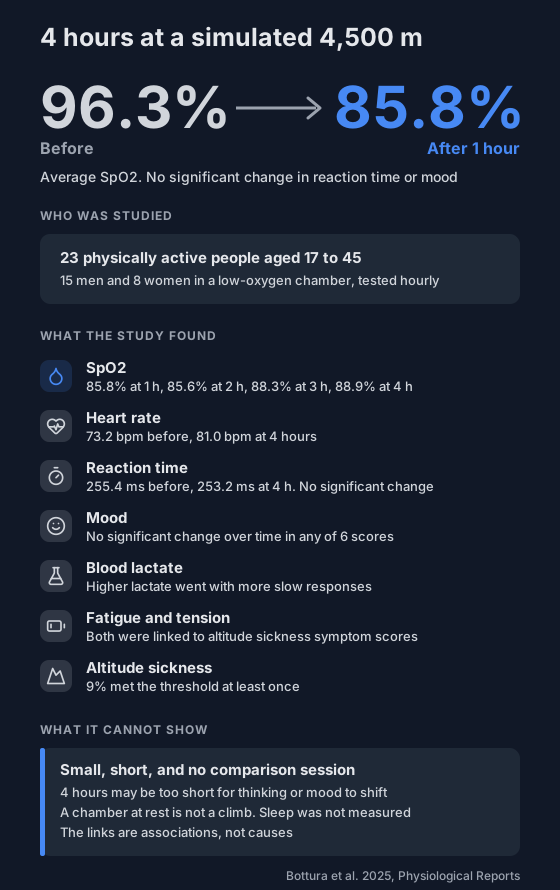
A 2025 study put 23 people in a chamber simulating 4,500 m for 4 hours. SpO2 fell from 96.3% to about 86%, but reaction time and mood did not change significantly.
Thin air at high altitude is known to affect thinking and mood. Most of that research looks at people after many hours or days.
A 2025 study looked at the first 4 hours only. Oxygen levels fell quickly, but reaction time and mood did not change significantly.
Who was studied?
- 23 physically active volunteers: 15 men and 8 women, aged 17 to 45 (average 29).
- None had been above 2,500 m in the previous 6 months.
- They sat in a chamber with reduced oxygen that simulates 4,500 m, for 4 hours.
- Air pressure in the chamber was the same as outside. Only the oxygen level was lowered.
What was measured?
Everything was measured before going in, then after 1, 2, 3 and 4 hours.
- SpO2 and heart rate, with a fingertip pulse oximeter.
- Blood glucose and lactate, from a finger prick.
- Altitude sickness symptoms, with the Lake Louise score.
- Reaction time, with a 3-minute test: press a button as soon as a light comes on. A response slower than 355 ms counted as a "lapse".
- Mood, with a 24-word scale that gives six scores: tension, depression, anger, vigor, fatigue and confusion.
What happened to oxygen and heart rate?
| Before | 1 h | 2 h | 3 h | 4 h | |
|---|---|---|---|---|---|
| SpO2 (%) | 96.3 | 85.8 | 85.6 | 88.3 | 88.9 |
| Heart rate (bpm) | 73.2 | 78.3 | 77.0 | 79.2 | 81.0 |
- SpO2 was significantly lower in the chamber than before.
- Heart rate was significantly higher than before at hours 3 and 4.
For more on these two numbers, see blood oxygen at altitude and heart rate and SpO2 at altitude.
Did thinking or mood change?
Not significantly, in these 4 hours.
- Average reaction time was 255.4 ms before and 253.2 ms at 4 hours.
- Average lapses per test were 0.4 before and 0.1 at 4 hours.
- None of the six mood scores changed significantly over time.
The authors think 4 hours was probably too short. They point to an earlier chamber study where mood shifted after 20 hours.
Did anyone get altitude sickness symptoms?
- The average symptom score was 0.4 before and 0.9 at 4 hours, on a scale where each of five symptoms is rated 0 to 3.
- The paper does not report a significance test for that change.
- 9% of participants met the paper's threshold for acute mountain sickness at least once: a score of 3 or more, with a headache.
What went together?
The authors pooled all the readings and looked for measurements that moved together.
- Lactate and lapses: readings with higher blood lactate came with more lapses.
- SpO2 and heart rate: neither was significantly linked to lapses or to reaction time.
- Fatigue and symptoms: higher fatigue scores came with higher altitude sickness symptom scores.
- Tension and symptoms: the two were significantly linked, but the paper is unclear on the direction. The text says more tension came with more symptoms. The results table gives a negative figure, which points the other way. Average tension was highest before entering the chamber (2.0) and fell to 0.5 by hour 4.
So in this study, lower SpO2 readings did not go with slower responses.
What can't it show?
The paper has no limitations section. The authors do say this:
- 4 hours is short, and may not be long enough for thinking or mood to shift. They note altitude sickness symptoms can first appear within 6 hours.
- Sleep was not measured. They say other studies tie early changes in thinking partly to disrupted sleep.
These points come from the methods, not from the authors:
- It is small: 23 people, all physically active.
- There was no comparison session in ordinary air, so some changes could come from sitting in a chamber for a morning, or from the snack given after the first measurements.
- The chamber lowers oxygen but not air pressure, and nobody was climbing. A real climb adds exertion.
- The links are associations. The study cannot say lactate causes lapses, or that fatigue causes altitude sickness. Fatigue is also one of the five symptoms in the altitude sickness score.
- The paper is inconsistent in places: on the direction of the tension link, and its discussion names depression where its results name tension. Depression was not significantly linked to symptoms in the results table.
What can you do with it?
- Know what this group's numbers looked like: SpO2 averaged about 86% after 1 hour at a simulated 4,500 m and was still below 90% at 4 hours.
- Don't read a steady head in the first few hours as a sign that you've adapted. This study only covered 4 hours.
- If you carry an oximeter, log SpO2 and heart rate alongside how you feel. In this study SpO2 and heart rate were not linked to slower responses.
- Altitude sickness is judged on symptoms. See how common altitude sickness is and whether oximetry can predict it.
Not a medical device. Does not diagnose, treat or prevent any condition. Discuss results and changes with a clinician.
References
- Bottura RM, Bisio A, Hipolide DC. Early adaptation to high-altitude: Mood and cognitive responses at simulated 4500 m. Physiological Reports. 2025;13(19):e70601. doi:10.14814/phy2.70601