Acetazolamide and SpO2 at Altitude: A Trial
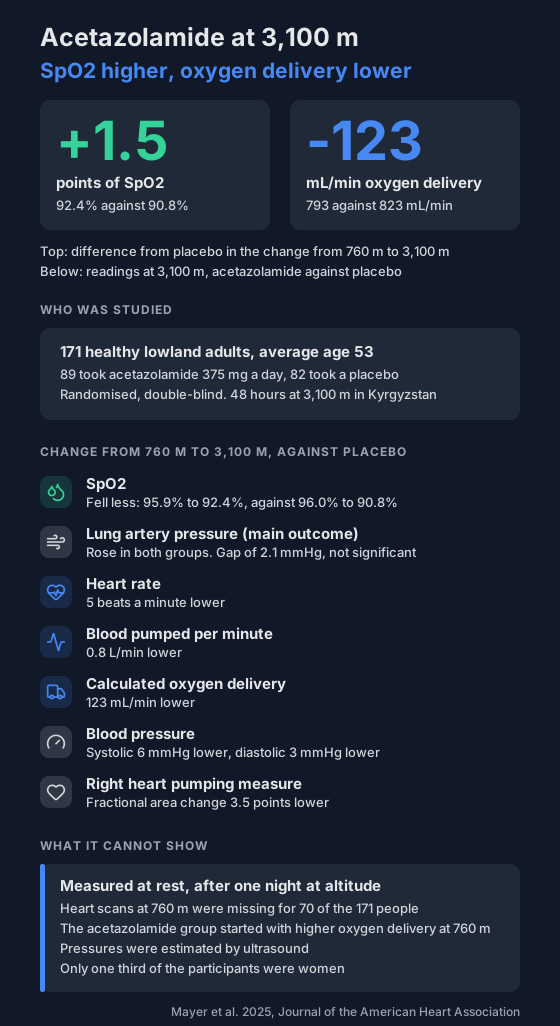
A 2025 trial gave 171 healthy adults acetazolamide or a placebo for a trip to 3,100 m. SpO2 fell less on the drug, but blood pumped per minute and calculated oxygen delivery dropped compared with placebo.
Guidelines recommend acetazolamide as a first-line drug for trips to altitude. It makes you breathe more, so your SpO2 drops less.
A 2025 trial checked what else it does. SpO2 fell less on the drug, but calculated oxygen delivery fell too, while it rose on placebo.
Who was in the trial?
- 171 healthy adults aged 40 to 75 who had always lived below 800 m in Kyrgyzstan.
- Average age 53, and 33% were women.
- 89 took acetazolamide (125 mg in the morning, 250 mg in the evening) and 82 took a placebo.
- They started the capsules 24 hours before going up, then spent 48 hours at 3,100 m.
- Randomised and double-blind.
Measurements were taken at 760 m and after the first night at 3,100 m.
What happened to SpO2?
It fell in both groups, which is what altitude does.
- Placebo: 96.0% to 90.8%.
- Acetazolamide: 95.9% to 92.4%.
The paper puts the difference at 1.5 points.
So why was oxygen delivery lower?
The paper calculates it as the oxygen in the blood multiplied by how much blood the heart pumps each minute. It compares how each measure changed from 760 m to 3,100 m. Against placebo, the change on acetazolamide was:
- Heart rate: 5 beats a minute lower.
- Blood per beat: 6 mL lower.
- Blood pumped per minute: 0.8 L lower.
- Oxygen delivery: 123 mL a minute lower.
- Systolic blood pressure: 6 mmHg lower.
- One measure of right heart pumping: 3.5 points lower.
What was the trial's main question?
Whether acetazolamide limits the rise in lung artery pressure at altitude. Pressure rose in both groups. The 2.1 mmHg gap between the two rises was not statistically significant.
What can't it show?
- Blood flow was measured at rest only, after one night.
- Lung artery pressure was estimated by ultrasound, not measured directly.
- Heart scans at 760 m were missing for 70 of the 171 people.
- The acetazolamide group started with higher oxygen delivery at 760 m (885 against 791 mL a minute), and at 3,100 m the readings were 793 against 823.
- Only a third of the participants were women.
- Symptoms are not reported here, though the authors say the same dose lowered the rate of altitude sickness in the wider trial.
What does it mean for your readings?
A pulse oximeter shows how full your blood is with oxygen. It doesn't show how much blood your heart is pumping. In this trial, compared with placebo, the two moved in opposite directions.
Whether to take acetazolamide is a decision for you and your doctor.
See also overnight oxygen and altitude sickness.
Not a medical device. Does not diagnose, treat or prevent any condition. Discuss results and changes with a clinician.
References
- Mayer L, Lichtblau M, Furian M, Buergin A, Saxer S, Mademilov M, Bader PR, Schneider SR, Sooronbaev T, Bloch KE, Ulrich S. Effect of Acetazolamide on Pulmonary Hemodynamics and Right Heart Function in Healthy Adults Going to Altitude: A Randomized Controlled Trial. Journal of the American Heart Association. 2025;14(17):e041941. doi:10.1161/JAHA.125.041941