Heart Rate and SpO2 at Altitude: A Review
A 2025 review sets out how heart rate and SpO2 change over hours, weeks and months at high altitude, and where the pulse oximeters and watches that track them fall short.
Go up a mountain and your pulse oximeter shows a lower SpO2 and a faster pulse. A 2025 review in Frontiers in Physiology sets out what happens to both numbers after that, and where the devices that track them fall short.
What did the review cover?
- It's a narrative review by three authors at Chengdu University.
- It covers lowlanders who go up, people who live high, and the devices used to measure both.
What happens over time?
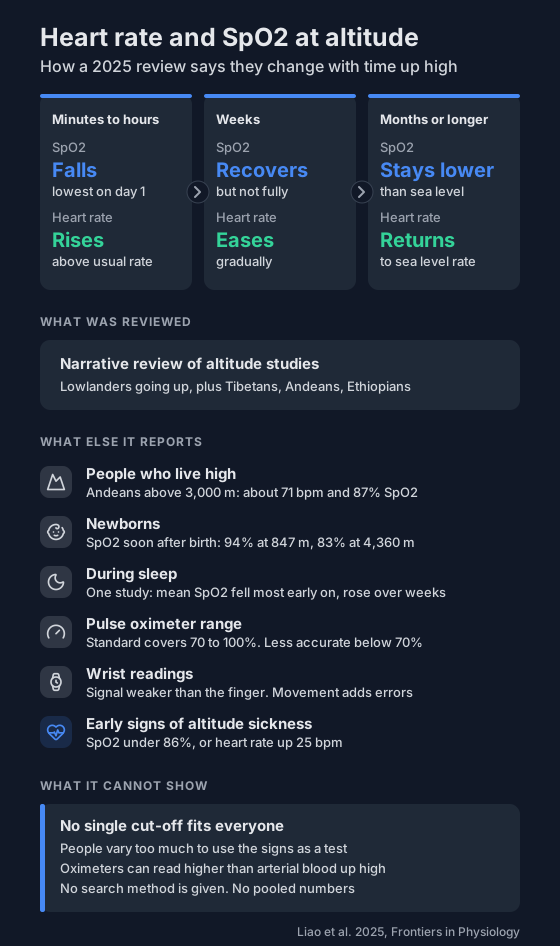
- Minutes to hours. SpO2 falls and heart rate rises. In one study at 5,380 m, SpO2 was lowest on the first day.
- Weeks. SpO2 climbs back but stays below its sea-level value. Heart rate comes down.
- Months or longer. Heart rate returns to its sea-level value. SpO2 doesn't.
In the one sleep study it cites, mean SpO2 fell most early on, then rose over weeks. See blood oxygen at altitude.
What about people who live up there?
- Andeans above 3,000 m averaged about 71 bpm and 87% SpO2.
- Tibetans at 3,000 to 4,000 m averaged about 89%.
- Ethiopian highlanders had SpO2 close to lowlanders, from limited research.
How good are the devices?
The reference methods, ECG and arterial blood samples, are hard to use on a mountain. So most studies use the light sensors in pulse oximeters and watches.
- The international standard for pulse oximeters covers 70 to 100% SpO2. Below 70%, the error grows.
- The signal at the wrist is weaker than at the finger, and movement loosens the sensor.
- In one study, the Apple Watch Series 6 differed from a standard pulse oximeter by 2.0% on average, and by more below 90%. See watches against pulse oximeters.
- Skin tone, sweat and low blood flow add error. See pulse oximeters and skin tone.
- At altitude, pulse oximeters tended to read higher than arterial blood.
Can the numbers flag altitude sickness?
- The review names SpO2 below 86% and a heart rate rise of 25 bpm as early warning signs in people who aren't used to altitude.
- It says neither can be used as a test, because people vary too much.
- It reports that going down is the main response, with extra oxygen as an alternative.
See predicting altitude sickness with oximetry.
What can't it show?
- It gives no search method, and nothing is pooled.
- The authors say watches still need checking against medical pulse oximeters at altitude.
Record a few nights at home first, then compare nights from the trip.
Not a medical device. Does not diagnose, treat or prevent any condition. Discuss results and changes with a clinician.
References
- Liao Y, Lu D, Yang J. Changes and monitoring technology of human heart rate and blood oxygen saturation under high-altitude hypoxia. Frontiers in Physiology. 2025;16:1642777. doi:10.3389/fphys.2025.1642777