A Probiotic and SpO2 at 5,050 m: A Trial
A small 2026 trial gave 21 Italian trekkers and 8 Nepalese porters a probiotic or a placebo on a trek to 5,050 m. Overnight SpO2 was higher on the probiotic at the peak, and altitude sickness rates showed no statistically significant difference.
Your SpO2 drops at altitude. The paper names slow ascent and acetazolamide as the only two approaches with strong evidence for coping with it.
A small 2026 trial tested something different: a probiotic. At 5,050 m, overnight SpO2 was higher on the probiotic than on a placebo. Altitude sickness rates showed no statistically significant difference.
Who was in the trial?
- 21 Italian lowlanders on a 121 km trek to the Pyramid Laboratory near Everest, at 5,050 m.
- 7 women and 14 men, average age 37.
- 8 Nepalese porters of Rai and Tamang ethnicity, all men, average age 31, used to working at altitude.
- Each group was split at random between the probiotic and a placebo, in identical sachets.
- Neither the participants nor the researchers knew who took what.
The probiotic was Oxxyslab, a mix of 8 bacterial strains. Everyone took it or the placebo for 8 days.
All the Italian trekkers also took acetazolamide, 125 mg twice a day, on the way up. The porters took no drugs.
How was oxygen measured?
Each person wore a Checkme O2 oximeter for the whole night, at several points on the trek. The trekkers were measured in Kathmandu, at 3,450 m, at 5,050 m, and back in Kathmandu. The porters were measured at home in Namche (3,450 m) and at 5,050 m.
Altitude sickness was scored with the Lake Louise checklist at 3,450 m, 4,320 m and 5,050 m.
What did they find?
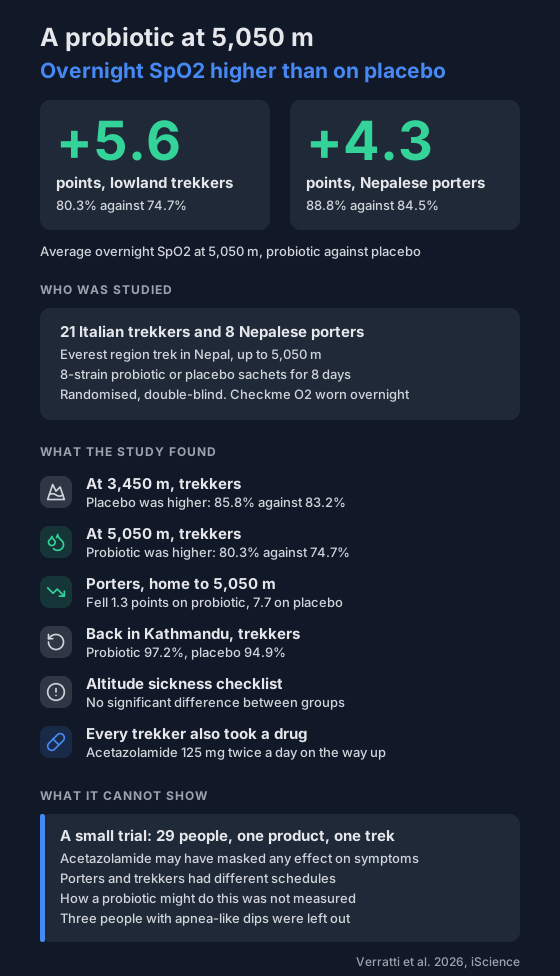
In the Italian trekkers, average overnight SpO2 was:
- At 3,450 m: 83.2% on the probiotic, 85.8% on placebo.
- At 5,050 m: 80.3% on the probiotic, 74.7% on placebo.
- Back in Kathmandu: 97.2% on the probiotic, 94.9% on placebo.
The 5.6 gap at the peak is in percentage points, not a relative change. The paper's abstract writes it as "5.6%". The authors note that SpO2 gaps of 3 points or less are generally down to measurement error, which covers the gaps at 3,450 m and back in Kathmandu.
In the porters, from home to 5,050 m:
- Probiotic: 90.1% to 88.8%, a drop of 1.3 points.
- Placebo: 92.2% to 84.5%, a drop of 7.7 points.
That leaves a 4.3 point gap at the peak. The result held when the authors left out one person at a time.
Did it change altitude sickness?
Not in a way the trial could show. The checklist flagged altitude sickness in 14.3%, 33.3% and 14.3% of the trekkers at the three heights. The rates did not differ significantly between the probiotic and placebo groups. The probiotic group had more positive checklists at 3,450 m and 4,320 m, and fewer at 5,050 m.
The authors say the acetazolamide every trekker took may have hidden any difference.
What can't it show?
- It's small: 29 people in all, on one trek.
- It tested one commercial product, and an earlier trial at 3,800 m also tested it.
- The paper declares no conflicts of interest and doesn't name a funder.
- The trekkers' acetazolamide could have affected the results.
- The porters and trekkers took the sachets on different schedules and were measured on different nights, so the authors don't compare the two groups.
- Three people were left out of the SpO2 analysis because their baseline recordings showed dips that looked like breathing pauses.
- How a probiotic might raise SpO2 is a theory. The trial didn't measure it.
- The paper says three people were left out of the SpO2 analysis, but its one-at-a-time check ran 21 times for the trekkers and 8 for the porters, and it doesn't say which group the three came from.
- At 4,320 m, the altitude sickness table's placebo total (1 person) doesn't match its own rows (2 people).
What does it mean for your readings?
One small trial doesn't show that a supplement will raise your oxygen at altitude. The trekkers here were also on acetazolamide and following a planned ascent.
If you're going high, an overnight oximeter shows how your own SpO2 changes from night to night. See what overnight oxygen showed about altitude sickness and the acetazolamide trial at 3,100 m.
Not a medical device. Does not diagnose, treat or prevent any condition. Discuss results and changes with a clinician.
References
- Verratti V, Marazzato M, Prosperi P, Abad Bruzzo KF, Verza G, Mrakic-Sposta S, Marzola M. Probiotic supplementation preserves oxygen saturation during severe hypobaric hypoxia in lowland and high-altitude populations. iScience. 2026;29(9):117305. doi:10.1016/j.isci.2026.117305