Smartwatch SpO2 vs Pulse Oximeter for Sleep
What an Apple Watch, Oura ring or Garmin records for blood oxygen while you sleep, and how that differs from an overnight pulse oximeter.
Your watch already shows a blood oxygen number. So do you need a separate oximeter?
It depends on how much of the night you want to see.
How do they compare at a glance?
| Smartwatch or smart ring | Overnight oximeter | |
|---|---|---|
| Reads from | Wrist, or finger for a smart ring | Finger |
| Overnight readings | Occasional, or a nightly average | Every few seconds |
| Dip count per night | Usually not | Yes |
| Raw data export | Limited | CSV file |
What does a smartwatch record?
It varies by brand and model, and it changes with software updates. At the time of writing, the makers' own pages said:
- Apple Watch occasionally takes background readings, usually when you're not moving. Readings during sleep only happen if Track Sleep with Apple Watch is on. The Blood Oxygen app isn't available in every country, and on some watches sold in the US the result is worked out on your iPhone and shown in the Health app.
- Oura reports an average blood oxygen figure and a breathing regularity rating, for sleep longer than three hours.
- Garmin watches with Pulse Ox have three modes: all day, during sleep, or on demand. Garmin says turning tracking on shortens battery life.
Check the support pages for your own model before you rely on any of this.
What does a dedicated oximeter record?
An overnight oximeter such as the Wellue O2Ring records a reading every few seconds, all night. It stores SpO2, pulse and movement, and you can export the lot as a file.
That's the main difference. A watch mostly gives you a summary. An oximeter gives you the full trace, so you can count individual dips and see when they happened.
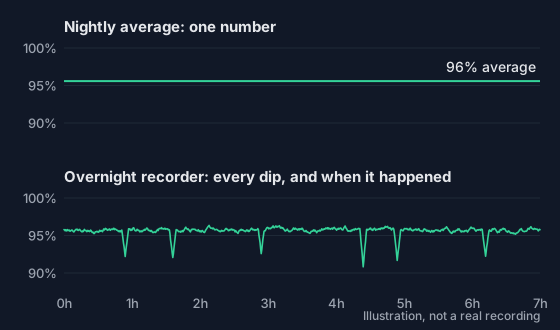
If that's new to you, start with what counts as an oxygen dip.
Why does the wrist matter?
A watch reads light reflected back from your wrist. A ring or finger sensor shines light through your finger, which is how the oximeter at a clinic works. The finger usually gives a stronger signal.
Both can still be thrown off by cold hands, movement and a loose fit. See why a reading might be wrong.
Is a watch accurate?
One lab study put an Apple Watch Series 6 and a hospital finger oximeter on 24 healthy adults while they breathed low-oxygen air.
- On average the two agreed.
- Single readings differed by up to 6 points when oxygen was between 90% and 100%.
- Below 90%, single readings differed by up to 8 points.
Those people were awake, in a lab. The study didn't test a night's sleep.
So a watch can show that your oxygen was lower. It's less suited to counting short dips, because it takes fewer readings and each one has more scatter.
Like dedicated oximeters, watch sensors are also affected by skin tone and fit.
What about battery?
- A watch does a lot of other jobs, and overnight SpO2 adds to the drain. Garmin and Oura both say so.
- An overnight oximeter does one job. Wellue lists 16 hours for the O2Ring, so plan to charge it daily.
If your watch charges overnight, it can't record your sleep at all.
Can you get the data out?
- Apple Watch: readings are saved to the Health app on your iPhone.
- Oura and Garmin: you see the results in their own apps.
- Wellue oximeters: you can download a night as a PDF or CSV file.
A CSV has one row per reading, so any tool can open it. Here's what an O2Ring export looks like.
What does each cost?
If you already own the watch, its SpO2 feature costs you nothing extra. Some brands put parts of their app behind a subscription, so check yours.
At the time of writing, Wellue's own store listed its overnight oximeters between about $150 and $230. Check the listing, because prices change.
So which one do you need?
A watch is enough if:
- You want a rough nightly average alongside your other sleep stats.
- You don't plan to look at individual dips.
A dedicated oximeter makes sense if:
- You want ODI, time below 90% and your lowest reading for each night.
- You want to test a habit, like sleeping on your side, and compare nights.
- You want a recording you can hand to your doctor.
- You use CPAP and want an oxygen log to go with it.
You can use both. Keep the watch for sleep times and the oximeter for oxygen. If you also record sound, see snoring apps vs oximeters.
Neither one is a sleep study. If you snore loudly, stop breathing or gasp in your sleep, or you're worn out during the day, see a doctor.
If you go with a Wellue oximeter, PulseOxTracker lines your nights up so you can compare weeks. Not sure which type to get? Read ring vs fingertip vs wrist.
Not a medical device. Does not diagnose, treat or prevent any condition. Discuss results and changes with a clinician.
References
- Rafl J, Bachman TE, Rafl-Huttova V, Walzel S, Rozanek M. Commercial smartwatch with pulse oximeter detects short-time hypoxemia as well as standard medical-grade device: Validation study. Digital Health. 2022;8:20552076221132127. doi:10.1177/20552076221132127
- Apple. How to use the Blood Oxygen app on Apple Watch. support.apple.com/120358. Checked October 2026.
- Oura. Blood Oxygen Sensing (SpO2). ouraring.com. Checked October 2026.
- Garmin. Changing the Pulse Oximeter Tracking Mode, owner's manual. garmin.com. Checked October 2026.
- Wellue. O2Ring product listing. getwellue.com. Checked October 2026.