Smartphone SpO2 Accuracy: A Lab Test
A 2025 lab study checked a Samsung Galaxy phone and a Galaxy Watch 4 against arterial blood in two separate groups of 12 healthy adults. The phone's error was 2.6% and the watch's 1.8%.
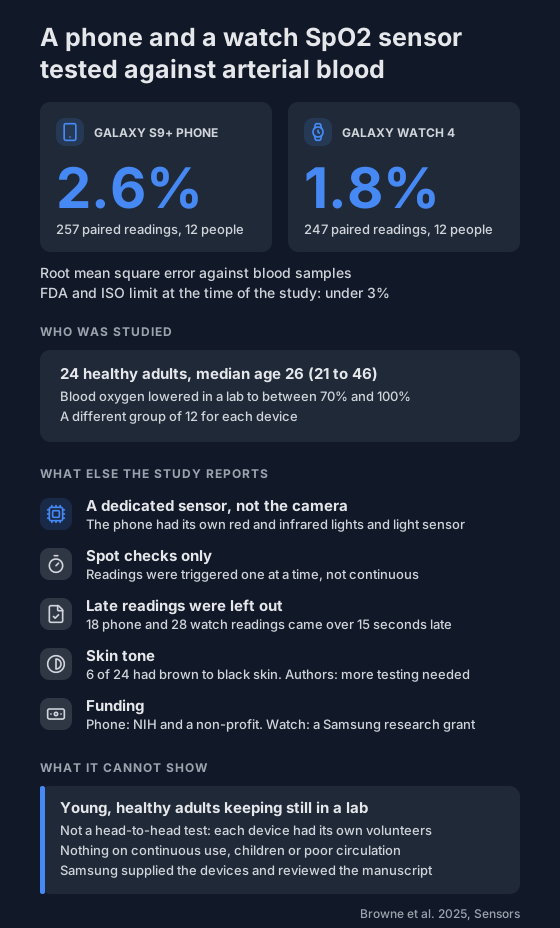
Phone apps that read blood oxygen through the camera have tested badly in earlier studies, the authors of a 2025 paper say. Some Samsung Galaxy phones have a separate SpO2 sensor on the back instead. Their study checked one of those phones, and a Galaxy Watch 4, against arterial blood.
Who was studied?
- 24 healthy, non-smoking adults at the University of California San Francisco hypoxia lab.
- 12 tested the phone and a different 12 tested the watch.
- Median age 26, range 21 to 46, and 62.5% were women.
- Skin type came from a questionnaire: 5 people were white to fair, 13 average to light brown, and 6 brown to black.
How was it tested?
- Each person breathed a gas mix that lowered their blood oxygen in steps, from 100% down to 70%.
- At each step, two blood samples were taken from an artery in the wrist, about 30 seconds apart.
- The device took an SpO2 reading at each sample.
- Hands and arms were kept still on arm boards.
- The phone sat in a case with a silicone boot that held the finger in place.
- A technician tightened the watch strap and kept it tight.
This is the method the FDA and ISO ask for when a pulse oximeter is tested for medical use.
What did it find?
The study reports one error figure per device, the root mean square error against the blood samples. It combines how far off the readings were on average and how much they scattered.
- Phone: 2.6%, from 257 paired readings.
- Watch: 1.8%, from 247 paired readings.
The FDA and ISO limit at the time was under 3%, so both were inside it. The authors say this is the first report of a phone's own SpO2 sensor meeting that limit against arterial blood. Nobody had an adverse event.
Readings that arrived more than 15 seconds after the blood sample were left out: 18 for the phone and 28 for the watch.
For comparison, a separate study found 5 of 11 fingertip oximeters went over the 3% limit in the same kind of test.
Which phone and watch?
- The methods section names a Samsung Galaxy S9+ running the Samsung Health app. The paper's summary says "Galaxy S9/10".
- The watch was a Samsung Galaxy Watch 4.
- The phone's sensor is separate from the camera, with its own red and infrared lights and light sensor.
- Both devices show no reading when the pulse signal is poor.
The authors say the sensor hardware is what matters, not the phone's make and model. The study did not test camera-based apps or any other phone.
What about skin tone?
- 3 people in each group had brown to black skin.
- The paper gives no error figures by skin tone.
- The authors say the spread in individual readings means more testing is needed in people with darker skin.
- They also say the FDA and ISO rules are under review for this reason.
More on this in pulse oximeters and skin tone.
Who paid for it?
- The phone testing was funded by a US National Institutes of Health grant and a non-profit that the lead author is affiliated with.
- The watch testing was funded by a research grant from Samsung Electronics.
- Samsung supplied the devices and reviewed the manuscript.
- One author was employed by a company called Physio Monitor.
- The authors thank a person at Analog Devices for help with the manuscript. The paper lists Analog Devices alongside Maxim Integrated as the maker of the phone's sensor.
What can't it show?
- The volunteers were young, healthy and keeping still, with the watch fitted by a technician.
- The phone and the watch were tested on different people, so the two numbers aren't a head-to-head comparison.
- It tested spot checks only, not continuous or overnight recording.
- It has no data below 70%.
- It says nothing about children, poor circulation in the hands, blood disorders such as sickle cell, or heavy smokers.
- The paper does not say that either device has FDA clearance for medical use.
What does this mean for you?
- In this lab, both sensors stayed inside the 3% limit for spot readings, with the person sitting still and the device fitted carefully.
- The study doesn't cover wearing a watch all night. For that, see smartwatch SpO2 vs a pulse oximeter.
- Not every watch did this well in a similar test. See the Apple Watch in low oxygen study.
- If a reading worries you, talk to your doctor.
Not a medical device. Does not diagnose, treat or prevent any condition. Discuss results and changes with a clinician.
References
- Browne SH, Bernstein M, Bickler PE. Evaluation of Pulse Oximetry Accuracy in a Commercial Smartphone and Smartwatch Device During Human Hypoxia Laboratory Testing. Sensors. 2025;25(5):1286. doi:10.3390/s25051286