34 Pulse Oximeters Tested for Skin Tone Bias
A UCSF lab tested 34 pulse oximeters against arterial blood. 28 met today's ISO accuracy bar, but only 1 met all of the FDA's expected new criteria, and 11 read higher on darker skin.
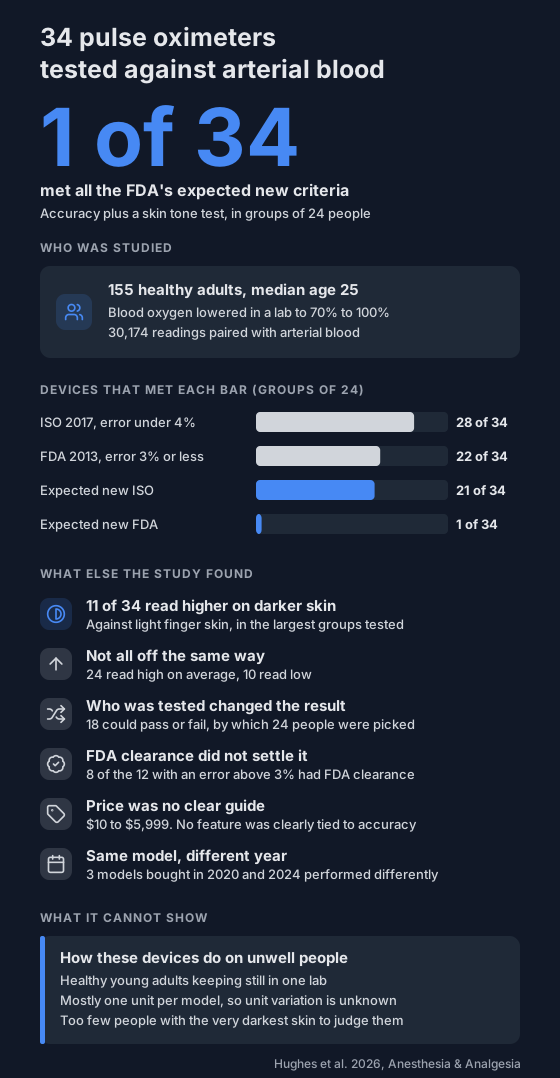
You've probably read that pulse oximeters read too high on darker skin. That's often told as if it's true of every device.
A 2026 study from the University of California, San Francisco hypoxia lab tested 34 oximeters against arterial blood. The skin tone gap showed up in some models and not others. And only 1 of the 34 met all of the new criteria the FDA is expected to bring in.
The same lab tested 11 fingertip models in an earlier study, covered in fingertip pulse oximeter accuracy. This one is three times bigger and scores the devices against the new rules.
Who was studied?
- 155 healthy adults aged 18 to 50, median age 25, about half of them women.
- About a quarter were Black or African American, a quarter Asian and 30% white.
- They breathed a low-oxygen gas mix that held their blood oxygen at steady steps between 70% and 100%.
- Each oximeter reading was paired with an arterial blood sample, 30,174 pairs in all.
- Each device was tested on 24 to 120 people.
- Skin tone was measured with a meter on the finger and forehead, and rated by eye on a 10-point colour scale.
Hands weren't warmed, and sensors went on any of the five fingers. Most makers' own tests warm the hands, which is known to help oximeters, and use the middle three fingers.
The 34 devices were picked from online best-sellers, clinicians' suggestions and aid agencies' buying lists. They cost $10 to $5,999.
What are the old and new rules?
Accuracy is scored as one error figure: how far the readings sit from the blood value.
- Today's rules: the 2017 ISO standard asks for an error under 4%, and the 2013 FDA guidance 3% or less. Both ask for testing on at least 10 people.
- The new rules: ISO and the FDA are both updating theirs. They want more people with dark skin in the test, and a check that a device's error doesn't differ too much between dark and light skin.
- The FDA's 2025 draft is stricter. It judges the whole likely range of the error, not just the best guess, and asks for 150 people.
How many passed?
The main test used 24 people per device, the number both bodies had floated when the study was designed. In those groups of 24:
- 28 of 34 met the 2017 ISO bar.
- 22 of 34 met the 2013 FDA bar.
- 21 of 34 met both parts of the expected new ISO standard.
- 1 of 34 met both parts of the expected new FDA guidance.
Under the expected FDA rules, the skin tone check was the biggest hurdle. 32 of the 34 passed the ISO version of it, and only 1 passed the FDA version. 12 of 34 met the FDA's new accuracy test on its own.
With the larger groups, more devices passed: 7 of 34 under the expected FDA rules and 25 under ISO.
The error ranged from 1.69% for the best device to 8.04% for the worst. Of the 12 devices with an error above 3%, eight had FDA clearance. All six above 4% carried a CE mark.
Did they all read high on darker skin?
No.
- Reading high is the risky direction: it can make low oxygen look better than it is.
- Overall, 24 devices read high on average and 10 read low.
- In the largest groups, 11 of 34 read significantly higher on dark finger skin than on light. The median gap was 1.42 points.
- 4 more did so only when the darkest group was compared with light skin.
- A few read higher on light skin instead.
The gap was biggest at the lowest oxygen levels. In groups of 24, between 70% and 80%, four devices read a median 4.22 points higher on dark skin than on light.
How skin tone was measured changed the count. The finger meter flagged the most devices with a gap, and grouping people by race flagged the fewest.
So the skin tone gap is real for some models, and close to absent for others. The wider research is in pulse oximeters and skin tone and skin pigment and oximeter bias in pooled data.
Why did who was tested matter?
The team rebuilt the test 100 times per device, each time with a different set of 24 people. 18 devices passed in some sets and failed in others, according to the paper's summary.
The authors say a maker who hand-picked participants, instead of taking them in order, could make a weak oximeter look better. Neither the current nor the new rules explicitly forbid that.
What else turned up?
- No device feature, including price, number of light wavelengths or design, was clearly tied to accuracy. The study wasn't built to test that.
- Three models were bought twice, in 2020 and 2024. The two units of each performed differently, with no obvious hardware or software change.
What can't it show?
- These were healthy young adults keeping still in one lab. The results may not carry over to unwell people, children or devices that weren't tested.
- Mostly one unit per model was tested, so the spread between units of the same model is unknown.
- Each device was tested on a similar but not identical group. The two most accurate devices were tested on people with stronger blood flow to the fingers.
- Too few people with the very darkest skin took part to judge that group on its own.
- Blood gas analysers can differ by 1 to 3 points between brands.
The lab is paid by companies to test their devices, but not for this study. It was funded by foundations and global health funders, and no company had a role in it.
What can you do with this?
- A badge on the box doesn't tell you how well that model reads. In this test, FDA-cleared and CE-marked devices were among those that missed today's bars.
- Read your own numbers as a trend across nights, not as an exact value. See pulse oximeter accuracy.
- The oximeter accuracy calculator shows the range a reading may sit in, from the error figure in your manual.
- Buying one? Here's what to check before buying an oximeter.
- Cold fingers make readings less reliable. See warming the arm and which finger to use.
Not a medical device. Does not diagnose, treat or prevent any condition. Discuss results and changes with a clinician.
References
- Hughes C, Chen D, Law T, Bickler P, Feiner J, Shmuylovich L, Behnke E, Ortiz L, Leeb G, Zamora RV, Monk E, Lipnick MS, et al. Pulse Oximeter Performance and Skin Pigment: Comparison of 34 Oximeters Using Current and Emerging Regulatory Frameworks. Anesthesia & Analgesia. 2026;143(5):1137-1147. doi:10.1213/ANE.0000000000008048