Skin Pigment and Oximeter Error: Lab Data
A 2024 maker-funded analysis pooled 10,800 paired readings from 131 healthy adults. One hospital sensor family read 0.58 points high on dark skin and 0.30 on light skin when blood oxygen was 70 to 80%.
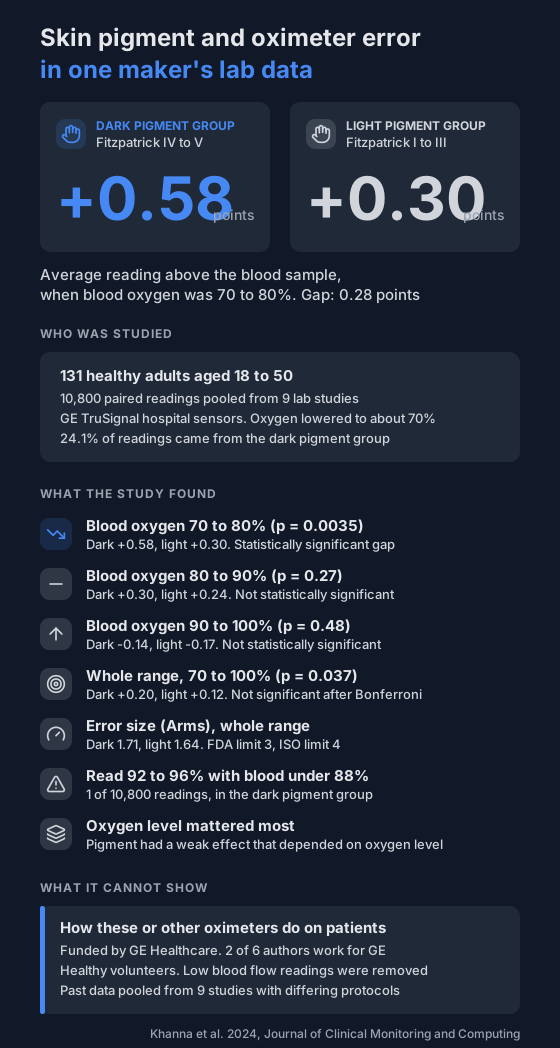
Hospital studies have found that pulse oximeters can read too high on darker skin. A 2024 paper looked at that question for one maker's sensors, using lab data the maker already had.
It found a small gap between pigment groups, which was statistically significant only at the lowest oxygen levels tested. GE Healthcare makes the sensors, funded the study and employs two of the six authors.
For the wider picture, see pulse oximeters and skin tone.
Who was studied?
- 131 healthy, non-smoking adults aged 18 to 50. The average age was about 26.
- They came from nine earlier lab studies of GE TruSignal sensors, which are made for hospital monitors.
- In each study, volunteers breathed air with less oxygen so their blood oxygen fell in steps, down to about 70%.
- At each step, the sensor reading was paired with a blood sample from an artery.
- The final dataset had 10,800 paired readings.
The authors split the readings into two pigment groups:
- Light: Fitzpatrick skin types I to III. 8,202 readings (75.9%).
- Dark: Fitzpatrick skin types IV to V. 2,598 readings (24.1%).
The paper reports these splits by reading, not by person. It doesn't say how many of the 131 people were in each group.
How far off were the readings?
"Bias" here means the average sensor reading minus the blood sample. A plus number means the sensor read high.
| Blood oxygen | Dark group | Light group | p-value |
|---|---|---|---|
| 70 to 80% | +0.58 | +0.30 | 0.0035 |
| 80 to 90% | +0.30 | +0.24 | 0.2699 |
| 90 to 100% | -0.14 | -0.17 | 0.4765 |
| Whole range | +0.20 | +0.12 | 0.0370 |
- The only statistically significant gap was at 70 to 80%: 0.28 points.
- The results table gives the whole-range gap a p-value of 0.0370 with no correction. In the discussion, the authors say it was not significant after a Bonferroni correction for multiple comparisons, which put the cut-off at 0.05/4 = 0.0125.
- Across all readings, the sensors read 0.14 points high on average.
- 92.3% of readings were within 3 points of the blood sample and 99.1% were within 5. The largest miss was 10.2 points.
What about overall error?
Regulators use a figure called Arms, which combines bias and scatter. The FDA limit quoted in the paper is 3 and the ISO limit is 4.
- Whole range: 1.71 in the dark group, 1.64 in the light group.
- At 70 to 80%: 2.33 in the dark group, 2.11 in the light group.
- The authors report no statistically significant difference in Arms or in scatter between the groups.
Both groups got less accurate as oxygen fell. In the authors' models, oxygen level had a strong effect on bias. Pigment had a weak effect, and whether it reached significance depended on the oxygen range.
Did a low reading ever look fine?
The authors looked for readings of 92 to 96% when the blood sample was under 88%.
- They found one in 10,800: a reading of 92.0% against a blood sample of 87.4%.
- It was in the dark pigment group.
They contrast that with a 2020 hospital study, which found this in 11.4% of Black patients and 3.6% of White patients.
What can't it show?
- It's maker-funded. GE Healthcare paid for the study. Two authors are GE employees and shareholders, three work for firms GE supported for this research, and the lead author consults for GE and other device makers.
- It's one sensor family. Only GE TruSignal hospital sensors were tested, not other brands or home devices.
- It's healthy volunteers in a lab. Readings taken during movement or very low blood flow were removed, and so were samples with low hemoglobin. The authors say the findings may not carry over to hospital patients.
- It's a look back at pooled data. The nine studies differed in protocol and in the patient monitor used. Finger size and blood flow couldn't be checked as factors.
- The dark group was smaller. It supplied 24.1% of the readings, and the paper describes it as covering Fitzpatrick types IV to V.
- Below 70% isn't covered. Readings under 70% were excluded. The paper says 189 were removed, all from volunteers who identified as white, so there was no comparison group.
The authors call for studies of the same sensors on real patients.
Other studies have found larger gaps with other devices. See the review of 42 studies and the NHS home oximeter study.
What can you do with it?
- Don't assume a result for one hospital sensor applies to your own oximeter.
- Watch your trend across nights more than any single number.
- If you feel unwell, tell a doctor, whatever the reading says.
More on what affects a reading: pulse oximeter accuracy.
Not a medical device. Does not diagnose, treat or prevent any condition. Discuss results and changes with a clinician.
References
- Khanna AK, Beard J, Lamminmäki S, Närväinen J, Antaki N, Yapici HO. Assessment of skin pigmentation-related bias in pulse oximetry readings among adults. Journal of Clinical Monitoring and Computing. 2024;38(1):113-120. doi:10.1007/s10877-023-01095-1