Oximeter vs Blood Gas at a Black Lung Clinic
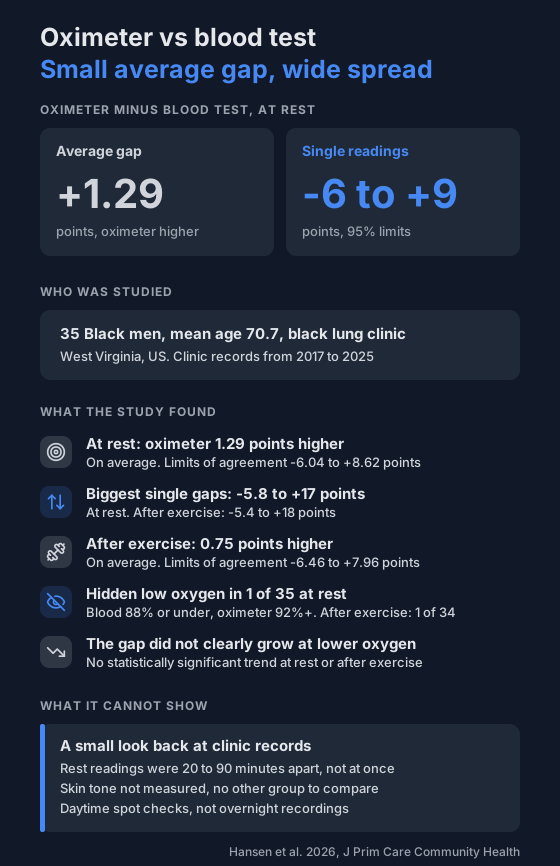
A 2026 study of 35 Black men at a black lung clinic compared pulse oximeter readings with arterial blood gas results. The average gap was 1.3 points, but most single readings fell between about 6 points low and 9 points high.
Earlier studies found pulse oximeters read a little high on average in people with darker skin. Most of that research comes from hospitals.
A 2026 study looked at an outpatient clinic instead: a black lung clinic in West Virginia, where oximeter readings feed into decisions about home oxygen and disability claims. The average gap was small. Single readings varied a lot more.
Who was studied?
- 35 men seen at a black lung clinic run by Cabin Creek Health Systems, in rural West Virginia.
- Black lung is a lung disease caused by years of breathing coal dust.
- All were men who self-identified as African American, with a mean age of 70.7.
- Visits took place between January 2017 and December 2025.
The team went back through clinic records and found every visit where a pulse oximeter reading and an arterial blood gas test were both taken. An arterial blood gas test measures oxygen in a blood sample from an artery, so it is the reference.
- At rest, a finger sensor was used, and the two readings were taken 20 to 90 minutes apart.
- After an exercise test, a forehead sensor was used, and the readings were taken within minutes of each other.
How close was the oximeter?
Close on average, but not reading by reading.
| Measure | At rest (35 men) | After exercise (34 men) |
|---|---|---|
| Average gap, oximeter minus blood | +1.29 points | +0.75 points |
| 95% limits of agreement | -6.04 to +8.62 | -6.46 to +7.96 |
| Biggest single gaps | -5.8 to +17 | -5.4 to +18 |
- A plus means the oximeter read higher than the blood test.
- The limits of agreement are the range most single readings fall into.
- So at rest, one reading could be about 6 points lower or nearly 9 points higher than the blood test.
- The oximeter read high more often than low.
- The authors note this spread is well beyond the roughly 2 points usually quoted for oximeters under ideal conditions.
Did the gap get bigger at lower oxygen?
Not in a statistically significant way. The authors tested for that and found no statistically significant trend at rest or after exercise. They read the gap as general variation between the two methods, not a bias at one oxygen level.
What is hidden low oxygen?
The study counted it as a blood result of 88% or under while the oximeter showed 90% or over.
- At rest: 1 of 35 men.
- After exercise: 1 of 34.
- In both cases the oximeter read 92% or over.
The paper does not say whether this was the same man both times. With so few cases, the authors say this shows the problem can happen, not how often.
For the wider evidence on skin tone, see pulse oximeters and skin tone.
What can't it show?
- Small and looking back. 35 men from one clinic, and the authors say a sample this size makes the limits of agreement less precise.
- Not at the same moment. At rest, the two readings were up to 90 minutes apart, so oxygen may have really changed in between.
- Two different sensors. Finger at rest, forehead after exercise.
- Skin tone. It was not measured, and with no other group in the study, it cannot show a difference by race or skin tone.
- Device makes. The paper does not name the oximeters.
- Overnight readings. These were daytime spot checks, not a night of recording.
No funding was received, and the authors declared no conflicts of interest.
What does this mean for your own readings?
- One oximeter reading can sit several points from a blood test, even when the average gap is small.
- An overnight recorder takes thousands of readings, so you see the pattern, not one number. Look at time below 90% and how the night unfolds.
- A steady bias in your device would still be there all night, so changes across the night and between nights tell you more than any single value.
- Compare several nights before reading much into one. See how many nights to record.
- If a number doesn't fit how you feel, raise it with your doctor. Here's how to share your data.
For a lab test of the same question in healthy volunteers, see fingertip oximeter vs arterial blood.
Not a medical device. Does not diagnose, treat or prevent any condition. Discuss results and changes with a clinician.
References
- Hansen S, Burchfield K, Hupp K, Yousuf SH, Baus A. Pulse Oximetry and Arterial Blood Gas Agreement in an Outpatient Black Lung Clinic: Implications for Clinical Assessment and Decision Making. Journal of Primary Care & Community Health. 2026;17:21501319261485526. doi:10.1177/21501319261485526