ICU Pulse Oximeter Accuracy: Age vs Skin Tone
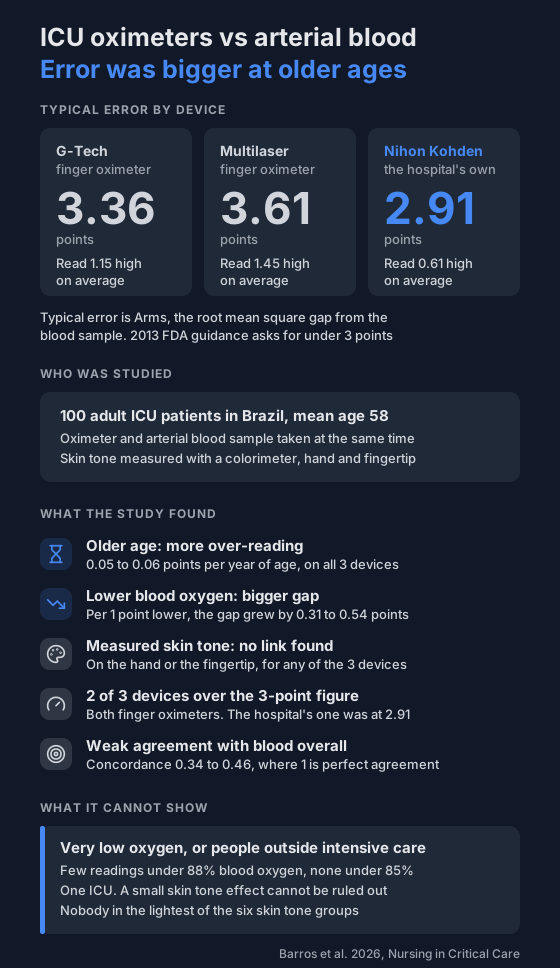
A 2026 study compared three pulse oximeters with arterial blood in 100 intensive care patients. Reading error was bigger at lower oxygen and older age. No link was found with measured skin tone.
You've probably read that pulse oximeters are less accurate on darker skin. Several studies have reported that, and we cover them in pulse oximeters and skin tone.
A 2026 study from an intensive care unit in Brazil measured skin tone with an instrument and didn't find that link. What it did find was a bigger reading error at lower oxygen levels and in older patients.
Who was studied?
- 100 adults in the intensive care unit (ICU) of one tertiary hospital in Brazil.
- Mean age 58, range 18 to 90. 54 men and 46 women.
- Each had an arterial blood sample taken as part of their usual care in 2024, with oximeter readings taken at the same time.
- The blood result is the reference. The gap between it and the oximeter is the error.
Three oximeters were compared:
- Two finger oximeters: a G-Tech Oled Graph and a Multilaser HC023.
- The pulse oximeter the hospital already used, a Nihon Kohden Life Scope G5.
Not every patient had a reading on every device: 96 on the G-Tech, 99 on the Multilaser and 100 on the Nihon Kohden.
How was skin tone measured?
With a colorimeter, not by asking patients or by eye.
- It was measured in two places: the back of the hand, and the pad of the finger used for the oximeter.
- The result is a single number called the individual typology angle (ITA).
- By the back of the hand, 55 patients were in the "brown" group, 18 "tan", 11 "intermediate", 10 "dark" and 6 "light". None were in the lightest group.
- Asked about ethnicity, 79 described themselves as White, 15 as Brown and 6 as Black.
The authors point to that mismatch as a reason not to use self-reported race as a stand-in for skin tone.
How far off were the oximeters?
All three read higher than the blood sample on average. The paper's methods section writes the gap as blood minus oximeter, but its results, its regression table and its conclusions all describe the oximeters over-reading, so that's the direction used here.
| Device | Average gap | Typical error (Arms) | 95% limits of agreement |
|---|---|---|---|
| G-Tech | +1.15 points | 3.36 points | -5.08 and +7.37 |
| Multilaser | +1.45 points | 3.61 points | -5.06 and +7.97 |
| Nihon Kohden | +0.61 points | 2.91 points | -4.98 and +6.21 |
- Arms is the root mean square gap from the blood sample.
- The paper compares it with a figure of under 3 points from 2013 FDA guidance. The two finger oximeters were over it. The hospital's own device was under.
- Agreement with blood was weak for all three. The concordance scores were 0.34, 0.37 and 0.46, where 1 is perfect agreement.
For what these accuracy figures mean, see pulse oximeter accuracy.
What went with a bigger error?
Lower blood oxygen. For each 1 point drop in blood oxygen, the gap grew by 0.31 to 0.54 points, depending on the device. So the lower the true level, the more the oximeters read above it.
Older age. Across all three devices, the oximeters read 0.05 to 0.06 points higher against blood for each extra year of age, after allowing for blood oxygen level and skin tone. The link with age was statistically significant on every device.
The authors don't think age itself is the cause. They suggest older ICU patients more often have poor blood flow to the fingers, low blood pressure or narrowed vessels, which weaken the signal the oximeter reads. The study didn't measure those, so that's an explanation they offer, not a result. There's more on blood flow in oximeter accuracy with motion and low perfusion.
And skin tone?
No link was found.
- In the main model, neither skin tone measurement was associated with the gap, on any device.
- The authors also ran the comparison FDA proposes, which sets the darkest skin tones against the lightest. On the back of the hand the differences were -2.05, -2.04 and +0.35 points for the three devices.
- Two of those are just past the 2.0 points FDA suggests as a ceiling. On the fingertip the differences were 1.15, 0.82 and 1.29 points.
- Every confidence interval crossed zero, so none could be told apart from chance.
The authors' own wording is careful: the data don't show a skin tone effect, and a small one can't be ruled out. They say the random scatter in the readings was large enough to hide a small effect.
Other studies have found one. See the pooled skin pigment data and the NHS home oximeter study.
What can't this study show?
- Very low oxygen. Few readings had blood oxygen under 88% and none were under 85%. The authors say that's where larger errors and skin tone gaps might show up.
- Other settings. It was one ICU with 100 patients. The authors say the results may not carry over to other clinical settings or countries.
- The lightest skin. Nobody fell in the lightest of the six skin tone groups.
- Other causes. Body temperature and hydration weren't recorded, and either could affect the readings.
- Cause and effect. It's a cross-sectional study, a single snapshot. It shows what went along with a bigger error, not what caused it.
The study was funded by Brazilian research agencies and a hospital foundation, and the authors declare no conflicts of interest.
What can you do with this?
- Read a single number as an estimate. In this study the gap from blood could be several points either way.
- Watch the trend over several nights more than any one number. Here's how many nights to record.
- If your readings are low or you feel unwell, talk to your doctor. A blood test is the reference, not the oximeter.
Not a medical device. Does not diagnose, treat or prevent any condition. Discuss results and changes with a clinician.
References
- Barros KB, Pinheiro JS, Sampaio MS, Junior LBC, Ferreira FF, Basile-Filho A, Guirro RRJ, Bachmann L. Accuracy and Bias of Pulse Oximetry in the Intensive Care Unit: A Prospective Observational Study. Nursing in Critical Care. 2026;31(3):e70433. doi:10.1111/nicc.70433