Laser vs LED Oximeters and Skin Pigment
A 2025 pilot study by a device maker tested a laser-based pulse oximeter prototype against two LED-based ones on 18 volunteers. On dark skin the LED devices read about 3 points high, the laser 0.26.
Pulse oximeters can read too high on darker skin, mostly when blood oxygen is low. The research on skin tone has shown that for years.
A pilot study published in 2025 tested one proposed fix: swap the LEDs in the sensor for lasers. It was run and paid for by the company that owns the laser prototype, so read it with that in mind.
Why would a laser make a difference?
This is the authors' explanation.
- A pulse oximeter shines red and infrared light through your finger.
- A red LED doesn't emit one wavelength. Its light can span more than 80 nanometres.
- Melanin absorbs the shorter wavelengths in that span more than the longer ones.
- That shifts the red light the sensor receives toward longer wavelengths, and the oximeter reads higher. The effect only shows when blood oxygen falls.
- A red laser's light spans less than 1 nanometre, so there is almost nothing to shift.
Who was studied?
- 18 volunteers: 9 darkly pigmented and 9 lightly pigmented.
- They came only from the three darkest and three lightest levels of the ten-level Monk Skin Tone Scale.
- Each wore six finger sensors at once: four laser prototypes and two LED-based oximeters, a Masimo Rad-97 and a Medtronic PM1000N.
- Their oxygen was lowered in steps by breathing air with added nitrogen.
- At each step, arterial blood was drawn and measured on a lab analyser.
The test took place at the UCSF Hypoxia Lab. It's the same kind of test described in fingertip oximeter vs arterial blood.
What did it find?
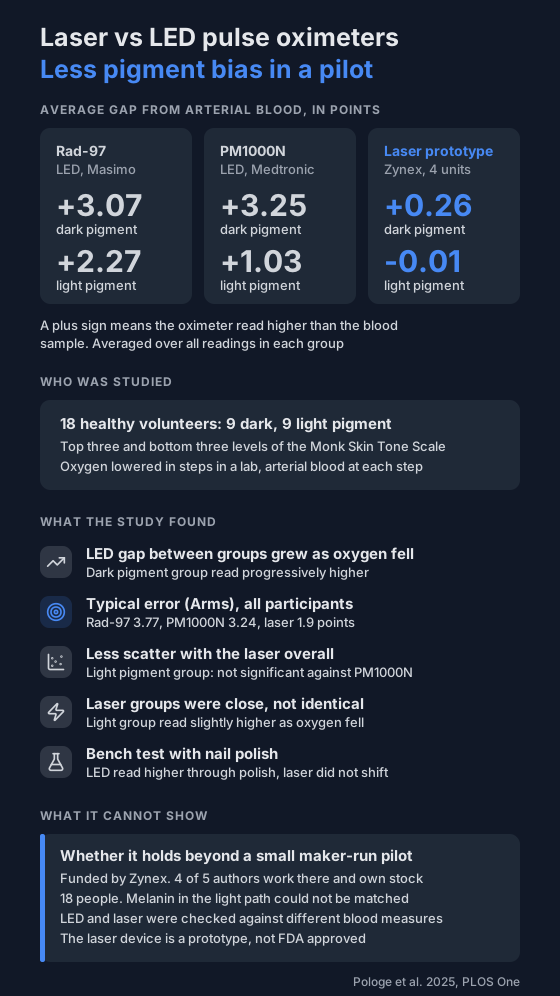
Average gap from the blood sample, in points. A plus sign means the oximeter read higher than the blood.
| Device | Dark pigment | Light pigment |
|---|---|---|
| Rad-97 (LED) | +3.07 | +2.27 |
| PM1000N (LED) | +3.25 | +1.03 |
| Laser prototype | +0.26 | -0.01 |
- LED devices. The gap between the two groups grew as oxygen fell, with darkly pigmented participants reading progressively higher.
- Laser prototype. The authors report almost no difference between the groups.
- Typical error. Arms combines the average gap and the scatter. Across all participants it was 3.77 points for the Rad-97, 3.24 for the PM1000N and 1.9 for the laser.
- Scatter. Readings from both LED devices varied more than the laser's, across all participants and in the darkly pigmented group. In the lightly pigmented group the difference was significant for the Rad-97 (p = 0.046) and not for the PM1000N (p = 0.44).
The LED figures come from 188 readings per device. The laser figures pool 680 readings from the four prototypes.
Was the laser completely unaffected?
Not quite.
- As oxygen fell, the lightly pigmented group read slightly higher than the darkly pigmented group on the laser. That's the reverse of the LED pattern.
- The authors say this may be random variation, or a weaker signal because melanin absorbs more of the light.
- In the lightly pigmented group, the laser's typical error was 2.08 points, close to the PM1000N's 2.33.
What about the nail polish test?
The team also ran a bench test on artificial fingers with human blood pumped through them, using the Rad-97 and one laser prototype. They put a glass slide coated with one nail polish between the sensor and the finger, to stand in for melanin.
- The LED oximeter read higher through the polish, more so at lower oxygen levels.
- The laser prototype did not shift.
What can't it show?
- It's a maker's study. Zynex Monitoring Solutions funded it and owns the laser prototype. Four of the five authors work there and own stock, and one holds patents on the technology. The authors state they may be biased.
- It's small. 18 people, and the authors call it a pilot.
- Melanin wasn't matched. The authors could not make sure everyone in a group had the same amount of melanin in the light path. It varies with finger size and where the sensor sits.
- Different yardsticks. The LED devices were compared with one blood measure (functional saturation) and the laser with another (fractional saturation), to match how each was calibrated. The paper says the two typically differ by less than about 3% in healthy volunteers.
- A filter set by the laser device. Only readings where the laser prototype showed a perfusion index above 1.0% were analysed.
- No direct test of the pigment gap. For the volunteer study, the paper reports significance tests for scatter, not for the difference in average gap between the two pigment groups.
- Not on sale. The prototype is for investigational use and is not yet FDA approved for clinical use.
The paper's title says the laser "eliminates" pigment effects. The authors themselves list the small sample as a limitation, and report that the two groups were close on the laser, not identical.
What does this mean for your own oximeter?
- Your oximeter uses LEDs. The paper says currently available pulse oximeters do.
- In this study the LED gap between the groups grew at the lower oxygen levels.
- A single reading tells you less than a trend. Record several nights and compare them with each other.
- If you have darker skin and a reading doesn't match how you feel, go by how you feel and talk to your doctor.
More on this: pooled lab data on skin pigment and a review of pigmentation and oximeter error.
Not a medical device. Does not diagnose, treat or prevent any condition. Discuss results and changes with a clinician.
References
- Pologe JA, You NK, Blumstein M, Snyder KL, Hay WW. Laser-based pulse oximetry eliminates pigmentation effects on oxygen saturation measurements: A pilot study. PLOS One. 2025;20(10):e0333109. doi:10.1371/journal.pone.0333109