Do Oximeters Miss Low Oxygen on Dark Skin?
A 2025 systematic review of 42 studies found pulse oximeters tend to read higher than a blood sample on darker skin, and got less accurate as oxygen fell. The gap ranged from 1 point or less to 5 points.
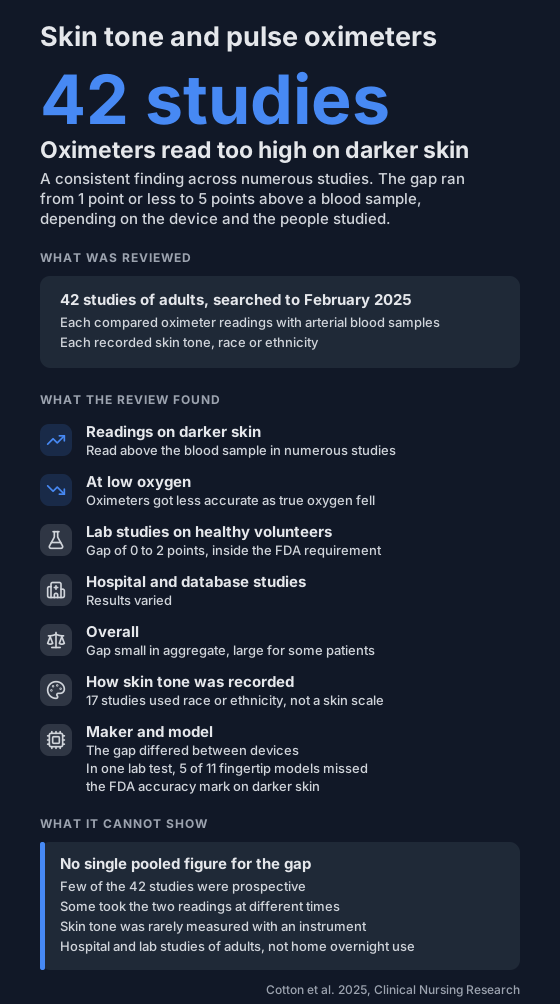
You may have read that pulse oximeters read too high on darker skin. A systematic review published in 2025 went through 42 studies to check.
Short answer: yes, they tend to, and oximeters got less accurate as oxygen fell. Taken together the gap was small, but not for everyone.
For the background, see pulse oximeters and skin tone.
What did the review look at?
- 42 studies of adults: 31 from a search of PubMed and Embase up to February 2025, and 11 found through citations.
- Every study compared an oximeter reading (SpO2) with an arterial blood sample, which is the reference test.
- Every study recorded skin tone, race or ethnicity.
- Three enrolled only light-skinned or white men, and one enrolled only Black men.
- The largest group of studies was on intensive care patients.
- 11 were done in a lab or clinic. The lab studies lowered the oxygen of healthy volunteers on purpose.
What did it find?
- Darker skin. Oximeters reading higher than the blood sample was a consistent finding across numerous studies.
- Size of the gap. It ranged from 1 point or less to 5 points, depending on the device and the people studied.
- Low oxygen. Oximeters got less accurate as the true oxygen level fell.
- Missed low oxygen. A few studies found it was more common in Black patients than in white patients. That's a blood sample below 88% while the oximeter shows a typical reading.
- Overall. The authors say the gap tends to be small in aggregate, and call that reassuring. They also say some patients had a major gap.
Did the setting matter?
Yes.
- Lab studies. The gap was 0 to 2 points, which is inside the FDA requirement for healthcare use.
- Hospital and database studies. Results varied.
The authors point to circulation. A healthy volunteer in a lab usually keeps good blood flow while their oxygen is lowered. A hospital patient may not, and the review says poor blood flow can add to the over-read.
Did the device matter?
Yes. The review says accuracy varied by maker and model as well as by skin tone.
- One lab study tested 11 fingertip oximeters. Five didn't meet the FDA accuracy standard on darker skin.
- One study compared two brands. One read too low and the other too high.
A 2026 study of five NHS home oximeters also found differences between models.
How was skin tone measured?
Rarely with an instrument.
- 17 studies used race or ethnicity, taken from the medical record or reported by the patient or someone on their behalf.
- Others used a colour scale, or the researcher sorted people into "light" and "dark" by eye.
- Few used a spectrophotometer, an instrument that measures skin colour directly. The authors say that's the best method.
The authors say this adds variability between studies.
What can't it show?
- One number. The review describes the studies. It doesn't pool them into a single average gap.
- Cause. The authors say the studies don't explain why the gap is bigger in some groups.
- Timing. Some studies used old hospital records, where the oximeter reading and the blood sample weren't always taken at the same moment.
- Design. Few of the 42 studies were prospective.
- Outcomes. It doesn't show whether acting on a missed low reading changes how patients do.
- Home use. The settings the review lists are intensive care, hospital wards, labs, clinics and hospital databases. Overnight use at home is not among them. For three studies the setting was not reported.
Who paid for it?
- The work was supported by a nursing dissertation grant (the WIN/CANS Martha J. Lentz Dissertation Grant).
- One author declared NIH funding, income from Livanova, Zoll, Eli Lilly and Powell Mansfield, and a philanthropic donation from ResMed to his university, UC San Diego.
What can you do with this?
These are our suggestions, not findings from the review, which looked at hospital and lab use.
- Compare your own nights. Use the same device on the same finger, and look at the trend across nights more than any single number.
- Be careful with your lowest readings. That's where the review found oximeters least accurate. It affects your lowest reading and your T90.
- Go by how you feel. If you're short of breath or worn out, see a doctor whatever the number says.
- Check your model. See what to check before buying an oximeter.
- Rule out the everyday causes. Cold hands and a loose fit throw off readings too. See why your reading might be wrong.
Not a medical device. Does not diagnose, treat or prevent any condition. Discuss results and changes with a clinician.
References
- Cotton SA, Lee JA, Malhotra A, McGuire WC. Do Differences in Skin Pigmentation Affect Detection of Hypoxemia by Pulse Oximetry: A Systematic Review of the Literature. Clinical Nursing Research. 2025;34(8):403-411. doi:10.1177/10547738251374746