NHS Home Oximeters and Skin Tone: BMJ Study
A 2026 BMJ study tested five fingertip pulse oximeters the NHS gave out for home use. All five read 0.6 to 1.5 points higher on darker skin, and missed low oxygen more often.
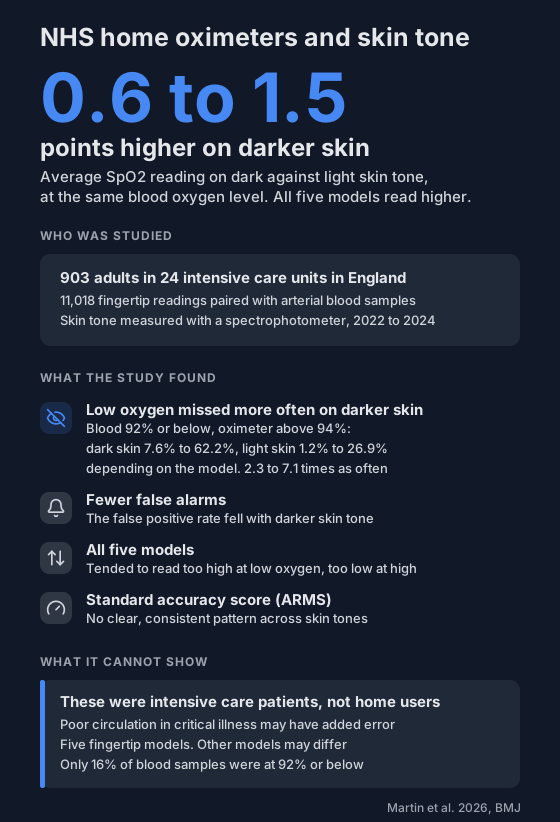
During COVID, the NHS in England gave people fingertip pulse oximeters to check their oxygen at home. It's been known for years that oximeters can read high on darker skin. A BMJ study published in January 2026 tested five of those NHS models against blood samples to measure by how much.
Who was studied?
- 903 adults on ventilators in 24 intensive care units in England.
- Patients with darker skin were deliberately over-sampled.
- Skin tone was measured with a handheld spectrophotometer, not guessed from ethnicity or a colour chart.
- Each fingertip reading was paired with an arterial blood sample, the reference test. That gave 11,018 pairs.
What did it find?
- All five models read higher on darker skin.
- At the same blood oxygen level, readings on the typical dark skin tone averaged 0.6 to 1.5 percentage points higher than on the typical light one, depending on the model.
- Every model tended to read too high when blood oxygen was low and too low when it was high.
- So at high oxygen levels, the extra points on darker skin meant less error. At low levels they meant more.
Does one point matter?
At a cut-off, yes. The home scheme told people to seek medical help at 94% or below.
For blood samples at 92% or below, the researchers estimated how often the oximeter still read above 94%, comparing the typical dark and typical light skin tone in the study:
- Light skin: 1.2% to 26.9% of readings, depending on the model.
- Dark skin: 7.6% to 62.2%.
- That's 2.3 to 7.1 times as often.
False alarms went the other way and were less common on darker skin.
ARMS, the single accuracy score the international standard relies on, showed no clear pattern by skin tone.
What can't it tell you?
- Home use. These were critically ill patients. Poor circulation can make the skin tone error larger.
- Other devices. The authors say the results may not apply to other oximeter models. No ring or overnight recorder was tested.
- Low oxygen. Only 16% of blood samples were at 92% or below.
What can you do with this?
The authors say trends in SpO2 should carry more weight than single readings, particularly for people with darker skin.
- Compare your own nights with each other, on the same device and the same finger.
- Be careful with fixed lines like 90%, which is what T90 counts against.
- If you feel short of breath, get medical help whatever the number says.
- See what else affects pulse oximeter accuracy.
Not a medical device. Does not diagnose, treat or prevent any condition. Discuss results and changes with a clinician.
References
- Martin DS, Doidge JC, Gould D, Shahid T, Cowden A, Charles WN, Francis Johnson A, Garrett R, Mbema C, Olusanya O, Healy E, Rowan K, Mouncey P, Harrison DA; EXAKT Study Investigators. The impact of skin tone on performance of pulse oximeters used by NHS England COVID Oximetry @home scheme: measurement and diagnostic accuracy study. BMJ. 2026;392:e085535. doi:10.1136/bmj-2025-085535