What Is T90? Time Below 90% SpO2 Explained
T90 is the share of the night your blood oxygen spent below 90%, and here's how to read it next to your other numbers.
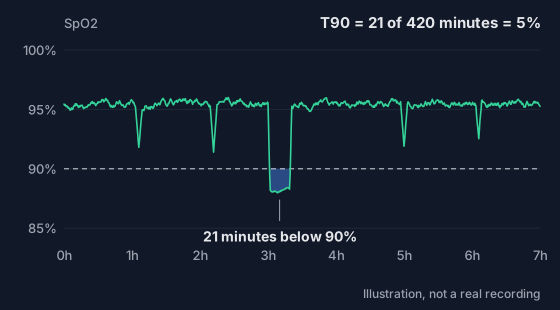
T90 is the share of your recording where your SpO2 was below 90%. Some apps show it as a percentage, and some show it as minutes.
How is it worked out?
Count the readings below 90%, then divide by all the usable readings.
Say you recorded 7 hours and spent 21 minutes below 90%. That's 21 out of 420 minutes, so your T90 is 5%.
Why 90%?
Published sleep research uses 90% as its reference line, so that's the one most reports copy. It's a convention from the literature. It's not a line your ring drew for you, and home oximetry is not a sleep study.
How is it different from ODI?
They answer different questions.
- ODI counts how often your oxygen dipped and came back.
- T90 measures how long it stayed low.
You can have one without the other. Lots of short dips from 96% to 92% give you a high ODI and a T90 of zero. One long stretch at 89% gives you a T90 and barely moves your ODI.
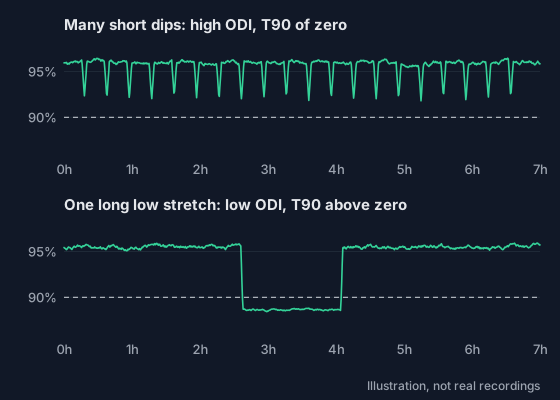
That's why it helps to read them together. Here's what counts as a dip.
What can throw it off?
- A bad fit. A loose ring or a cold hand can read low for minutes, and all of that lands in T90. See why your reading might be wrong.
- A short recording. Ten low minutes is a bigger share of a 4 hour night than an 8 hour one.
- Altitude. Sleep somewhere high and your whole night sits lower, so T90 jumps. That's expected at altitude.
- Different cutoffs. Some reports also show time below 88%. Don't compare one against the other.
What should you do with yours?
- Check the chart before you trust the number. One flat, low block with a gap either side is often the sensor.
- Compare your own nights against each other, in the same units.
- Read it next to ODI and your lowest reading, not alone.
If you see long stretches below 90% on several nights, with a good fit, take your recordings to your doctor. Do the same if you snore loudly, someone has heard you stop breathing or gasp, or you're exhausted during the day.
PulseOxTracker shows T90 and time below 88% for every night, so you can compare nights side by side. You can also check a single recording for free in the session viewer.
Not a medical device. Does not diagnose, treat or prevent any condition. Discuss results and changes with a clinician.