What Counts as an Oxygen Dip?
The three rules that decide whether a drop in your overnight SpO2 gets counted as a dip, and why two apps can disagree.
Your SpO2 wobbles all night. Most of that wobble isn't counted. A "dip", or desaturation event, is a drop that passes a few rules.
What are the rules?
There are three, and every app has to pick a value for each.
- How far it fell. The common choices are 3 points or 4 points.
- Fell from where. The drop is measured against your recent level, not against 100%.
- How long it lasted. A single low reading doesn't count.
How does PulseOxTracker count one?
Here's exactly what we do:
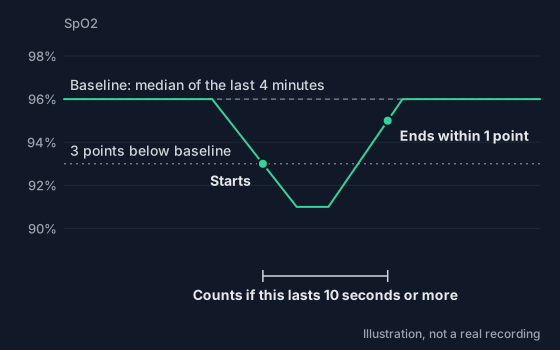
- Your baseline is the median of your previous 4 minutes of readings.
- A dip starts when a reading is 3 or more points below that baseline.
- It ends when you're back within 1 point of it.
- It only counts if it lasted at least 10 seconds.
We run the same count again with a 4 point drop. That gives you two numbers, ODI-3% and ODI-4%. The 4% count is always the same or lower, because it ignores the shallower dips.
Why is the baseline your recent level?
Because your level drifts through the night. If you've settled at 93% for a while, a reading of 92% isn't a dip. If you were at 97% and you're now at 93%, it is. A moving baseline handles both.
Why do two apps give different counts for the same night?
They've picked different rules. A different drop size, a different baseline window or a different minimum length will each change the total. So only compare counts that came from the same app and the same rule. The ODI post has more on 3% versus 4%.
Is every dip real?
No. A cold hand, a loose ring or rolling over can produce a drop that looks like one. The 10 second rule removes single stray readings, but it won't remove a minute of bad contact. We covered the causes in why your reading might be wrong.
What should you look at?
- The count per hour. That's your ODI.
- How long they last. Short dips and long ones are different nights.
- When they happen. Check whether they bunch up in one part of the night.
- Time below 90%. A dip from 97% to 94% counts as a dip, but adds nothing to T90.
A dip count isn't a sleep study. If you snore loudly, someone has heard you stop breathing or gasp, or you're exhausted during the day, see a doctor.
You can zoom into the dips on the chart in PulseOxTracker, or load one night into the free session viewer.
Not a medical device. Does not diagnose, treat or prevent any condition. Discuss results and changes with a clinician.