Fingertip Oximeter vs Arterial Blood Test
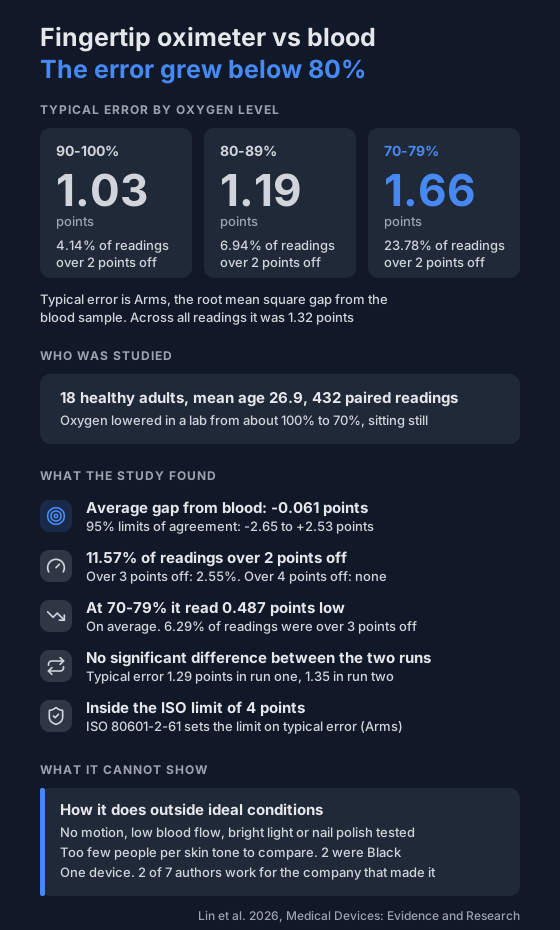
A 2026 lab study compared a fingertip pulse oximeter sensor with 432 arterial blood samples from 18 healthy adults. The error was 1.32 points overall and grew below 80%.
A pulse oximeter estimates your blood oxygen from light shone through a finger. The only way to know how close that estimate is, is to compare it with oxygen measured in arterial blood.
A study published in 2026 did that for one device, and shows where the error grows. The device was a monitor with a matched fingertip sensor, tested as one system.
How is an oximeter tested against blood?
The method is called controlled hypoxemia, and it is the standard way to test a pulse oximeter.
- Healthy volunteers breathe a nitrogen and oxygen mix, so their blood oxygen falls in steps.
- At each step the level is held steady.
- About 1 mL of arterial blood is drawn and the oximeter reading is recorded at the same moment.
- A blood gas analyser measures the oxygen saturation in the sample. That is the reference.
This study used three steps: 90-100%, 80-89% and 70-79%. Each volunteer went through them twice.
For a test that used the same method on 11 devices, see 11 fingertip oximeters tested.
Who was studied?
- 18 healthy volunteers at a single centre, with a mean age of 26.9.
- 6 men and 12 women.
- 14 were Asian, 2 were Black and 2 were Caucasian.
- Each gave 24 paired readings, for 432 in total.
The device was a monitor with an M201 SpO2 module and a matching fingertip sensor, made by Shenzhen Witleaf Medical Electronics. The paper tested the monitor, the module, its software and the sensor together as one system.
Volunteers sat still, with the sensor on the index or middle finger of the non-dominant hand. Fingers could be warmed if blood flow to them was poor.
How close was the oximeter?
Close on average.
- The average gap from blood was -0.061 points.
- The typical error (Arms, the root mean square of the gaps) was 1.32 points.
- The 95% limits of agreement ran from -2.65 to +2.53 points.
- 11.57% of readings were more than 2 points off.
- 2.55% were more than 3 points off.
- None were more than 4 points off.
The paper compares that 1.32 with the ISO 80601-2-61 limit of 4 points.
Where did the error grow?
Below 80%.
| Blood oxygen step | Typical error | Average gap | Over 2 points off | Over 3 points off |
|---|---|---|---|---|
| 90-100% | 1.03 | +0.159 | 4.14% | 1.38% |
| 80-89% | 1.19 | +0.141 | 6.94% | 0% |
| 70-79% | 1.66 | -0.487 | 23.78% | 6.29% |
- The 70-79% step differed from the other two, and the difference was statistically significant.
- The 90-100% and 80-89% steps did not differ significantly from each other.
- At 70-79% the oximeter read lower than the blood sample on average.
- The authors re-ran the numbers grouped by the measured blood value instead of the target step, and got the same pattern.
- The two runs through the steps did not differ significantly from each other.
The authors say that when a reading is low, or does not fit how the person looks, it should be read alongside an arterial blood test and the wider clinical picture.
No serious adverse events were reported.
Who paid for it?
- Two public grants: China's National Key Research and Development Program, and the Shenzhen Science and Technology Innovation Commission.
- 2 of the 7 authors work for Shenzhen Witleaf, the company that developed the device.
- The other 5 are at Shenzhen University Medical School and declared no competing interests.
The study was not registered in a trial registry before it started.
What can't it show?
- Real-world conditions. Nobody moved. The authors say it cannot show performance with motion, low blood flow, strong room light, nail polish or a low body temperature.
- Skin tone. The volunteers covered a range of skin tones, but there were too few in each group to compare them. See pulse oximeters and skin tone.
- Other people. All 18 were healthy young adults, with a mean age of 26.9.
- Other devices. One monitor and one sensor were tested. The authors note that a different probe on the same monitor can give a different error.
- Timing and quality records. The paper does not report the exact time between the blood draw and the oximeter reading, or the analyser's quality control records.
- Repeated readings. 432 readings came from 18 people, so they are not 432 independent tests.
What does this mean for your own readings?
- An oximeter reading is an estimate. In this lab test, 11.57% of readings were more than 2 points from the blood sample.
- In this test the gap was wider at lower oxygen levels.
- Volunteers sat still and cold fingers could be warmed, so the test does not show how the sensor does with movement or low blood flow.
- Look at the trend across several nights before reading much into one low number.
More on this in how accurate pulse oximeters are.
Not a medical device. Does not diagnose, treat or prevent any condition. Discuss results and changes with a clinician.
References
- Lin J, Pan S, Ma L, Ye J, Liu C, Wang F, Zhang X. Agreement and Accuracy of a Commercial Pulse Oximeter Compared with Arterial Oxygen Saturation During Controlled Hypoxemia in Healthy Volunteers. Medical Devices: Evidence and Research. 2026;19:626574. doi:10.2147/MDER.S626574