Fingertip Pulse Oximeter Accuracy: 11 Tested
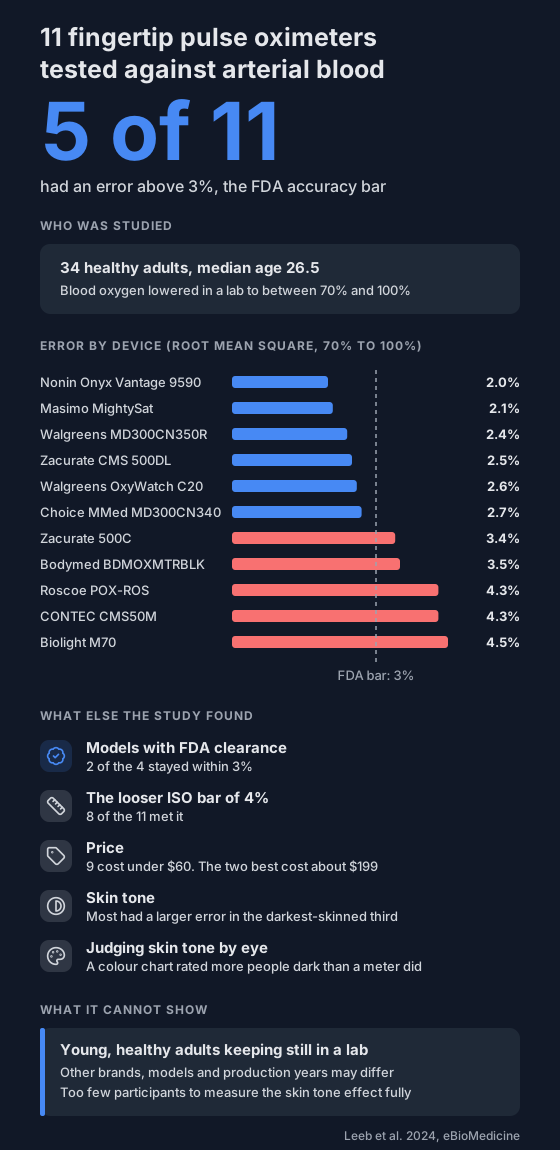
A 2024 lab study tested 11 popular fingertip pulse oximeters against arterial blood in 34 healthy adults. Five had an error above the FDA's 3% accuracy bar.
Fingertip pulse oximeters are cheap and sold everywhere. It's easy to assume the number on the display is close to the real one.
A 2024 study from the University of California, San Francisco checked 11 popular models against arterial blood. Five of them missed the FDA's accuracy bar.
Who was studied?
- 34 healthy adults, median age 26.5, half of them women.
- They breathed a low-oxygen gas mix while keeping still, which held their blood oxygen at steady levels between 70% and 100%.
- Each oximeter reading was paired with an arterial blood sample. Every device had more than 200 pairs.
How was accuracy scored?
By root mean square error: one figure for how far the readings sat from the blood value.
- FDA guidance asks for 3% or less.
- The ISO standard allows 4% or less.
How many met the bar?
- 6 of the 11 came in at 3% or less.
- 8 of the 11 came in at 4% or less.
- The two with the lowest error were the Nonin Onyx Vantage 9590 (2.0%) and the Masimo MightySat (2.1%). Both cost about $199.
- The other nine cost under $60. Four of those were within 3%.
- The three highest were the Roscoe POX-ROS (4.3%), CONTEC CMS50M (4.3%) and Biolight M70 (4.5%).
Four of the 11 had FDA clearance. Only two of those four stayed within 3% in this test.
Did skin tone matter?
The team measured skin pigment with a spectrophotometer, a meter that reads reflected light, and also rated it by eye on a colour chart.
- Most devices had a larger error in the darkest-skinned third of participants than in the lightest third.
- A printed colour chart, judged by eye, put more people in the dark group than the meter did.
The authors say the study was too small to measure the skin tone effect fully. For the wider research, see pulse oximeters and skin tone.
What can't it show?
- These were young, healthy people keeping still in a lab. The authors expect every oximeter to do worse on unwell patients.
- Only 11 models were tested. Other brands, models and production years may differ.
- No ring or wrist sensors were tested.
What can you do with this?
- In this test, a low price didn't rule a device out, and FDA clearance didn't settle it.
- Buying one? Here's what to check before buying an oximeter.
- Read your own numbers as a trend over many nights, not as an exact value. See pulse oximeter accuracy.
Not a medical device. Does not diagnose, treat or prevent any condition. Discuss results and changes with a clinician.
References
- Leeb G, Auchus I, Law T, Bickler P, Feiner J, Hashi S, Monk E, Igaga E, Bernstein M, Chou YC, Hughes C, Schornack D, Lester J, Moore K Jr, et al. The performance of 11 fingertip pulse oximeters during hypoxemia in healthy human participants with varied, quantified skin pigment. eBioMedicine. 2024;102:105051. doi:10.1016/j.ebiom.2024.105051