How Many Nights of Oximeter Data Do You Need?
Why one night of oximeter data isn't enough, and how many baseline and experiment nights to record before you compare them.
You slept on your side last night and your dip count halved. Is that down to side sleeping? One night can't tell you.
Why isn't one night enough?
Your numbers move around from night to night, even when you change nothing. Things that shift them include:
- How long you slept, and how much of it was on your back.
- A drink, a late meal or a blocked nose.
- How the sensor sat on your finger. A loose fit or cold hands can cause gaps and false dips.
So how many nights do you need?
Here's a workable rule:
- Baseline: at least five ordinary nights. Change nothing.
- Experiment: about two weeks. Change one thing and keep it changed.
If your baseline nights are all close together, five is plenty. If they're all over the place, record a few more before you start.
What counts as an ordinary night?
A night that looks like most of your nights. Leave these out of your baseline, or tag them so you can exclude them later:
- Nights when you were ill.
- Nights after heavy drinking, if that's unusual for you.
- Travel nights, especially at altitude or on a flight.
- Short recordings, or ones where the sensor came off.
How do you compare the two sets?
- Take the average of each number across your baseline nights.
- Do the same for your experiment nights.
- Then look at the spread. Write down the lowest and highest ODI in each set.
If the two ranges overlap a lot, you can't say the change did anything. If most experiment nights sit outside your baseline range, that's worth a longer look.
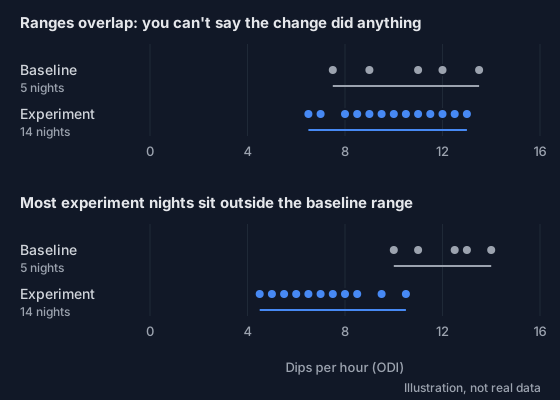
Either way, it's an association in your own nights, not proof of cause.
What mistakes should you avoid?
- Changing two things at once. If you cut alcohol and switch to your side in the same week, you won't know which one mattered.
- Stopping at the first good night. Finish the two weeks.
- Picking nights after the fact. Decide which nights count before you look at the numbers.
What can you test?
Start with one of these:
Where do you do the comparing?
The device's own app shows one night at a time. In PulseOxTracker you can tag the nights in each set and see average ODI and heart rate for tagged nights next to the rest.
An oximeter is not a sleep study. If you snore loudly, gasp in your sleep or feel exhausted during the day, see a doctor.
Not a medical device. Does not diagnose, treat or prevent any condition. Discuss results and changes with a clinician.