3 Nights of Oximetry in Motor Neuron Disease
A 2025 study of 132 three-night oximeter recordings in people with motor neuron disease found the numbers barely moved night to night, yet night one alone missed 11 of 94 recordings that crossed a cut-off.
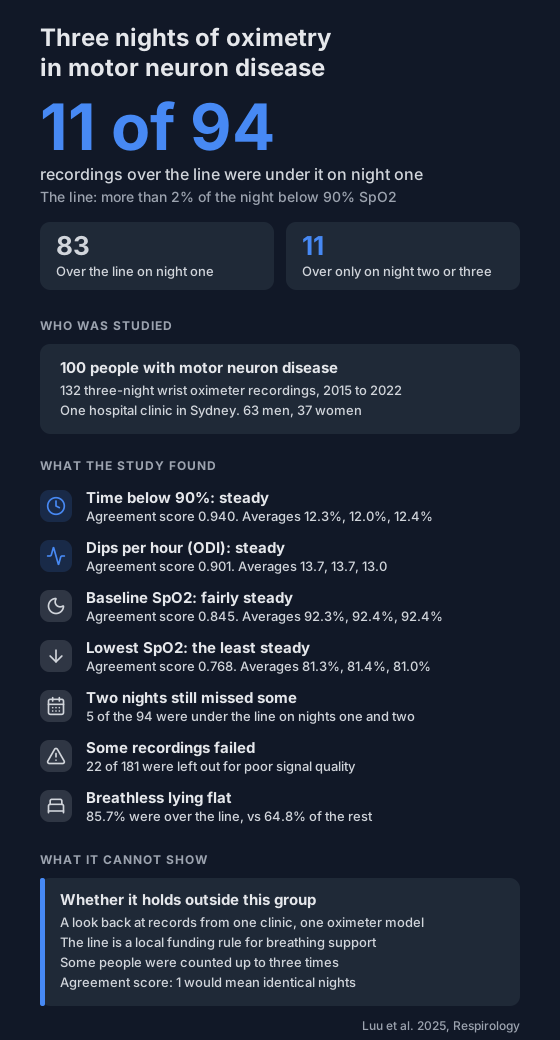
If your numbers look the same every night, one night should be enough. That sounds reasonable. A 2025 study of people with motor neuron disease found it isn't quite true.
The numbers were very steady across three nights. One night still put some people on the wrong side of a cut-off.
For the general question, see how many nights to record.
Who was studied?
- 100 people with motor neuron disease at one hospital clinic in Sydney, 63 men and 37 women.
- 132 recordings, each three nights in a row, made between 2015 and 2022.
- Everyone wore the same wrist oximeter, and each night needed at least 4 hours of clean signal.
- 78 people gave one recording, 12 gave two and 10 gave three.
In motor neuron disease the breathing muscles weaken, and it often shows first during sleep. Clinics use overnight oximetry to help decide when to offer a breathing support machine worn at night (non-invasive ventilation). The guidelines the authors checked don't say how many nights to record.
How steady were the numbers?
Very. The averages across the 132 recordings:
| Night 1 | Night 2 | Night 3 | |
|---|---|---|---|
| Time below 90% | 12.3% | 12.0% | 12.4% |
| Dips per hour (ODI) | 13.7 | 13.7 | 13.0 |
| Baseline SpO2 | 92.3% | 92.4% | 92.4% |
| Lowest SpO2 | 81.3% | 81.4% | 81.0% |
The authors also scored how well each person's three nights agreed, on a scale where 1 means identical.
- Time below 90%: 0.940.
- Dips per hour: 0.901.
- Baseline SpO2: 0.845.
- Lowest SpO2: 0.768.
They rated the first two "excellent" and the last two "good". Lowest SpO2 is a single moment in the night, so one bad reading can set it. The authors say it can mislead when nobody has checked the trace for artefact.
So why did one night miss people?
In the authors' region, government funding for the machine needs more than 2% of the night below 90% SpO2, among other criteria. The study counted a recording as over the line if any of its three nights passed 2%.
- 94 of the 132 recordings were over the line.
- 83 of those 94 were already over it on night one.
- 11 (12%) were under it on night one.
- 5 (5%) were still under it after nights one and two.
High agreement across a group still leaves room for one person's nights to land on different sides of a fixed line. The paper doesn't report how close those 11 were to it.
Night one wasn't the only information the clinic had. 5 of the 11 also had a lung capacity test below 50% of the predicted value, a cut-off some guidelines use for the same decision. 3 of the 11 had no lung capacity result on file.
What else did it find?
- Failed recordings. 22 of the 181 recordings the clinic had on file were left out for poor signal quality, and 19 more had fewer than three nights.
- Breathless lying flat. 85.7% of recordings from people who reported it were over the line, against 64.8% of the rest. The range around that estimate was wide.
- Weak cough. A low peak cough flow showed no statistically significant link with being over the line.
- Lung function tests. None showed a statistically significant link with how much a person's numbers varied between nights.
The authors favour several nights for this decision. They say one night may do when other tests already point strongly the same way, or when more nights aren't practical.
What can't it show?
- It looked back at existing records from one clinic.
- Everyone used one oximeter model, so other devices may behave differently.
- Recordings from the same person were counted as separate, so some people count up to three times.
- People with other heart or lung conditions weren't excluded, and those can also lower oxygen overnight.
- Much of the lung function data was missing.
- The 2% line is a local funding rule, not a universal one.
- It's about people with motor neuron disease. The authors note that night-to-night variation has been reported as high in sleep apnea and COPD and low in chronic heart failure.
The authors report no specific funding. One author sits on the journal's editorial board and took no part in the decision to publish.
What can you take from it?
- Steady averages across a group don't make one night enough for one person.
- Record several nights before reading anything into a number near a cut-off. Another study compared one night with weeks of tracking.
- Some nights won't record cleanly, which is another reason to plan for more than one.
- Don't lean on your lowest SpO2 from a single night.
- If you have a neuromuscular condition, your care team decides what your recordings mean. Here's how to share them.
Not a medical device. Does not diagnose, treat or prevent any condition. Discuss results and changes with a clinician.
References
- Luu S, McGuiness O, Menadue C, Piper AJ, Wong K, Yee BJ, Gray EL. Inter-Night Variability of Nocturnal Pulse Oximetry in People Living With Motor Neuron Disease: A Retrospective Observational Study. Respirology. 2025;30(10):995-1002. doi:10.1111/resp.70072