One Sleep Study vs 3 Months of Tracking
A 2026 study tracked 92 adults with an under-mattress sleep tracker for 3 months alongside a single-night sleep study. For 16 of 78, the two landed on different sides of the same cut-off.
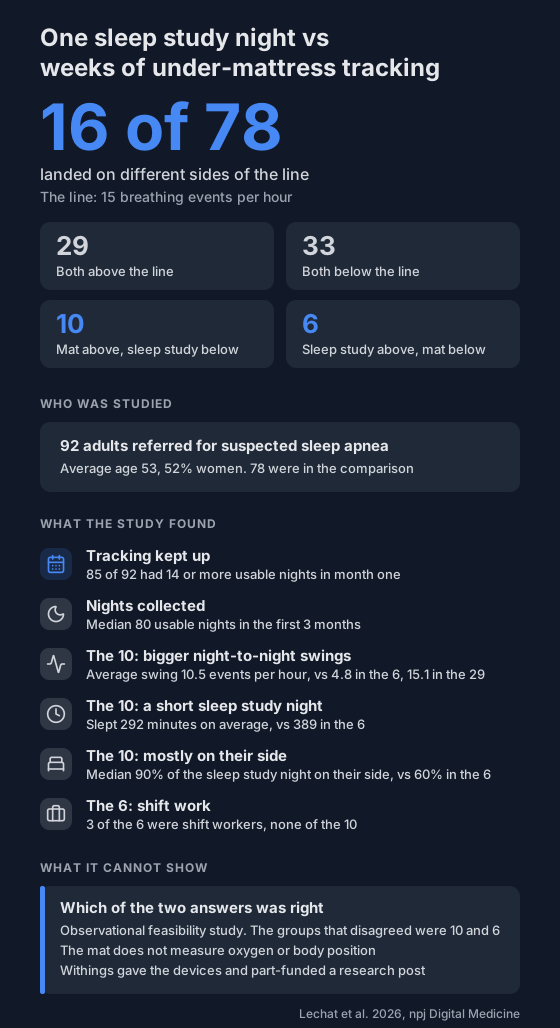
A sleep study measures one night. Breathing during sleep changes from night to night.
A 2026 Australian study put a sleep tracker under people's mattresses for 3 months and compared it with their single-night sleep study.
Who was in the study?
- 92 adults referred to sleep clinics in South Australia for suspected sleep apnea.
- Average age 53, 52% women.
- Each got a Withings Sleep Analyzer, a mat under the mattress that estimates breathing events per hour.
- Each also had one sleep study: 54 in a lab, 38 at home.
Did people keep tracking?
- 85 of the 92 (92%) had at least 14 usable nights in the first month.
- The median was 80 usable nights over 3 months.
How often did the two disagree?
The cut-off was 15 breathing events per hour. The sleep study was compared with the mat's average over the weeks around it, in 78 people. The other 14 were on therapy already or started it too early.
- 29 were above the cut-off on both.
- 33 were below it on both.
- 10 were above it on the mat only.
- 6 were above it on the sleep study only.
So 16 of 78 got a different answer.
What did those people have in common?
The 10 above the cut-off only on the mat:
- Had bigger night-to-night swings: 10.5 events per hour on average, against 4.8 in the 6. The 29 above on both had the biggest swings, 15.1.
- Slept less on the sleep study night: 292 minutes on average, against 389.
- Spent a median 90% of that night on their side in the paper's table, against 60% in the 6.
Of the 6 above it only on the sleep study, 3 were shift workers, against none of the 10. The authors say irregular sleep may throw off the mat's estimate.
More: back vs side sleeping.
What can't it show?
- Which answer was right. Neither method was taken as the reference.
- This was an observational feasibility study, and comparing the two methods was a secondary aim.
- Why they disagreed. The authors urge caution with groups this small.
- The mat doesn't measure oxygen or body position.
- Withings gave the devices and part-funded a research assistant.
What can you do with this?
The study used a mat, not an oximeter.
- Record several nights before reading much into one. See how many nights to record.
- Put nights side by side with the compare nights tool.
Not a medical device. Does not diagnose, treat or prevent any condition. Discuss results and changes with a clinician.
References
- Lechat B, Proctor S, Manners J, Loffler KA, Leviton A, Toson B, Vena D, Vakulin A, Fitton J, Adams RJ, Mukherjee S, Eckert DJ. Zero burden multi night monitoring with AI enabled technology reduces obstructive sleep apnea misdiagnosis. npj Digital Medicine. 2026;9(1):753. doi:10.1038/s41746-026-02914-w