Asleep or Awake on CPAP? A 2026 Study
CPAP logs count mask hours, not sleep. A 2026 study taught a model to tell sleep from wake using CPAP airflow and got 82% of 30-second stretches right, better on sleep than wake. Three authors are from PranaQ.
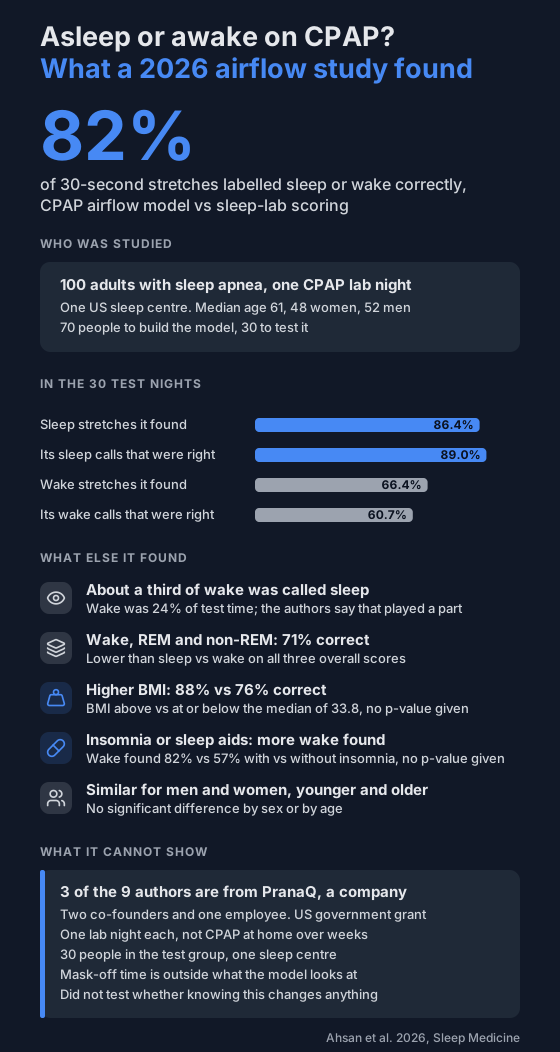
Your CPAP machine's usage hours count the time the mask is on. They don't tell you whether you were asleep for those hours. A 2026 study from Yale asked whether the machine's own airflow signal could tell sleep from wake.
A computer model got 82% of 30-second stretches right, compared with sleep-lab scoring. It was much better at spotting sleep than wake. Three of the nine authors are from PranaQ, a company in New York.
Who was studied?
- 100 adults with obstructive sleep apnea, picked at random from people who had a CPAP night at the Yale sleep lab between 2018 and 2023.
- 48 women and 52 men, with a median age of 61 and a median BMI of 33.8.
- Most had other health problems: over 75% had high blood pressure, and about a third had insomnia.
- On CPAP at the pressure chosen for them, they had a median of 3 breathing events per hour.
The team used 70 people to build the model and the other 30 to test it. Trained sleep technologists scored each 30-second stretch as sleep or wake from brain waves, as usual in a sleep lab.
How did the model work?
It used only things a CPAP user already has:
- The airflow signal from the CPAP machine, broken into 30-second stretches.
- The CPAP pressure.
- Age, sex and BMI.
From the airflow it worked out 126 measures, such as how regular the breathing was. Breathing tends to be steadier in sleep than when you're awake. Times with the mask off were left out.
What did it find?
In the 30 test nights, about 210 hours of recording, 76% of the time was sleep and 24% was wake.
- Overall: 82% of stretches labelled correctly.
- Sleep: it found 86.4% of the sleep, and 89.0% of the stretches it called sleep were sleep.
- Wake: it found 66.4% of the wake, and 60.7% of the stretches it called wake were wake.
So about a third of the time people were awake on CPAP, the model called it sleep. The authors put this partly down to sleep making up most of the night. They also say a wake call from the model told you more than a sleep call did, once you allow for wake being the rarer state.
The authors compare the 82% with the 83% agreement that sleep technologists reach with each other in a US scoring programme, though that programme covers five sleep stages, not two.
Who did it work best for?
- Men and women, younger and older: no significant difference.
- BMI above 33.8: 88% correct, against 76% at or below it.
- Insomnia: it found 82% of wake with insomnia, against 57% without.
- Sleep aids: it found 83% of wake in people on them, against 50% in people not on them.
Each of these groups had 12 to 18 people in the test set. The paper gives no p-values for the BMI, insomnia and sleep-aid gaps. The authors describe them as marked, and suggest broken, lighter sleep makes the switch between sleep and wake easier to see in the breathing. Quiet, still wake looks more like sleep.
Telling wake, REM sleep and non-REM sleep apart was harder: 71% of stretches correct.
What can't it tell you?
- Who wrote it. Three of the nine authors are from PranaQ: two co-founders and one employee. Another author has grant funding from ResMed, which makes CPAP machines. The study was funded by a US government research grant. The paper doesn't say whether the model is a PranaQ product.
- Home use. Everyone was in a sleep lab for one night, where the pressure is adjusted during the night. Accuracy wasn't linked to how often the pressure changed, but the authors say it needs testing on CPAP at home, over many nights.
- Size. The model was tested on 30 people from one sleep centre.
- A gap between groups. The test group had spent more time below 90% oxygen on their earlier sleep test than the training group (median 28.5% vs 8.0% of the night). The authors say that may have affected the results.
- Mask-off time. The model only looks at time with the mask on. It can't say how much sleep happened after the mask came off.
- Whether it changes anything. It didn't test whether knowing your mask-on sleep time changes CPAP use or how you feel.
What can you do with this?
Read your CPAP usage hours as mask time, not sleep time. If you often lie awake with the mask on, or take it off partway through the night, tell your clinic. The usage hours show when the mask came off, but not whether you were awake with it on.
For more on what the CPAP log does and doesn't record:
- What your CPAP log misses on part-use nights
- Misjudging your own sleep with sleep apnea
- Still sleepy on CPAP
The model didn't use oximeter data. An overnight oximeter doesn't tell sleep from wake either, but it logs your oxygen and pulse for as long as you wear it, mask on or off. Tracking your oxygen alongside CPAP explains what that adds and what it can't tell you.
Not a medical device. Does not diagnose, treat or prevent any condition. Discuss results and changes with a clinician.
References
- Ahsan M, Chen HY, Chen CJ, Anwar AI, Tolbert TM, Rapoport DM, Yaggi HK, Wu HT, Zinchuk AV. Predicting sleep state from continuous positive airway pressure flow in patients with obstructive sleep apnea. Sleep Medicine. 2026;145:109044. doi:10.1016/j.sleep.2026.109044