Bed Sensor vs CPAP Data: A 2026 Study
A 2026 study put an under-mattress sensor beside CPAP machines for 448 nights. The sensor counted 11.3 breathing events an hour, the machines 2.0. The sensor's maker funded it.
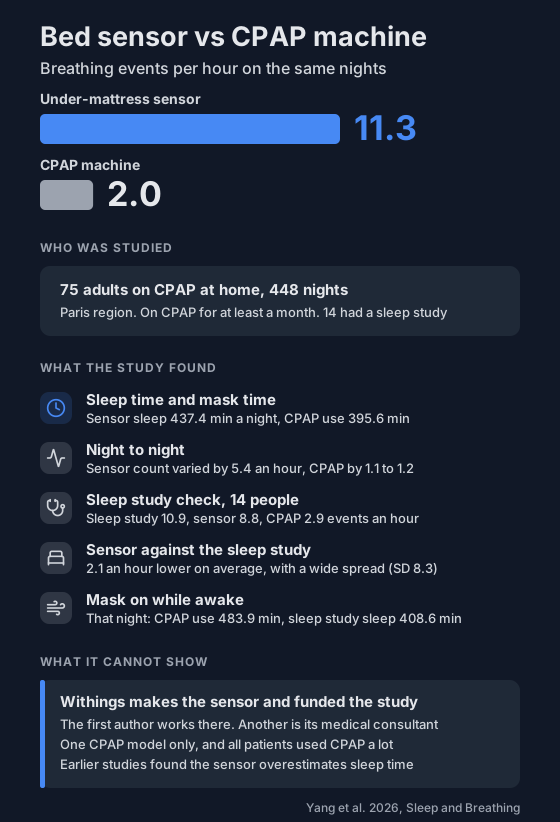
Your CPAP machine reports how many breathing events it still sees each hour. A 2026 study put a second device in the same bed and got a higher count. The second device's maker paid for the study.
Who was in the study?
- 75 adults with obstructive sleep apnea from six sleep centres around Paris. 115 enrolled and 40 were excluded for protocol deviations.
- All had been on CPAP for at least a month and used it a lot.
- Each had a Withings Sleep Analyzer, a pressure pad under the mattress, for about a week.
- 448 nights were analysed, all with over 5 hours of sensor-logged sleep.
What did the two devices report?
- Breathing events per hour: sensor 11.3, CPAP machine 2.0.
- Time: the sensor logged 437.4 minutes of sleep a night. The machine logged 395.6 minutes of use.
- Night to night: the sensor's count moved by 5.4 an hour within the same person. The machine's moved by 1.1 to 1.2 (the paper prints both).
The authors give two reasons for the 42-minute gap. Some sleep happened with the mask off, and earlier studies found the sensor overestimates sleep by 20 to 26 minutes.
Which one was closer to a sleep study?
14 patients had a one-night home sleep study with both devices running.
- Sleep study: 10.9 events an hour.
- Sensor: 8.8.
- CPAP machine: 2.9.
The sensor was closer on average, but its count was still statistically lower than the sleep study's. The differences were spread wide (standard deviation 8.3 an hour).
That night the patients kept their masks on until a technician arrived. So CPAP use (483.9 minutes) was longer than sleep on the sleep study (408.6 minutes). The authors say time awake with the mask on can make the machine's hourly count look lower.
What can't it show?
- Withings funded the study and paid clinicians for their time.
- The first author is a Withings employee, and the corresponding author is its medical consultant.
- The sleep study check covered 14 people for one night.
- One CPAP model only, the ResMed AirSense 10. The authors say the result may not hold for other brands.
- Nobody saw the sensor data during the study, so it doesn't show whether having it changes anything.
What can you do with it?
A CPAP report covers only the time the mask is on. For a record of the whole night, you can track your oxygen alongside CPAP. Take questions about your numbers to your sleep clinic.
Not a medical device. Does not diagnose, treat or prevent any condition. Discuss results and changes with a clinician.
References
- Yang RY, Seailles T, Aisenberg N, Felix O, Sabil A, Escourrou P. Comparison of under-mattress sensor and CPAP data for home monitoring in obstructive sleep apnea. Sleep and Breathing. 2026;30(4):194. doi:10.1007/s11325-026-03741-9