What Your CPAP Log Misses on Part-Use Nights
A 2026 study ran a phone-based sleep test beside CPAP for 667 nights. On nights the mask came off early, the phone counted 11.0 breathing events an hour and the machine 2.8. Six authors work for the app's maker.
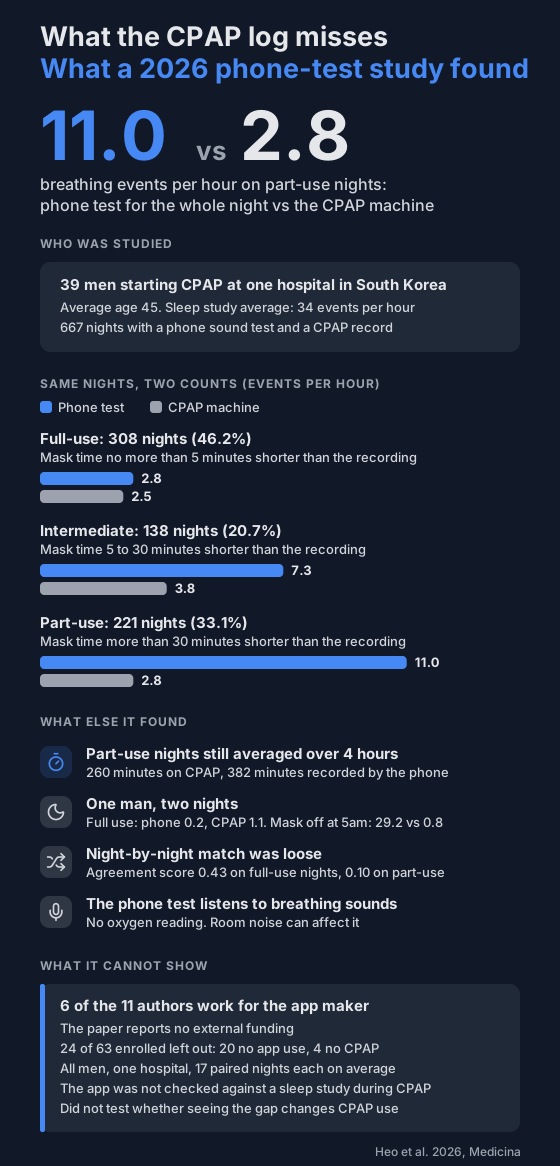
Your CPAP machine reports how many breathing events it still sees each hour. It can only count while the mask is on. A 2026 observational study from South Korea ran a phone-based home sleep test beside CPAP for 30 days to see what happens in the rest of the night. Six of its 11 authors work for the company that makes the phone app.
On nights when the mask was on for only part of the night, the phone counted 11.0 breathing events per hour. The CPAP machine reported 2.8.
Who was studied?
- 63 adults newly prescribed CPAP at one hospital sleep clinic were enrolled.
- 24 were left out before the analysis: 20 didn't use the phone app and 4 never started CPAP.
- That left 39, all men, with an average age of 45.
- Their sleep-lab study had found an average of 34 breathing events per hour.
- They produced 667 nights with both a phone recording and a CPAP record, about 17 nights each.
How did the two counts work?
- CPAP machine: a ResMed AirSense 10 in auto-adjusting mode. It counts events from airflow, and only while it's running.
- Phone test: an app called ApnoTrack, placed within about 1 metre of the head of the bed. It estimates breathing events from sound for the whole recording.
The team sorted each night by how much shorter the mask time was than the phone recording:
- Full-use: no more than 5 minutes shorter. 308 nights (46.2%).
- Intermediate: 5 to 30 minutes shorter. 138 nights (20.7%).
- Part-use: more than 30 minutes shorter. 221 nights (33.1%).
What did the two counts show?
Average breathing events per hour, phone test vs CPAP machine:
- Full-use nights: 2.8 vs 2.5. No statistically significant difference (p = 0.13).
- Intermediate nights: 7.3 vs 3.8 (p < 0.001).
- Part-use nights: 11.0 vs 2.8 (p < 0.001).
The paper shows one man on two nights. On a full-use night the phone counted 0.2 and the machine 1.1. On a night when he stopped CPAP at about 5am, the phone counted 29.2 and the machine 0.8.
Weren't those short CPAP nights?
Not by the usual yardstick. Clinics commonly count 4 hours a night as adequate use.
On part-use nights the mask was on for an average of 260 minutes, which is over 4 hours. The phone recording averaged 382 minutes, so about 2 hours of the night were off CPAP.
The authors suggest phone monitoring during the first 30 days of CPAP, and a follow-up when the two counts differ by more than 3 events per hour on at least 30% of nights. That's their proposal, not something this study tested. They also say larger studies at more than one hospital are needed before this kind of monitoring can be broadly recommended.
What can't it tell you?
- Who wrote it. Six of the 11 authors work at the research institute of Asleep Inc., the company that makes the app. The paper's conflict of interest statement names those six, and the other five authors declare no conflicts. Its funding statement says the research received no external funding.
- Who was left out. 24 of 63 people dropped out of the analysis, mostly because they didn't use the app. The paper found no statistically significant differences between the two groups on the starting measures it compared, but the authors say the result favours people who can keep up with both devices.
- What kind of study. It was a small observational study at one hospital, with no comparison group.
- Everyone. All 39 were men. The authors say women, other ethnic groups and people with fewer events per hour need their own studies.
- Which count is right. The app was checked against home sleep studies in earlier work, but not against a sleep study during CPAP. Here it was only compared with the machine's own count.
- Single nights. The averages lined up on full-use nights, but individual nights didn't match closely. The agreement score was 0.43 on full-use nights and 0.10 on part-use nights, on a scale where 1 is a perfect match.
- Oxygen. The app works from sound alone and records no oxygen level. The authors list room noise, the phone's microphone and a second sleeper as things that can affect it.
- Whether it changes anything. The study didn't test whether showing people the gap leads to more CPAP use.
What can you do with this?
Read your machine's events-per-hour figure as a count for mask-on time, not for the whole night. Check it next to the usage hours on the same report.
If the mask often comes off before morning, tell your clinic. What a review found about sticking with CPAP covers the common reasons.
Other studies have put a second device beside CPAP:
An overnight oximeter is a different kind of record, and this study didn't use one. It doesn't count breathing events, but it logs your oxygen and pulse for as long as you wear it, mask on or off. Tracking your oxygen alongside CPAP explains what that adds and what it can't tell you.
Not a medical device. Does not diagnose, treat or prevent any condition. Discuss results and changes with a clinician.
References
- Heo S, Kim S, Moon S, Lee S, Lee D, Hong J, Chung YS, Kim HJ, Hong JK, Yoon IY, Kim JW. Continuous Monitoring of Positive Airway Pressure Therapy with a Smartphone-Based Home Sleep Apnea Test. Medicina (Kaunas). 2026;62(6):1008. doi:10.3390/medicina62061008