CPAP, Heart Events and Time Below 90%
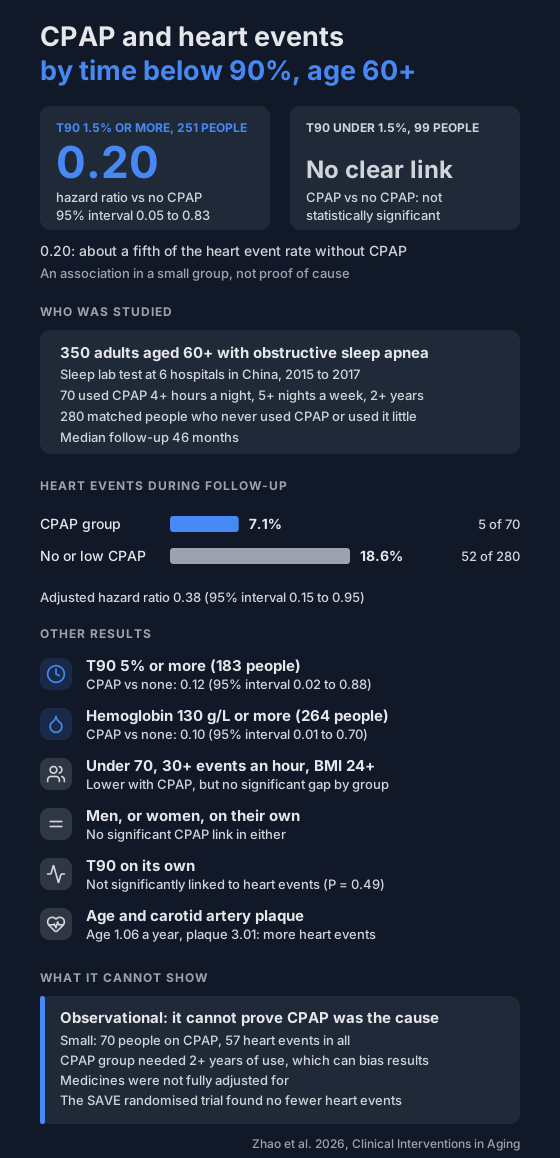
A 2026 study of 350 adults aged 60 and over with sleep apnea linked regular CPAP use to fewer heart events in those with a T90 of 1.5% or more, with no statistically significant link below that. It's observational and the CPAP group was 70 people.
A major randomised trial of CPAP, SAVE, found no fewer heart events overall. One reason discussed in this paper is that SAVE left out people with a lot of low oxygen at night.
A 2026 study from China looked at older adults with sleep apnea and split them by T90, the share of the night spent below 90% oxygen. Regular CPAP use was linked to fewer heart events in those with more time below 90%, with no statistically significant link in those with very little.
Who was in the study?
- 350 adults aged 60 and over, all with obstructive sleep apnea found on a sleep lab test at one of 6 hospitals in China, between 2015 and 2017.
- People who'd already been in hospital for a heart attack, unstable angina or heart failure were left out.
- 70 used CPAP regularly: at least 4 hours a night, at least 5 nights a week, for more than 2 years.
- 280 had never used CPAP or used it poorly, including people who stopped within 6 months.
- Each CPAP user was matched with 4 non-users on age, sex, BMI, breathing events per hour, T90, smoking, drinking and common health conditions.
- The median follow-up was 46 months.
Heart events meant a heart attack, death from heart disease, or a hospital stay for unstable angina or heart failure.
What did it find overall?
- 7.1% of the CPAP group had a heart event (5 of 70), against 18.6% of the others (52 of 280).
- After adjustment, the hazard ratio was 0.38 (95% interval 0.15 to 0.95).
- Older age and carotid artery plaque or thickening (in the neck) were each linked to more heart events.
Did time below 90% make a difference?
This is the part the authors focus on.
- T90 of 1.5% or more (251 people): CPAP use was linked to fewer heart events, hazard ratio 0.20 (95% interval 0.05 to 0.83).
- T90 of 5% or more (183 people): hazard ratio 0.12 (0.02 to 0.88).
- T90 under 1.5% (99 people): no statistically significant link between CPAP and heart events.
On a 7-hour night, 1.5% is about 6 minutes below 90%, and 5% is about 21 minutes.
A formal test found the T90 split made a statistically significant difference to the CPAP link, though only just (P = 0.049). The same was true for a split by hemoglobin, the oxygen-carrying protein in blood: the link was seen at 130 g/L or more, hazard ratio 0.10.
T90 on its own wasn't significantly linked to heart events. It mattered here only in how the CPAP link differed between groups.
What about other groups?
CPAP use was also linked to fewer heart events in people under 70, people with 30 or more breathing events an hour and people with a BMI of 24 or more. But the tests didn't show those groups differed significantly from the rest. Neither men nor women, on their own, showed a significant link.
What can't this study show?
The authors list several limits.
- It's observational. People chose whether to use CPAP, so it can't show CPAP caused the difference.
- It's small. 70 people were on CPAP and there were 57 heart events in all, so the subgroup results are unstable and could be false positives. The wide intervals show it.
- Grouping by long-term use. The CPAP group had to use it for more than 2 years, and the authors say grouping this way can bias the comparison.
- Missing factors. Blood pressure and diabetes medicines weren't fully adjusted for, so other differences between the groups can't be ruled out.
- Follow-up. About 4 years may be too short to see long-term effects.
The paper doesn't say how many CPAP users were in the low T90 group, only that there were fewer.
The authors also point to low CPAP hours in SAVE, an average of 3.3 a night, as a possible reason for its result. For the wider picture, see the 2026 review of CPAP and heart health and a larger cohort study of CPAP and heart events.
What can you do with this?
Your overnight oximeter reports T90, so you can see which side of 1.5% your nights fall on. The study measured T90 on a sleep lab test, and a home oximeter is not a sleep study. One night can mislead, so look at the trend across several.
If you use CPAP, an oximeter can show your time below 90% on and off the machine. See tracking your oxygen alongside CPAP. Take your numbers to your doctor if you want to talk about what they mean for you.
Not a medical device. Does not diagnose, treat or prevent any condition. Discuss results and changes with a clinician.
References
- Zhao L, Wang T, Gao Y, Ding Y, Zhang Y, Rui D, Zhao Z, Xue X, Zhao X, Liu L, Zeng Y. Effect Heterogeneity of CPAP on MACE by Nocturnal Hypoxia Burden in Older Adults OSAS: A Propensity Score Matching Study. Clinical Interventions in Aging. 2026;21:603046. doi:10.2147/CIA.S603046