CPAP Use in Over-70s: A Spanish Study
A Spanish study of 5,903 people on CPAP found those aged 70 and over used it slightly more each night than younger users: 4.9 hours against 4.5 on average.
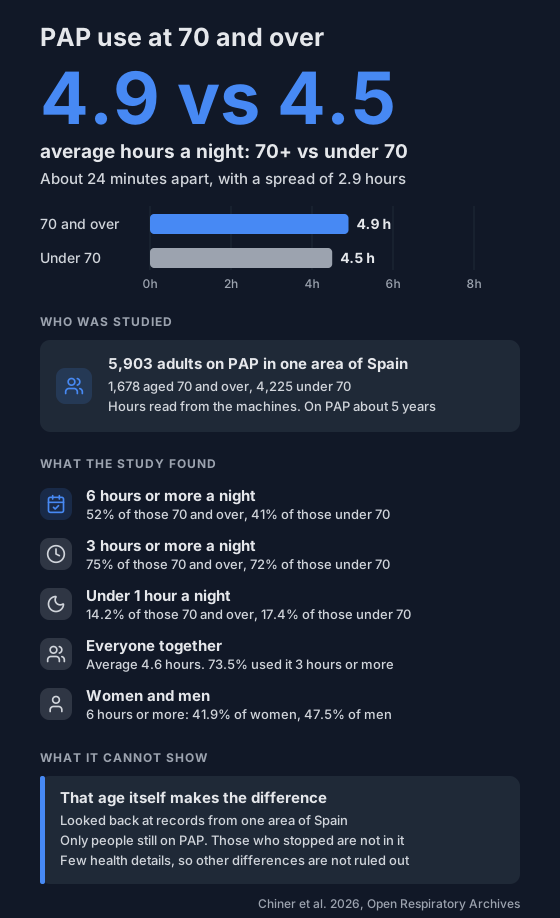
Some studies find older people are less likely to take up CPAP at the start. A short paper from Spain, published in 2026, looked at the hours recorded on 5,903 machines in one health area. People aged 70 and over used theirs slightly more each night than younger users.
Who was in the study?
- 5,903 adults with obstructive sleep apnea on positive airway pressure (PAP) in one health area around Alicante, Spain, which serves about 250,000 people.
- Most used fixed-pressure CPAP (4,843). 1,049 used AutoCPAP and 11 used a bilevel machine.
- 74.7% were men and the average age was 61. Among those over 70, half were women.
- They'd been on PAP for about 5 years on average (63.5 months).
- Hours of use came from the machine's hour counter, read twice 3 to 6 months apart, between 2024 and 2025.
What did it find?
Everyone together averaged 4.6 hours a night. 73.5% used it 3 hours or more, and 46.1% used it 6 hours or more. 16.4% used it under 1 hour.
Split by age:
- Average use: 4.9 hours a night at 70 and over, against 4.5 under 70.
- 6 hours or more: 52% of those 70 and over, against 41% of those under 70.
- 3 hours or more: 75% against 72%.
- Under 1 hour: 14.2% against 17.4%.
Men used it a little more than women: 47.5% of men and 41.9% of women reached 6 hours or more.
How big is that gap?
Small. 4.9 against 4.5 hours is about 24 minutes a night. In both groups, individual use spread widely, with a standard deviation of 2.9 hours. The difference was statistically significant (p < 0.001) in a large sample, but plenty of younger people used theirs more than plenty of older people.
The authors put their results alongside other studies in older adults, which found averages of 4.3 to 5.2 hours a night. Another series found average compliance of only 55% in people over 65, and the paper notes that education and family support went with better use there.
This doesn't match a 2026 review that found CPAP use falls with age, especially past 80. The paper itself notes earlier work suggesting use rises up to about 75 to 80 and drops after that. It doesn't split the over-70 group further.
What can't it show?
- Cause. It looked back at existing records, so it shows what went together, not that age itself makes the difference.
- People who gave up. It counted people still set up on PAP, about 5 years in. Anyone who stopped earlier isn't in the figures.
- Other differences. The authors say detailed health information wasn't collected, so other factors aren't ruled out.
- Anywhere else. It's one health area in Spain.
- Detail. It's a very short paper, and a few totals and p-values in its first table don't match the text.
The study had no specific funding, and the authors declared no conflicts of interest.
What can you do with this?
If you're over 70 and on CPAP, this study found people your age used it at least as much as younger users. For what helps people keep going, see sticking with CPAP.
Your machine's hours are one number. An overnight oximeter shows what your oxygen did on those nights, which you can track alongside CPAP and share with your doctor.
Not a medical device. Does not diagnose, treat or prevent any condition. Discuss results and changes with a clinician.
References
- Chiner E, Boira I, Verbilt C, Vañes S, Fernández P, Martínez A, Esteban V. Adherence Patterns to Positive Airway Pressure in Elderly Patients With Obstructive Sleep Apnea. Open Respiratory Archives. 2026;8(3):100650. doi:10.1016/j.opresp.2026.100650