Home Sleep Tests and CPAP Use: Iceland Study
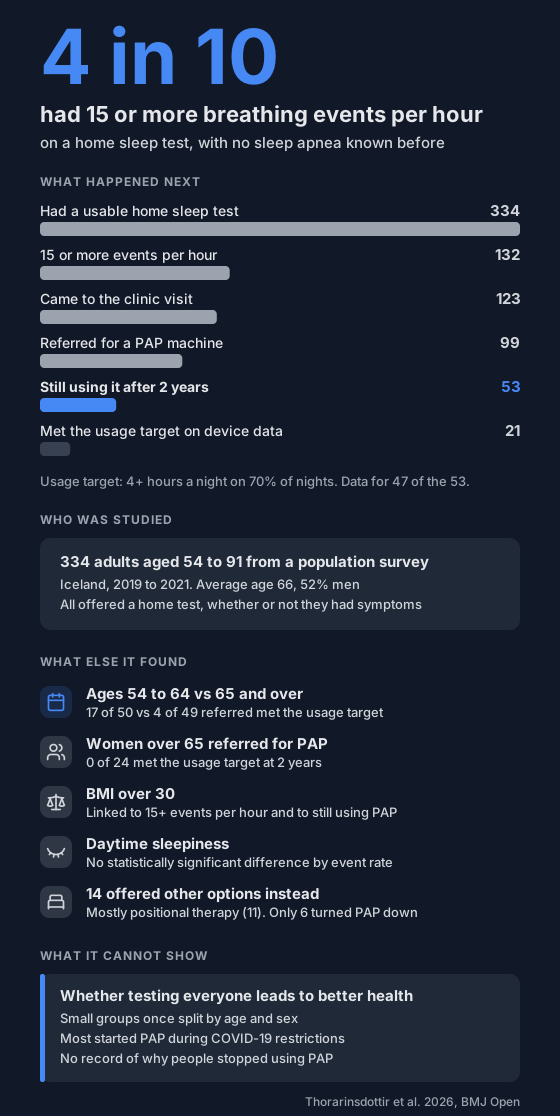
A 2026 Icelandic study offered home sleep tests to 334 adults aged 54 to 91. 4 in 10 had 15 or more breathing events per hour, and 53 of the 99 referred for a PAP machine were still using it two years later.
Sleep apnea often goes unrecognised. But what happens if you offer everyone a sleep test, not just people with symptoms?
An observational study from Iceland, published in BMJ Open in 2026, did just that with older adults from a population survey. 4 in 10 had 15 or more breathing events per hour. Most of those were referred for a PAP machine, and about half of them said they were still using it two years later.
Who was in the study?
- 334 adults aged 54 to 91, average age 66, 52% men.
- They came from a long-running lung health survey that picked adults at random from the general population in 2012.
- None had known sleep apnea: the 26 who already had a sleep apnea label were left out.
- Everyone was offered a home sleep test between 2019 and 2021, whether they had symptoms or not.
- The test recorded airflow, breathing effort and oxygen through a finger sensor.
Uptake was high. Only 12 people turned the test down.
What did the tests show?
- 16.4% had fewer than 5 breathing events per hour.
- 44.0% had 5 to 14.9.
- 27.0% had 15 to 29.9.
- 12.6% had 30 or more.
So 132 of 334 (39.5%) had 15 or more events per hour. That was the cut-off for being invited to a clinic visit.
People with more events per hour were more often older, male, heavier and snorers. Those with a BMI of 30 or more had about six times the odds of 15 or more events per hour, compared with a BMI under 25, after allowing for age, sex, sleepiness and snoring.
Daytime sleepiness scores didn't differ significantly between the groups. Many people with high event counts didn't feel especially sleepy. More on that in sleep apnea without sleepiness.
How many took up CPAP?
Of the 132:
- 123 came to the clinic visit.
- 99 were referred for an auto-adjusting PAP machine, the same family as CPAP.
- 14 were offered something else, mostly advice on sleep position (11 people), a mouthpiece (2) or an ear, nose and throat referral (1).
- 4 put it off because of other health problems.
- Only 6 turned PAP down.
Were they still using it two years later?
Of the 99 referred:
- 53 said they were still using it after two years.
- 3 never started.
- 43 were no longer using it.
- 40 had handed the machine back within the first year.
- 2 people died during follow-up, and the paper doesn't say which group they're counted in.
- Device data was available for 47 of the 53 users.
- 21 of those 47 met the usage target: at least 4 hours a night on 70% of nights in the past month.
The authors say that's similar to routine sleep clinic patients. For what helps and hinders long-term use, see sticking with CPAP.
Did age matter?
A lot, at least for regular use.
- Ages 54 to 64: 17 of the 50 referred met the usage target.
- Ages 65 and over: 4 of the 49 referred did.
- Women over 65: none of the 24 referred met it.
People still using PAP were more likely to have a BMI over 30. Age, sex, sleepiness, snoring and event count weren't significantly linked to still using it.
Not every study agrees: a Spanish study of people already on CPAP found those 70 and over used it slightly more.
What can't it tell you?
- Whether testing everyone helps. The study measured uptake, not health. The authors note a US panel found in 2022 that the evidence is not enough to say whether testing the general population leads to better health.
- Small groups. Once split by age and sex, some groups had only a few dozen people.
- COVID-19. Only 6 people started PAP before the pandemic restrictions, and follow-up was partly remote.
- Why people stopped. Reasons for giving up PAP weren't recorded.
- The test. A home test without brain-wave sensors can count fewer events than a sleep lab study.
- Who took part. People who stayed in the survey were younger than those who didn't come back for this round.
- Funding. The survey was funded by the UK Medical Research Council, AstraZeneca and the Icelandic Research Fund.
The authors suggest testing targeted at younger adults with obesity may fit better than testing everyone, and say that needs its own trial.
What can you do with this?
If you snore, or someone has heard you stop breathing, tell your doctor, even if you don't feel sleepy. The sleep apnea risk check takes about a minute and helps you decide whether to raise it.
An overnight oximeter can't tell you whether you have sleep apnea. It records your oxygen and pulse each night, and you can share that with your doctor. Already on CPAP? See tracking your oxygen alongside CPAP.
Not a medical device. Does not diagnose, treat or prevent any condition. Discuss results and changes with a clinician.
References
- Thorarinsdottir EH, Benediktsdottir B, Aspelund T, Palsdottir HS, Hreggvidsdottir S, Gudmundsson TL, Matin AR, Eysteinsdottir B, Janson C, Lindberg E, Potts J, Amaral AF, Gislason T. Screening for obstructive sleep apnoea in the general population in Iceland and uptake of positive airway pressure treatment: a prospective cohort study. BMJ Open. 2026;16(9):e119621. doi:10.1136/bmjopen-2026-119621