Sleep Apnea Without Sleepiness: A 2026 Study
A 2026 study of 117 adults with sleep apnea found 57% had no daytime sleepiness. Sleepy and non-sleepy people had similar numbers of breathing events per hour, but the sleepy group had more oxygen dips.
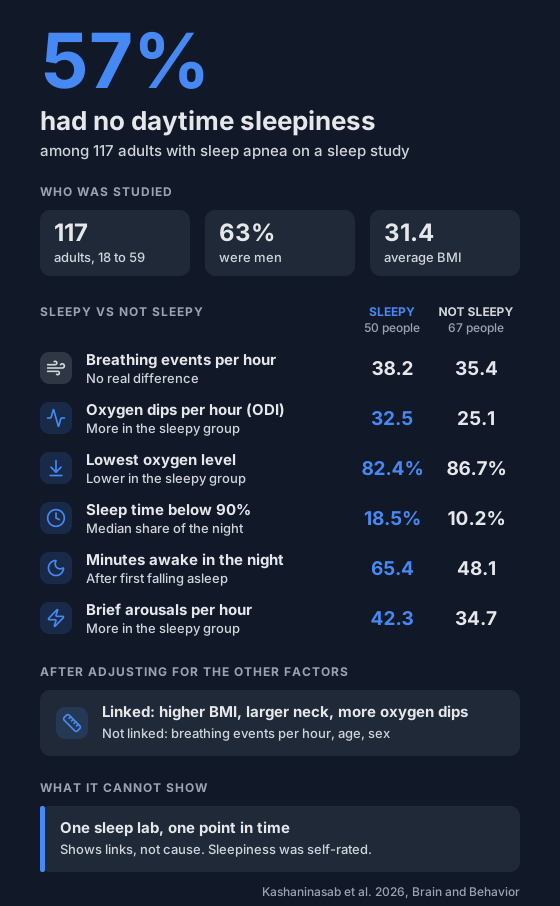
Daytime sleepiness is one of the best-known signs of sleep apnea. In a 2026 study, more than half of a group of people with sleep apnea didn't have it.
Who was in the study?
- 117 adults aged 18 to 59 at one hospital sleep lab in Tehran.
- All had obstructive sleep apnea confirmed by an overnight sleep study.
- 63.2% were men, the average age was 44 and the average BMI was 31.4.
Each filled in the Epworth Sleepiness Scale. 50 people (42.7%) scored 10 or more and counted as sleepy. 67 people (57.3%) did not.
What didn't differ between the groups?
None of these differences was statistically significant:
- Breathing events per hour: 38.2 in the sleepy group, 35.4 in the non-sleepy group.
- About 60% of each group had 30 or more events per hour.
- Sex, smoking, diabetes, heart disease and high blood pressure.
What was different?
The sleepy group had:
- More oxygen dips per hour (ODI): 32.5 vs 25.1.
- A lower lowest SpO2: 82.4% vs 86.7%.
- A lower average SpO2: 92.1% vs 93.8%.
- More sleep time below 90% (T90): a median of 18.5% vs 10.2%.
- More minutes awake in the night: 65.4 vs 48.1.
- More brief arousals per hour: 42.3 vs 34.7.
- A shorter time to fall asleep: 18.2 vs 28.6 minutes.
After adjusting for the other factors, higher BMI, a larger neck and a higher ODI stayed linked with sleepiness. Breathing events per hour, age and sex did not.
What about the head and neck finding?
12.0% of the sleepy group had a history of head or neck problems, such as sinusitis, a deviated septum or airway surgery, against 31.3% of the non-sleepy group. The authors urge caution, because that lumps different conditions together.
Five of the 6 opioid users were in the sleepy group, too few to conclude anything.
What doesn't it tell you?
- Cause. It's a cross-sectional snapshot.
- Everyone. One specialist sleep lab may see people with more events and symptoms.
- Measured sleepiness. It was self-rated.
- CPAP. There was no data on who used it.
What can you do with this?
Not feeling sleepy doesn't rule sleep apnea out. If you snore loudly or someone has heard you stop breathing in your sleep, see a doctor. Read snoring vs sleep apnea or take the sleep apnea risk check.
An overnight oximeter can't tell you whether you have sleep apnea. It records ODI, lowest SpO2 and T90, and you can share them with your doctor.
Not a medical device. Does not diagnose, treat or prevent any condition. Discuss results and changes with a clinician.
References
- Kashaninasab F, Fathalian Y, Khoozan M, Ghalehbandi M, Nikoubakht N. Comparing Demographic and Clinical Features of Obstructive Sleep Apnea Patients With and Without Sleepiness: A Cross-Sectional Study. Brain and Behavior. 2026;16(10):e71720. doi:10.1002/brb3.71720