Oxygen Dips and the Inner-Ear Balance Organ
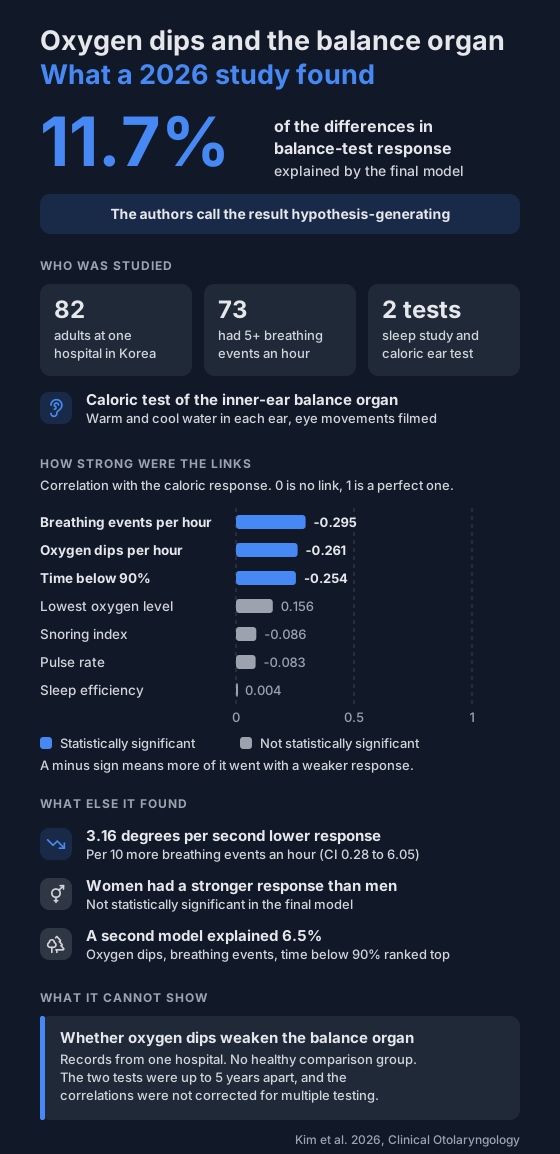
A 2026 study of 82 adults found that more overnight oxygen dips and more time below 90% went with a weaker response on a caloric balance test. The model explained 11.7% of the differences, and the authors call it hypothesis-generating.
Earlier studies have linked sleep apnea with dizziness and balance problems. A 2026 study from Korea asked which overnight measurement goes most closely with how the inner-ear balance organ responds.
The answer was breathing events per hour, oxygen dips per hour and time below 90%, but the link was weak. The authors call the result hypothesis-generating: an idea for future studies to test, not a conclusion.
Who was studied?
- 82 adults at one hospital in Seoul who had both an overnight sleep study in a lab and a caloric test, between 2017 and 2025.
- 73 of them had 5 or more breathing events per hour. 32 had 30 or more.
- The researchers went back through existing records. The two tests could be up to 5 years apart.
What is a caloric test?
It checks one part of the balance organ in each inner ear, the horizontal semicircular canal.
- Warm water (44°C) and cool water (30°C) are run into each ear for 30 seconds.
- That triggers a reflex eye movement, which a camera records.
- The score is the speed of that eye movement in degrees per second, added up over the four runs.
- A lower score means a weaker response.
What did it find?
Three measurements went with a weaker caloric response:
- More breathing events per hour (r = -0.295).
- More oxygen dips per hour, counting dips of 3 points or more (r = -0.261). That's the oxygen desaturation index.
- More time below 90% (r = -0.254).
These didn't show a statistically significant link:
- Lowest oxygen level of the night.
- Sleep efficiency.
- Snoring index.
- Pulse rate.
- The share of the night in each sleep stage.
The researchers then put 15 measurements into one model and removed the ones that added nothing. Breathing events per hour and sex were left. Each 10 extra breathing events per hour went with a response 3.16 degrees per second lower (95% confidence interval 0.28 to 6.05). For scale, the model's starting point for a woman with no breathing events was 81.4 degrees per second.
Women had a stronger response than men in the raw comparison. In the model, that difference wasn't statistically significant, and more of the men had high event counts.
How weak is the link?
Weak, and this is the main thing to take from the study.
- The final model explained 11.7% of the differences in caloric response between people. The model left the other 88.3% unexplained.
- A second, more flexible model explained 6.5% when tested on data it hadn't seen.
- That second model ranked oxygen dips per hour, breathing events per hour and time below 90% as the top three, in that order and almost level.
- Those three measurements move together. Breathing events and oxygen dips per hour had a correlation of 0.92, so the study can't say which one matters most.
The authors put it as oxygen being one contributing factor among many.
What can't it show?
- Cause. Both tests were looked at once. It can't show that oxygen dips weaken the balance organ.
- No comparison group. The authors say there was no control group without sleep apnea.
- Who was included. Everyone had been referred for both a sleep study and a balance test, so they may have had more symptoms than most people with sleep apnea.
- Timing. The gap between the two tests varied, up to 5 years.
- Statistics. 82 people is a small group for 15 measurements, and the correlations weren't corrected for multiple testing.
- Symptoms. The study measured a test response. It doesn't report on dizziness or falls.
The authors hypothesise that settings on positive airway pressure machines such as CPAP, tuned to keep oxygen dips and time below 90% low, might help preserve the caloric response. They say that needs a trial that follows people over time, and this study didn't test it.
What can you do with it?
- Don't read your own dip count as a sign of anything about your balance. The study doesn't support that.
- Dizziness, unsteadiness or falls are worth raising with your doctor in their own right.
- If you already track overnight oxygen, the study is one more that looked at dips per hour and time below 90% as well as event counts. See sleep apnea beyond event counts.
- Seeing a doctor about sleep or balance? Here's how to share your recordings.
Home oximetry is not a sleep study, and it doesn't measure the balance organ.
Not a medical device. Does not diagnose, treat or prevent any condition. Discuss results and changes with a clinician.
References
- Kim D, Bae SH, Cho HJ. Nocturnal Hypoxemia Burden Correlates With Vestibular Dysfunction in Obstructive Sleep Apnea. Clinical Otolaryngology. 2026;51(6):894-901. doi:10.1111/coa.70146