Sleep Apnea: What Event Counts Miss
A 2026 review of 70 articles says counting breathing events per hour leaves a lot out, and that time spent at low oxygen was the strongest predictor of heart events and death.
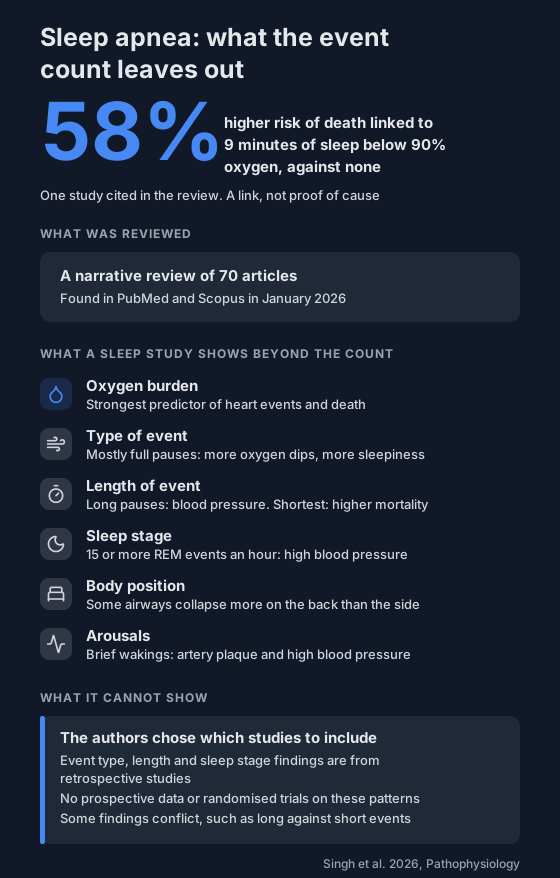
Sleep apnea is usually graded by one number: how many breathing events you have per hour of sleep. A 2026 review says that count leaves a lot out, and that oxygen loss said more about heart risk.
What did the review look at?
- It's a narrative review of 70 articles found in PubMed and Scopus in January 2026.
- The question: what does a sleep study show beyond the event count?
What does the count miss?
Two people with the same count can have very different nights:
- Type of event. In one retrospective analysis, people with mostly full pauses had more oxygen dips per hour and more daytime sleepiness. People with mostly partial events were older, more often women, and had more heart disease.
- Length. Pauses of 20 seconds or more went with louder snoring, morning fatigue and a higher risk of high blood pressure. A separate study linked the shortest events to higher mortality. See long pauses.
- Sleep stage. 15 or more events an hour in REM sleep was linked to high blood pressure, even when the overall count was below the usual threshold.
- Position. Some people's airways collapse more on the back than on the side. See back vs side.
- Arousals. Brief wakings were linked to artery plaque and high blood pressure. See arousals.
What does oxygen burden add?
The review uses the term for ODI, the area under the dip curve and time below 90% oxygen (T90).
- Oxygen burden was the strongest predictor of major heart events, ahead of the event count.
- Time below 90% was linked to a 50% higher risk of a heart event or death. The review doesn't say compared with what.
- In one cited study, 9 minutes below 90% was linked to a 58% higher risk of death than none.
- People with more overnight oxygen loss appeared to get more long-term heart benefit from PAP therapy.
What can't it show?
- A full picture. It's not a systematic review. The authors chose which studies to include.
- Cause. The review's own table lists the event type, event length and sleep stage findings as coming from retrospective studies. The authors say prospective data and randomised trials on these patterns are lacking.
- A settled answer. Findings conflict on event length, and some studies found no significant difference in risk between full and partial events.
What can you do with this?
An overnight oximeter records ODI, T90 and your lowest SpO2. It can't count breathing events, sleep stages or arousals, and home oximetry is not a sleep study.
Had a sleep study? Ask your doctor what else it showed. You can also share your recordings.
Not a medical device. Does not diagnose, treat or prevent any condition. Discuss results and changes with a clinician.
References
- Singh H, Qadir N, Bhamrah M, Rosales-Gonzalez W, Bhamrah P, Ghildiyal N, Monceaux B, Liendo C, Asghar S, Alexander JS, Chernyshev OY. Redefining Obstructive Sleep Apnea: Multidimensional Phenotyping Beyond the Apnea-Hypopnea Index. Pathophysiology. 2026;33(2):24. doi:10.3390/pathophysiology33020024